
Altare Monte d'Accoddi
Italy
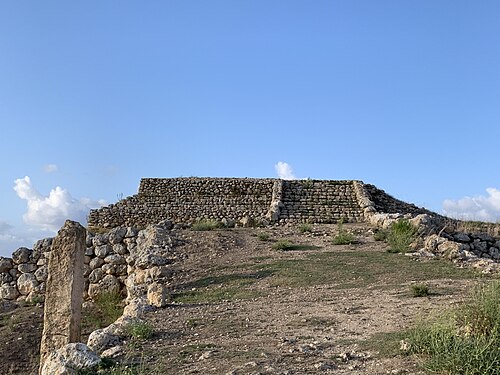
The altar is the superimposition of two phases, that of the ‘red temple,’ in the final Neolithic period (3500-2900 BC), and the following ‘terraced temple’, in the Aeneolithic period (about 2700 BC), as part of the Abealzu-Filigosa culture. In the first phase, several villages of quadrangular huts were part of a ceremonial hub, including a Domus de Janas necropolis and alongside the Santuario, in their original positions, are an elongated menhir (four and a half meters high), an enormous slab with seven holes (perhaps use to tie up victims) and boulders of spheroidal stone, one of five meters in circumference. All the rocks served a specific purpose in the sacrificial rituals. At the end of the final Neolithic period, the people of the Ozieri culture built a platform in the shape of a pyramidal trunk, with sides at the base extending 27 meters, above which stood a rectangular room with surfaces plastered and painted in ochre and traces of yellow and black. Of the sacred area remain the floor and remnants of a perimeter wall. Around 2800 BC, the structure of the ‘red temple,’ abandoned for about two centuries, was buried under a large filling of earth, stones, and limestone marlstone, in turn ‘covered’ with large blocks of stone. A new sizeable terraced pyramidal platform was built, with sides more extended than the previous one and accessible from a ramp that was forty meters long and thirteen to seven meters wide. The second sanctuary is reminiscent of the ziqqurat with an ‘open-air’ altar. The structure occupies 1,600 square meters, rising almost six meters (initially perhaps eight). Inside is an unexplored room. Probably, as in Mesopotamia, it contains the sacred bed where the ritual of regeneration of life and fertility of the earth was carried out. Around are the remains of a village, where ceramics were found almost intact. To be admired are finds safeguarded in the Sanna archaeological museum, along with a model of the altar in its earliest form. The building retained its religious function for a millennium. At its base, remains of sacred meals and objects used in propitiatory rituals were discovered. The site was abandoned at the beginning of the ancient Bronze Age (1800 BC) and occasionally reused for burials.
목차
8구간 · 구간을 누르면 글 앞부분이 보여요이 이야기는 영어로 쓰여 있어요. 한국어로 읽고 듣는 것은 앱에서 해요. 앱에서 열기 →
1Orientation
Welcome to Mon-teh Dah-koh-dee, arguably the most enigmatic and unique archaeological site in the entire Western Mediterranean. As we stand before this massive, stepped stone structure, your eyes are not deceiving you—its…
앱에서 듣기2The Access Ramp — The Ascending Path
We begin our detailed examination at the foot of the monumental ramp, which stretches nearly 40 meters in length. This is the path the ancient priests and supplicants would have trod to reach the 'High Place' of the altar. …
앱에서 듣기3The Red Temple — The Hidden Heart
Though we cannot see it from the surface, deep within the current structure lies the 'Tempio Rosso,' or Red Temple. This was the original sanctuary, a smaller rectangular building that sat atop the first iteration of the mound. …
앱에서 듣기4The Sacrificial Area — Remnants of the Rite
Descending slightly to the side of the main ramp, we encounter several large, flat stones with deep grooves and basins carved into their surface. These are the sacrificial slabs. …
앱에서 듣기5The Omphalos and the Spherical Stones
Near the base of the monument, we find two extraordinary objects: a large, egg-shaped limestone boulder known as an 'omphalos' and a smaller, perfectly carved spherical stone. In Greek, 'omphalos' means 'navel,' and it signifies…
앱에서 듣기6The Sorcerer's Hut — The Domestic and the Divine
To the east of the main altar, the remains of several circular stone structures are visible. The most prominent of these is traditionally called 'La capanna dello Stregone,' or the Sorcerer's Hut. …
앱에서 듣기7The Dolmen and the Periphery — A Sacred Landscape
Our final area of exploration lies on the outer edges of the sanctuary, where a small dolmen—a prehistoric stone table structure—stands. This dolmen likely predates the final version of the altar and may have been a tomb for an…
앱에서 듣기8Closing
As we conclude our journey at Mon-teh Dah-koh-dee, I hope you carry with you a sense of the profound mystery that still surrounds this place. We have stood on a ramp that was old when the Roman Empire was young, and we have…
앱에서 듣기
Altare Monte d'Accoddi은(는) 어떤 곳인가요?
Altare Monte d'Accoddi — Italy에 있는 장소로, 텔비에 이야기 8구간이 있어요. 구간마다 앞부분은 이 페이지에서 글로 읽고, 소리는 앱에서 들어요.
| 위치 | Italy |
|---|---|
| 종류 | 활동 |
| 이야기 구간 | 8 |
| 글 언어 | 영어 |
| 좌표 | 40.7907, 8.4489 |
| 최종 수정 |