Morning arrives over Luxor in a slow wash of rose and gold, illuminating the broad quiet ribbon of the Nile. Standing upon the riverbank before the heat of the afternoon sun descends, one feels the immediate gravity of ancient Thebes. This sacred city was known to the pharaohs as Ipet isut, meaning the most select of places, where kings carved their devotion into enduring granite and sandstone. To arrive here is to step into a landscape where human ambition attempted to rival eternity itself, leaving behind monumental temples and avenues that still command quiet reverence from every traveler who approaches their sacred thresholds.
The air carries a distinct stillness, a harmony of river water, desert dust, and thousands of years of human devotion. Looking across the river toward the western hills, one begins to understand why the ancients viewed this valley as the focal point of creation. Here, the sun god Amun Ra was worshipped with unmatched grandeur, and pharaohs built vast halls to reflect the celestial order upon the earth.
Voices Across the Desert Sands
Consider how time buries even the grandest achievements of kings, and how scholars painstakingly restored them to human memory. For many centuries, medieval and renaissance Western travelers struggled even to locate ancient Thebes with precision. Early European travel writers frequently placed the legendary city near Memphis, despite descriptions left behind by ancient geographers Herodotus and Strabo. It was only in fifteen eighty nine that an unknown Venetian recorded the first European description of Karnak, followed in sixteen sixty eight by Capuchin missionary brothers Protais and Charles Francois d'Orleans, who recorded the village name Karnak for the first time in published travel literature. Later, French explorers such as Claude Sicard and Pierre Laurent Pincia visited the ruins in seventeen eighteen and seventeen twenty to map their true position along the Nile bend.
Meanwhile, the grand walkway connecting Karnak and Luxor Temple lay hidden beneath shifting desert sands and centuries of urban growth. In eighteen ninety three, French archaeologist Georges Daressy reported that the southern stretch near Luxor was submerged below groundwater and could not yet be excavated. Yet in nineteen forty nine, Egyptian archaeologist Mohammed Zakaria Ghoneim unearthed the first eight carved sphinx statues near Luxor Temple. That breakthrough launched seven decades of continuous excavation that restored the magnificent two point seven kilometer procession lined with over one thousand sphinxes.
The Monument and the Literary Imagination
Near the southern terminus of that grand avenue stood the twin obelisks of Ramesses the Second, which sparked a legendary tale of nineteenth century diplomatic rivalry and artistic obsession. In the eighteen twenties, Jean Francois Champollion, celebrated for deciphering the Rosetta Stone, examined the Luxor obelisks and passionately urged King Charles the Tenth to acquire them above all other Egyptian monuments. When Ottoman ruler Muhammad Ali Pasha offered obelisks to France, Champollion subtly maneuvered French diplomat Mimault to encourage a gift of the Luxor obelisks while steering the British toward the obelisk of Hatshepsut at Karnak, knowing well that extracting it from surrounding stone structures was virtually impossible.
France accepted the shorter western monolith, which was lowered in eighteen thirty one and eventually raised at the Place de la Concorde in eighteen thirty six under King Louis Philippe. Champollion tragically passed away in eighteen thirty two, never witnessing his prized monument standing in Paris, an event later commemorated in eighteen forty two by American poet Lydia Huntley Sigourney. As you wander among these colossal pillars and carved avenue sphinxes today, allow these overlapping layers of ancient craftsmanship, scholarly passion, and literary memory to guide your steps.
Want to walk it yourself? Plan a trip with these places
The walk
On site, play just that chapter
- 1 min · on site
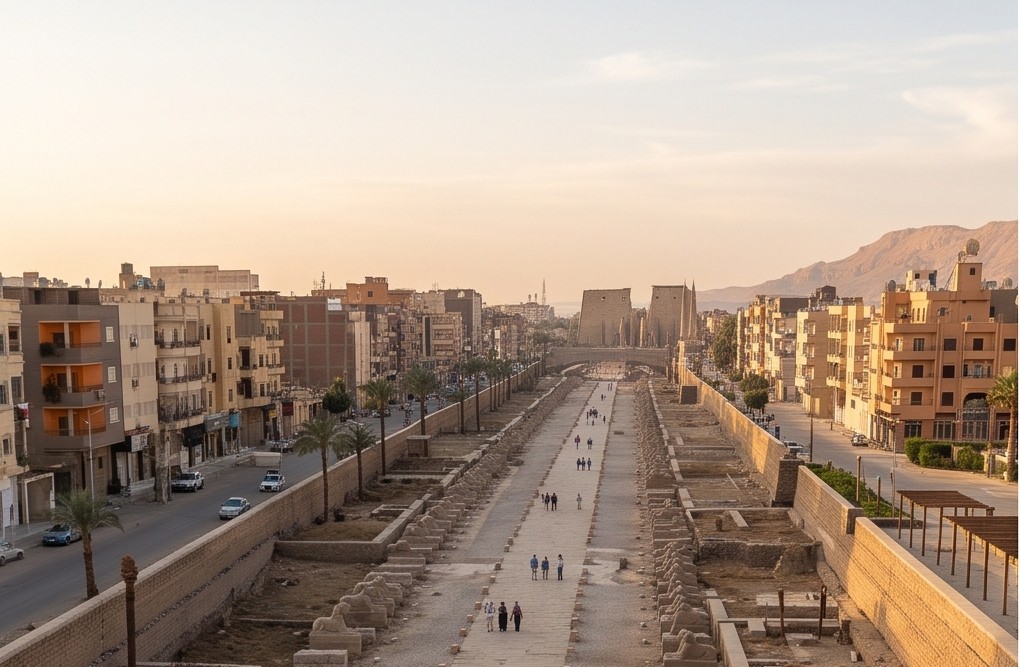
The Avenue of Sphinxes: Morning Light on the Sacred Procession
AI-generated image · may differ from the real place Step directly onto the paved stone walkway near the southern entrance of Luxor Temple where the restored Avenue of Sphinxes begins its long journey north. Look closely at the carved pedestals on either side, where over one thousand human headed sphinxes and ram statues stand guard under the desert sunlight. As you walk along this ancient ceremonial route, notice how the morning light casts deep shadows beneath the sphinx paws, revealing subtle pharaonic inscriptions that survived millennia under burial sands. Archaeologist Mohammed Zakaria Ghoneim uncovered the first statues here in nineteen forty nine, initiating decades of delicate restoration. Take your time to stroll the first few hundred meters early in the morning when the breeze is fresh and the crowds remain thin.
Now follow the stone path northward as it stretches directly toward the massive pylons of Karnak Temple Complex.
- 1 min · on site
Karnak Temple Complex: Entering the City of Amun Ra

Photo: ولاء · Public domain · Original file As you reach the end of the sphinx avenue, enter the grand complex of Karnak through the colossal First Pylon. Pause inside the vast court to gaze upon the towering mudbrick walls and the giant statue of Pinedjem standing over ten meters tall. Look up at the sandstone masonry transported south along the Nile from Gebel Silsila over three thousand years ago. In fifteen eighty nine, an anonymous Venetian traveler walked these very courts, recording the earliest European impression of Karnak without even knowing its ancient name. Step slowly across the central axis and admire how pharaohs of successive dynasties each added gateways to outshine their predecessors. Remember to carry water as you explore this immense open air sanctuary.
Now step through the towering gateway directly ahead to enter the shadow of the Great Hypostyle Hall.
- 1 min · on site
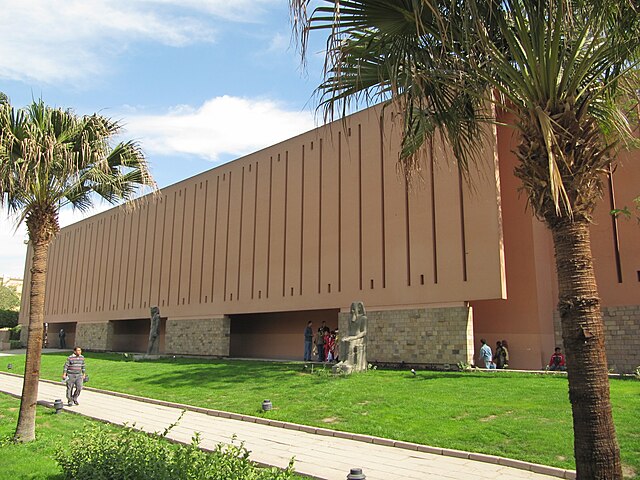
Luxor Museum: Masterworks of Art and Pharaonic Cachet
Photo · Wikimedia Commons Conclude your memorable journey at the modern Luxor Museum, conveniently situated along the scenic Nile Corniche overlooked by rustling palm trees. Step inside the air conditioned interior during the late afternoon break between temple visits when the golden sunlight outside glows warm over the Nile waters. Look for the brilliantly illuminated statues recovered from the Luxor statue cache, including the stunning double statue of Horemheb and Amun Ra. Wander slowly into the dedicated gallery displaying masterworks and exquisite grave goods from the tomb of Tutankhamun. The museum displays a select group of exceptional pharaonic masterworks in spacious, quiet halls, allowing you to appreciate each artifact in intimate detail. Allow the quiet elegance of these ancient stone sculptures to form your lasting memory of Luxor as dusk settles peacefully over the river.

As night falls over the East Bank and spotlights illuminate the grand avenues and soaring columns, the ancient voices of Thebes echo across the Nile, reminding every traveler that true monumentality lives not only in stone, but in the enduring stories of those who dared to dream in granite.
Take it further
Open the tour in the appThe tour in the app
The Sacred Procession of Thebes: Avenue of Sphinxes to KarnakWalk the ancient two point seven kilometer ceremonial route from the sphinx lined avenue to the colossal halls of Karnak and finish along the Nile Corniche at Luxor Museum. Discover thirty centuries of pharaonic architecture, royal devotion, and archaeological rediscovery along this extraordinary walking journey through ancient Thebes.
+ Add the tour to your planIf you have the app the tour opens right away; otherwise you go to the store.FAQ
- How long is the Avenue of Sphinxes and when was it constructed?
- The Avenue of Sphinxes stretches 2.7 kilometers connecting Karnak Temple with Luxor Temple. Construction began during the New Kingdom era and was completed during the Late Period reign of 30th Dynasty ruler Nectanebo I.
- What is the story behind the Luxor Obelisk standing in Paris?
- Carved from red granite in Aswan under Ramesses II, the western obelisk at Luxor Temple was gifted to France in 1830 by Ottoman ruler Muhammad Ali Pasha. Transported by a custom ship, it was erected at Place de la Concorde in 1836.