Morning in Lima arrives without glare or fanfare. The garua, that legendary Pacific sea mist, drapes the clifftops in soft gray cashmere. It is a muted, painterly light favored by portraitists and couturiers, gently softening every sharp edge of this desert capital perched above the crashing ocean. Take a breath as you begin your journey. You smell the cool sea salt mingled with roasting Arabica beans drifting from open doorway cafes, and beneath it all, the dry cedar fragrance of old colonial woodwork drying in the ocean breeze. Lima does not announce itself with aggressive glass towers or ostentatious modern gestures. Its elegance is theatrical yet disciplined, quiet yet deeply layered. Long before the Spanish mapped their rigid grid across the valley, coastal indigenous cultures shaped monumental ceremonial platforms out of hand-molded clay and sun-baked silt. When Francisco Pizarro founded the central settlement on a midsummer morning in January 1535, he imposed an empire's ambitions onto an ancient landscape, but the desert coast subtly bent every imported stone to its own enduring rhythm.
The Geometry of the Plaza
Consider the peculiar genius of this city's urban geometry. In the seventeenth century, the chronicler Bernabe Cobo walked the broad avenues of the central square and declared it the finest and most proportioned plaza he had ever seen, even comparing it to the proudest royal cities of Spain. Yet this pristine colonial symmetry was constantly being adapted and reanimated by the people who lived inside its frame. In the early viceregal years, a stark wooden gallows stood squarely at the very center of the plaza, an unyielding and grim reminder of judicial authority. It was the viceroy Diego Lopez de Zuniga y Velasco, Count of Nieva, who looked upon that somber focal point and decided that civic life deserved a far more graceful ritual. He banished the gallows to the riverbanks near the train station and commissioned an ornamental water fountain in its place, transforming an instrument of public execution into a shared oasis of sound and coolness. Decades later, another viceroy cast that fountain in dark bronze, where it still stands today, murmuring beneath tall palms. A century later, beneath the shaded arcades of the Portal de Escribanos, an early nineteenth-century culinary figure named Juan Jose Cabezudo set up his vibrant food stall. Celebrated across the capital for his steaming tamales and rich criollo stews, Cabezudo fed poets, merchants, and roaming dandies from early morning until late dusk. In Lima, imperial grandeur and street-level savor have always shared the exact same stones.
A Wardrobe of Civilizations
What defines Lima is this refusal to let one era entirely erase another. When General Jose de San Martin declared Peru's independence on a winter morning in 1821, he appeared before a cheering sea of citizens upon the wrap-around wooden balcony of Casa del Oidor. That dark cedar balcony had originally been erected for the royal magistrate Gaspar Melchor de Carbajal to listen to the daily grievances of ordinary townspeople. The house of the listener naturally became the platform of liberation. To stroll through Lima today is to move through a curated wardrobe of civilizations, each leaving its distinct texture upon the skyline. You walk past massive adobe pyramids rising quietly in residential neighborhoods, where pre-Inca priests once offered fish to desert deities. You wander across clifftop bridges in bohemian Barranco where mid-century waltzes were composed for waiting poets, and you trace neoclassical promenades where fountains dance with colored light after twilight. Lima teaches the traveler that genuine style is never about a single fleeting season. It is an accumulation of living history, worn with effortless confidence and sublime poise.
Want to walk it yourself? Plan a trip with these places
The walk
On site, play just that chapter
- 1 min · on site
The Stone Rampart Above the River
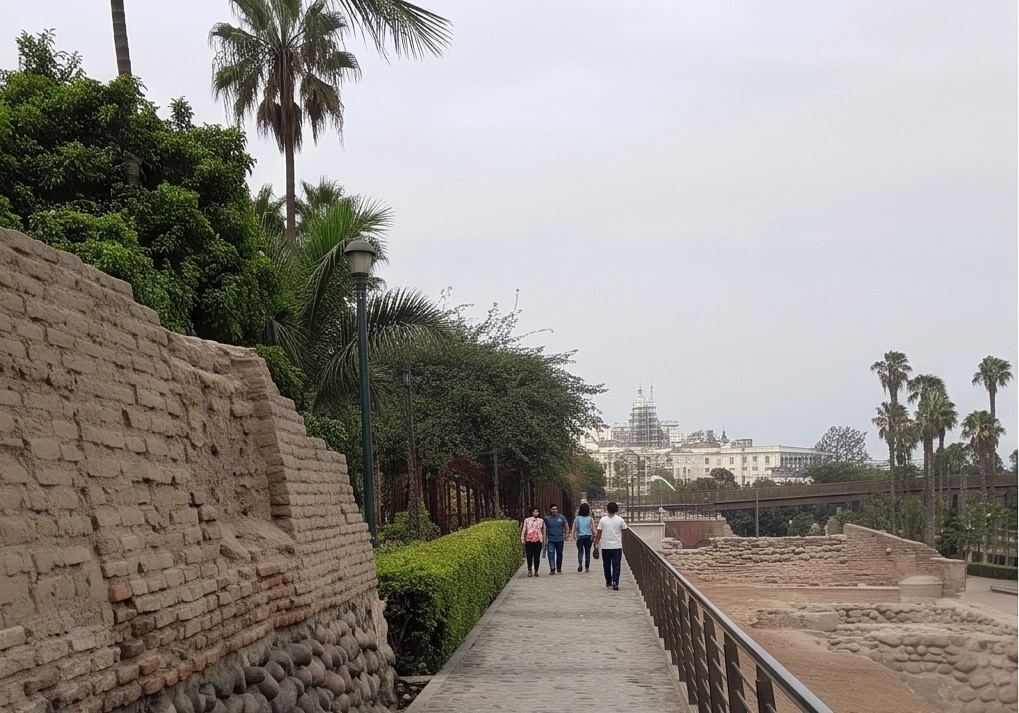
AI-generated image · may differ from the real place Stand by the stone balustrade overlooking the shallow bed of the Rimac River. Here at the northern edge of the historic quarter, you are looking at the surviving spine of seventeenth-century Lima, the fortified stone wall built to guard the city from corsairs and ocean tides. Look down along the excavated masonry where gray river boulders meet lime mortar. It is raw, muscular engineering, completely devoid of decorative vanity. To your left, notice how the city slopes gently toward the Andean foothills, the very corridor where pre-Hispanic canals once distributed mountain snowmelt to desert orchards. Modern traffic hums on the perimeter, yet this lookout maintains an austere serenity. The air smells faintly of wild river weeds and dry coastal dust. Before you depart, lean over the railing to observe the lower ramparts, where archaeologists revealed centuries of discarded pottery and colonial foundations beneath the modern park promenade.
Walk two blocks south along the gentle incline of the old lane toward the corner where the grand square opens.
- 1 min · on site
The Balcony of Whispers and Cheers
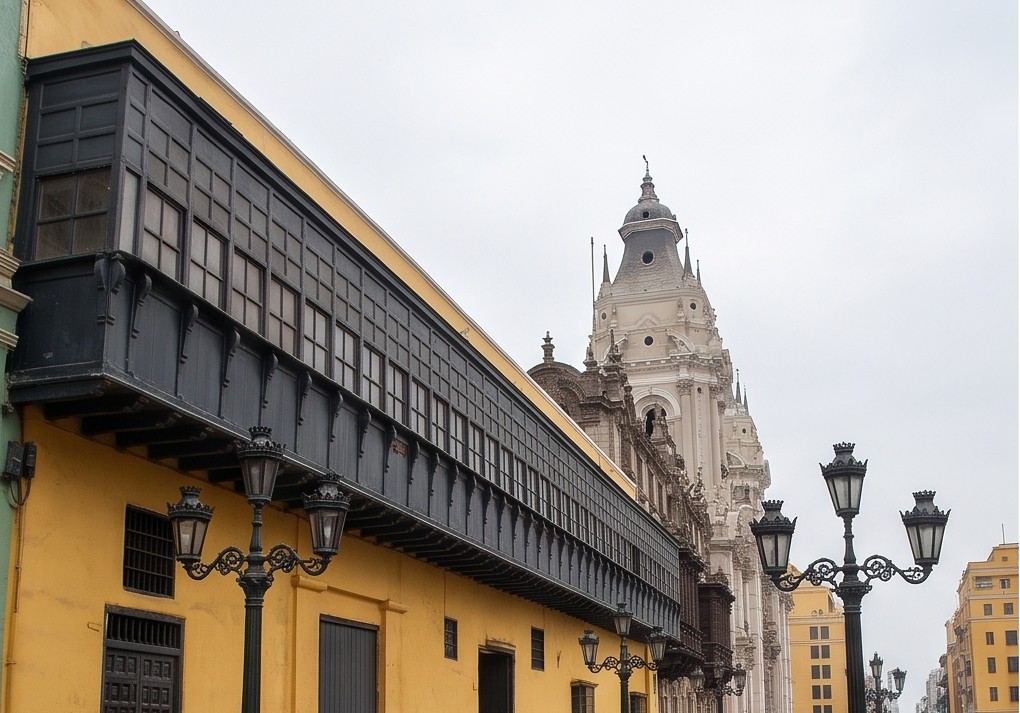
AI-generated image · may differ from the real place Pause on the eastern corner of the square and look upward. You are standing beneath the longest and most celebrated enclosed wooden balcony in Peru, the iconic green-tinted cedar gallery of the Casa del Oidor. Constructed upon one of the original plots assigned by Francisco Pizarro to his royal treasurer Alonso Riquelme, this house was designated for royal magistrate Gaspar Melchor de Carbajal. His official duty was to listen to the disputes, grievances, and complaints of the populace, giving this structure its enduring name. Step across the street to capture the full architectural rhythm of the dark latticework against the pale ochre walls. The carved panels served as an aristocratic veil, allowing residents to observe the bustling street below without being seen. It was upon this very balcony in the winter of 1821 that General Jose de San Martin stepped forth to receive the thunderous ovation of the newly liberated capital.
Step away from the shadow of the balcony and enter the vast open expanse of the plaza.
- 1 min · on site
The Foundation Grid and Bronze Fountain
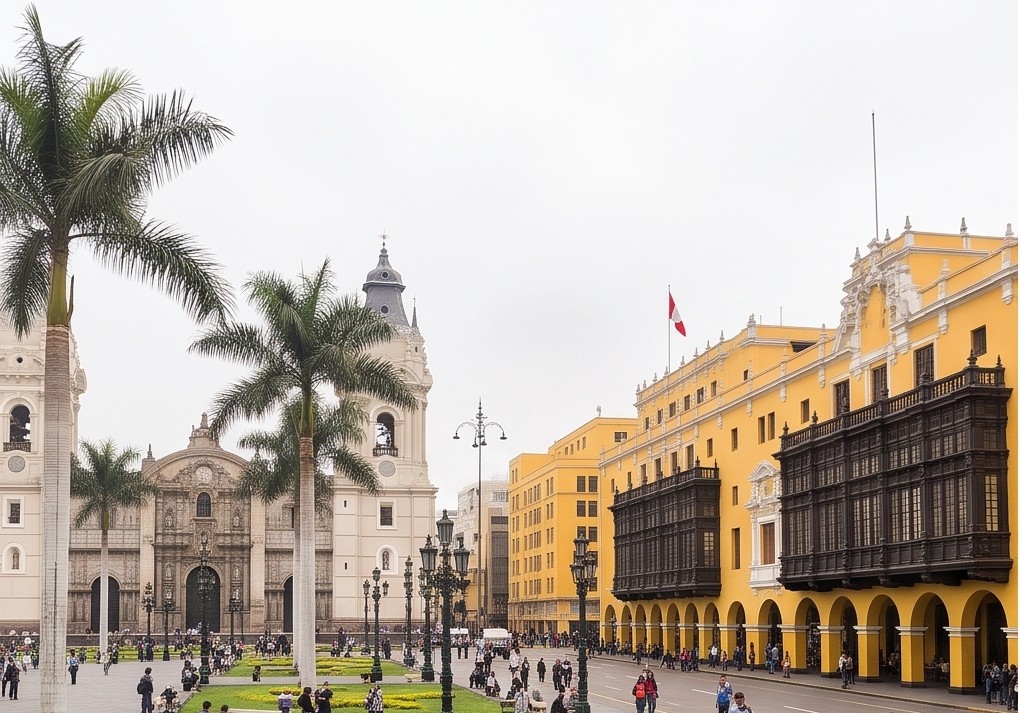
AI-generated image · may differ from the real place You have arrived at the symbolic heart of the Peruvian nation. Stay along the central paved paths and observe the grand perimeter, where the Government Palace, the Cathedral, and the Archbishop's Palace establish an imposing imperial frame. Direct your gaze to the center, where the dark bronze fountain inaugurated in 1651 by the Count of Salvatierra quietly trickles. This elegant water basin replaced the grim viceregal gallows, turning an arena of punishment into a promenade of pleasure. In the early nineteenth century, the charismatic chef Juan Jose Cabezudo operated his celebrated stall right under the adjacent arcades, serving warm tamales to writers and dignitaries. Look toward the Archbishop's Palace to admire its intricate cedar balconies, carved like Flemish lace against polished stone. The midday changing of the palace guard provides a rhythmic spectacle of brass music and formal equestrian uniforms that echoes across the wide square.
Head south along the central avenue as the afternoon softens into twilight, approaching the grand city gardens.
- 1 min · on site
Circuito Mágico del Agua del Parque de la Reserva
A Nocturnal Symphony of Liquid Light
AI-generated image · may differ from the real place Enter the neoclassical promenade of the Parque de la Reserva just as twilight bleeds into indigo. Designed in the 1920s by the French architect Claude Sahut, these eight hectares of formal pavilions and sculpted gardens honor the defenders of Lima. Today, the park transforms every evening into the world's most astonishing water choreography, featuring thirteen monumental fountains illuminated by lasers and vivid projections. Put on a light jacket against the drifting mist and make your way to the Tunnel Fountain of Surprises, where you can stroll beneath a shimmering thirty-five-meter vault of liquid crystal. Watch how the Magic Fountain propels an eighty-meter pillar of water into the night sky, creating a breathtaking theatrical crown over the lawns. The atmosphere is kinetic and playful, a celebration where neoclassical stone monuments meet modern light design in an effortless nocturnal salon.
Travel south into residential Miraflores, where ancient pre-Inca silence waits amid chic coastal streets.
- 1 min · on site
The Earthen Bookshelf of the Gods
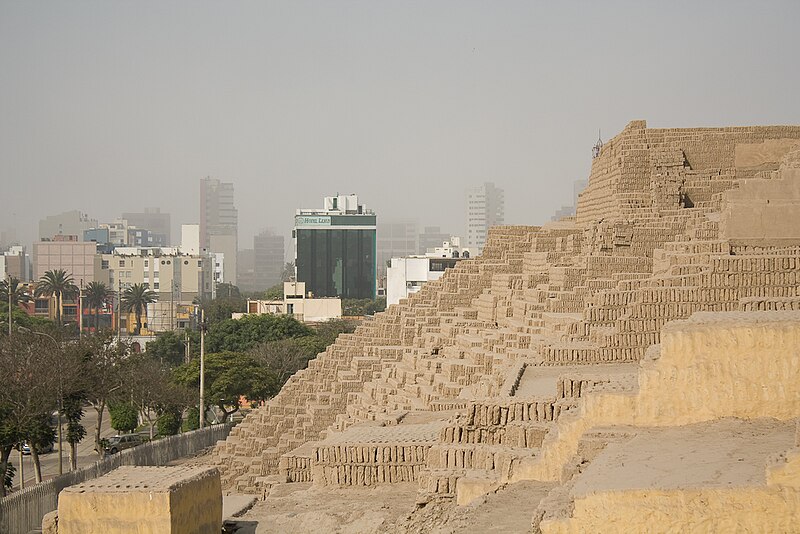
Photo · Wikimedia Commons Step into the dry courtyard of Huaca Pucllana and let the sheer scale of the desert pyramid take your breath away. Rising twenty-two meters above the manicured streets of Miraflores, this stepped adobe monument was built between the third and eighth centuries by the coastal Lima culture. Take a guided walk along the staggered platforms, keeping your eyes on the extraordinary bookcase style adobe construction. The builders placed vertical clay bricks with narrow gaps between them, allowing the structure to absorb seismic tremors for over fifteen centuries. Notice the deep excavated pits where priests offered marine fish to their maritime gods to ensure rainfall and bountiful harvests. Here, archaeologists also unearthed the intact tomb of the Lord of the Unkus, buried in woven ceremonial textiles with striking funerary masks. The contrast between ancient adobe terraces and surrounding modern penthouses is Lima's ultimate sartorial statement.
Follow the cooling sea breeze toward the cliffside lanes of Barranco, ending your stroll at the edge of the ravine.
- 1 min · on site
The Wooden Span of Creole Melody

Photo: Unknown author Unknown author · Public domain · Original file You are standing on the weather-worn timber planks of the Puente de los Suspiros, suspended above the lush Bajada de los Baños ravine in bohemian Barranco. Built in the nineteenth century, this pedestrian span has long been the romantic sanctuary of Peru's finest writers, painters, and musicians. Look down toward the cobbled path winding beneath fragrant bougainvillea toward the Pacific surf. It was here in 1960 that the legendary composer Chabuca Granda penned her timeless waltz, celebrating the bridge as a sleepy poet awaiting love in the pleasant quiet. Her close confidant, the poet Cesar Calvo, famously insisted that he was the very muse waiting upon these wooden planks. After crossing, stroll into the adjacent Parque Chabuca Granda to greet her sculpted likeness beneath flowering trees, and listen to the faint rhythm of criollo guitars drifting from neighboring cliffside taverns.
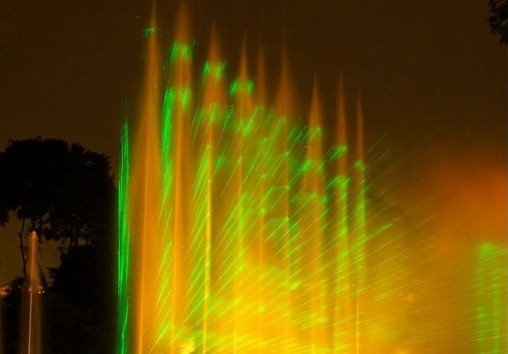

As night settles over the Pacific cliffs, Lima reveals its true secret. This city does not rush to modernize by shedding its past. Instead, it wears every century like a tailored coat, letting pre-Columbian adobe, viceregal cedar, and contemporary neon illuminate one another under the soft coastal sky.
Take it further
Open the tour in the appThe tour in the app
A Walk Through Lima's LayersThis curated architectural journey guides you from the seventeenth-century river ramparts and grand colonial plaza of central Lima to neoclassical illuminated water fountains, an ancient pre-Inca desert pyramid in Miraflores, and the romantic clifftop bridges of bohemian Barranco overlooking the Pacific surf.
+ Add the tour to your planIf you have the app the tour opens right away; otherwise you go to the store.FAQ
- What is the best time of day to follow this architectural walk through Lima?
- Begin in the morning in the historic center to appreciate the colonial balconies and plaza in clear light, then reach the parks and coastal districts as twilight illuminates the fountains and sea cliffs.
- What is the architectural significance of the enclosed wooden balconies in Lima?
- Introduced during the viceregal era, these intricately carved cedar balconies provided private ventilation, shade from the desert sun, and an elegant vantage point for observing street life discreetly.
This piece was newly written based on the Wikipedia articles ‘Plaza Mayor, Lima’, ‘Casa del Oidor’, ‘El puente de los suspiros (song)’ · CC BY-SA 4.0