Contents
History & cultureBY TELLBY2 sections · numbered as on the map01 The Geometry of Mist and Cedar
Morning in Lima arrives without glare or fanfare. The garua, that legendary Pacific sea mist, drapes the clifftops in soft gray cashmere. It is a muted, painterly light favored by portraitists and couturiers, gently softening every sharp edge of this desert capital perched above the crashing ocean. Take a breath as you begin your journey. You smell the cool sea salt mingled with roasting Arabica beans drifting from open doorway cafes, and beneath it all, the dry cedar fragrance of old colonial woodwork drying in the ocean breeze. Lima does not announce itself with aggressive glass towers or ostentatious modern gestures. Its elegance is theatrical yet disciplined, quiet yet deeply layered. Long before the Spanish mapped their rigid grid across the valley, coastal indigenous cultures shaped monumental ceremonial platforms out of hand-molded clay and sun-baked silt. When Francisco Pizarro founded the central settlement on a midsummer morning in January 1535, he imposed an empire's ambitions onto an ancient landscape, but the desert coast subtly bent every imported stone to its own enduring rhythm.
The Geometry of the Plaza
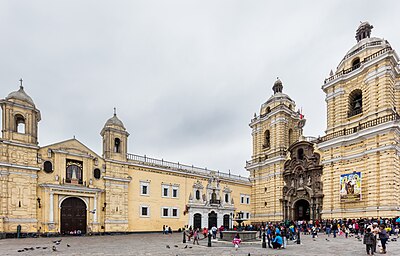
Consider the peculiar genius of this city's urban geometry. In the seventeenth century, the chronicler Bernabe Cobo walked the broad avenues of the central square and declared it the finest and most proportioned plaza he had ever seen, even comparing it to the proudest royal cities of Spain. Yet this pristine colonial symmetry was constantly being adapted and reanimated by the people who lived inside its frame. In the early viceregal years, a stark wooden gallows stood squarely at the very center of the plaza, an unyielding and grim reminder of judicial authority. It was the viceroy Diego Lopez de Zuniga y Velasco, Count of Nieva, who looked upon that somber focal point and decided that civic life deserved a far more graceful ritual. He banished the gallows to the riverbanks near the train station and commissioned an ornamental water fountain in its place, transforming an instrument of public execution into a shared oasis of sound and coolness. Decades later, another viceroy cast that fountain in dark bronze, where it still stands today, murmuring beneath tall palms. A century later, beneath the shaded arcades of the Portal de Escribanos, an early nineteenth-century culinary figure named Juan Jose Cabezudo set up his vibrant food stall. Celebrated across the capital for his steaming tamales and rich criollo stews, Cabezudo fed poets, merchants, and roaming dandies from early morning until late dusk. In Lima, imperial grandeur and street-level savor have always shared the exact same stones.
A Wardrobe of Civilizations
What defines Lima is this refusal to let one era entirely erase another. When General Jose de San Martin declared Peru's independence on a winter morning in 1821, he appeared before a cheering sea of citizens upon the wrap-around wooden balcony of Casa del Oidor. That dark cedar balcony had originally been erected for the royal magistrate Gaspar Melchor de Carbajal to listen to the daily grievances of ordinary townspeople. The house of the listener naturally became the platform of liberation. To stroll through Lima today is to move through a curated wardrobe of civilizations, each leaving its distinct texture upon the skyline. You walk past massive adobe pyramids rising quietly in residential neighborhoods, where pre-Inca priests once offered fish to desert deities. You wander across clifftop bridges in bohemian Barranco where mid-century waltzes were composed for waiting poets, and you trace neoclassical promenades where fountains dance with colored light after twilight. Lima teaches the traveler that genuine style is never about a single fleeting season. It is an accumulation of living history, worn with effortless confidence and sublime poise.
02 The Stone Rampart Above the River
Stand by the stone balustrade overlooking the shallow bed of the Rimac River. Here at the northern edge of the historic quarter, you are looking at the surviving spine of seventeenth-century Lima, the fortified stone wall built to guard the city from corsairs and ocean tides. Look down along the excavated masonry where gray river boulders meet lime mortar. It is raw, muscular engineering, completely devoid of decorative vanity. …