Morning arrives in Florence not with noise, but with texture. The fog lifts off the slow waters of the Arno like steam rising from a newly pressed wool, revealing the cool grey grain of pietra serena stone and terracotta roofs sharply etched against a pale Tuscan sky. In the quiet side streets between San Marco and the river, the city awakens to a familiar, private ritual: the crisp clatter of an espresso cup against a marble counter, the aroma of dark roast cutting through chilly air, and the rhythmic, authoritative click of bespoke leather soles echoing on flagstones worn smooth by six centuries of ambition. To walk through Florence in the morning is to enter an atelier that never closed its doors. Here, beauty was never an afterthought or an accidental romance. It was a rigorous discipline, an exacting craft, and above all, the primary currency of power.
The Sovereign Archive
The Florentine mind has always understood the sheer leverage of appearance. Long before modern ateliers defined haute couture, the merchant princes and dynastic patrons of this valley recognized that architecture, bronze, and paint were the ultimate instruments of public standing. Consider Anna Maria Luisa de Medici, the final descendant of the extraordinary banking family that bankrolled the Renaissance. When her male line collapsed in the eighteenth century, Europe hovered like a flock of eager vultures, ready to dismantle the grand ducal collections and ship centuries of treasures off to Paris, Vienna, and Madrid. Instead, she engineered one of the most brilliant acts of cultural preservation in human history. Through the famous Family Pact of 1743, she bequeathed the entire Medici heritage to the state of Tuscany on one unyielding condition: not a single painting, antique coin, or carved cameo could ever leave the city walls. They were to remain intact forever for the ornament of the state, the utility of the public, and the curiosity of foreigners. Her sovereign signature kept the soul of the Renaissance grounded firmly in its birthplace.
This was not an isolated triumph. That same protective fury over visual identity echoes through the centuries down to our present moment. Just a short walk away, when a glossy contemporary publication produced a lenticular cover that switched between the classical marble torso of Michelangelo David and a modern fashion model, the Galleria dell Accademia promptly took the publishers to court. Even five centuries later, Florence insists that its iconic silhouettes are neither casual commercial fodder nor interchangeable motifs. They belong to a fiercely guarded canon of Florentine proportion.
The Theater of Form
Across the river, in the monumental rusticated fortress of Palazzo Pitti, Duchess Eleonora di Toledo demonstrated that style could conquer the most severe political arena. Raised in the splendid, gilded court of Naples, she bought the unfinished palace from the impoverished heirs of banker Luca Pitti, turning an austere stone pile into an opulent stage for the Grand Duchy of Tuscany. She dressed the court in lavish Spanish brocades and commissioned Angelo Bronzino to saturate her private chapel with incandescent lapis lazuli and pearls, crafting an imperial image that outlasted the Medici empire itself.
These spaces are neither passive mausoleums nor silent archives. They are catwalks of statecraft and aesthetic desire where marble, paint, and leather refuse to concede to time. As you move through their galleries, do not simply inspect the historical markers. Observe the precise fall of drapery, the severe geometry of a courtyard, and the timeless Florentine certainty that perfection in form is the most enduring legacy one can leave behind.
Want to walk it yourself? Plan a trip with these places
The walk
On site, play just that chapter
- 1 min · on site
The Austere Refectory

Photo: Unknown author · CC BY 3.0 · Original file Begin where the city holds its breath. Push open an unassuming wooden door near the corner of Via Ventisette Aprile and step into the former refectory of Sant Apollonia. Once a strictly cloistered Benedictine convent, this cool hall preserves an extraordinary stillness. Turn your gaze toward the end wall. Here, Andrea del Castagno painted The Last Supper with the graphic precision of an architectural draft. Notice the sharp geometry of the white tablecloth, falling in crisp, immaculate pleats, and the dramatic faux marble panels behind the apostles that seem to vibrate with mineral electricity. Judas sits isolated on your side of the table, his profile sculpted in dark, unrelenting relief. There are no velvet ropes or murmuring tour groups here, only pure Renaissance austerity and the scent of aged plaster. Stand at the center of the tiled floor and absorb the geometry before the city outside begins its midday clamor.
Walk three blocks south along Via Ricasoli toward the monumental silhouette of the Accademia.
- 1 min · on site
Galleria dell'Accademia di Firenze
The Couture of Marble
Photo · Wikimedia Commons Step past the security cordon on Via Ricasoli and prepare for a masterclass in anatomical silhouette. In the main gallery, bypass the early Gothic altarpieces for a moment and look straight down the central corridor. Here stand Michelangelo unfinished Prisoners, rough-hewn giants still struggling to break free from the raw marble matrix. The visible chisel grooves reveal the sculptor physical labor, like unfinished basting stitches on a couture toile. Then the hall opens into the luminous domed tribune designed specifically for the original David. Gazing up, notice the extraordinary tension in the right hand and the watchful poise of the head. This statue was dragged here in the nineteenth century from Piazza della Signoria to safeguard its iconic form. Stand slightly to David left to catch the deliberate contrapposto stance. It remains the most copied, legally contested, and celebrated male silhouette in Western civilization.
Cut east through the quiet porticoes toward Piazza della Santissima Annunziata to reach the Museo degli Innocenti.
- 1 min · on site
The Geometry of Compassion

Photo: Francesco Bini · CC BY-SA 4.0 · Original file Piazza della Santissima Annunziata feels like an outdoor salon designed by a single master hand. Look up at the nine graceful arches of Brunelleschi loggia, supported by slender pietra serena columns. Set in the spandrels above are Andrea della Robbia glazed terracotta roundels of swaddled infants against a luminous cerulean blue, commissioned by the prestigious Silk Guild. Inside, this monument began with a bequest from the merchant Francesco Datini to shelter abandoned children. Head upstairs to the museum gallery to examine the quietest, most devastating archive in the city: small glass vitrines displaying the recognition tokens left by desperate mothers, including broken coins, halved rosary beads, and snipped fabric fragments. Before you leave, take the elevator up to the rooftop terrace cafe for a private view over the terracotta rooftops. The stark contrast between architectural harmony and raw human frailty makes this the most emotional address in Florence.
Head south down Via dei Servi as Brunelleschi dome rises dramatically behind you toward Piazza della Signoria.
- 1 min · on site
The Theater of Total Dominion
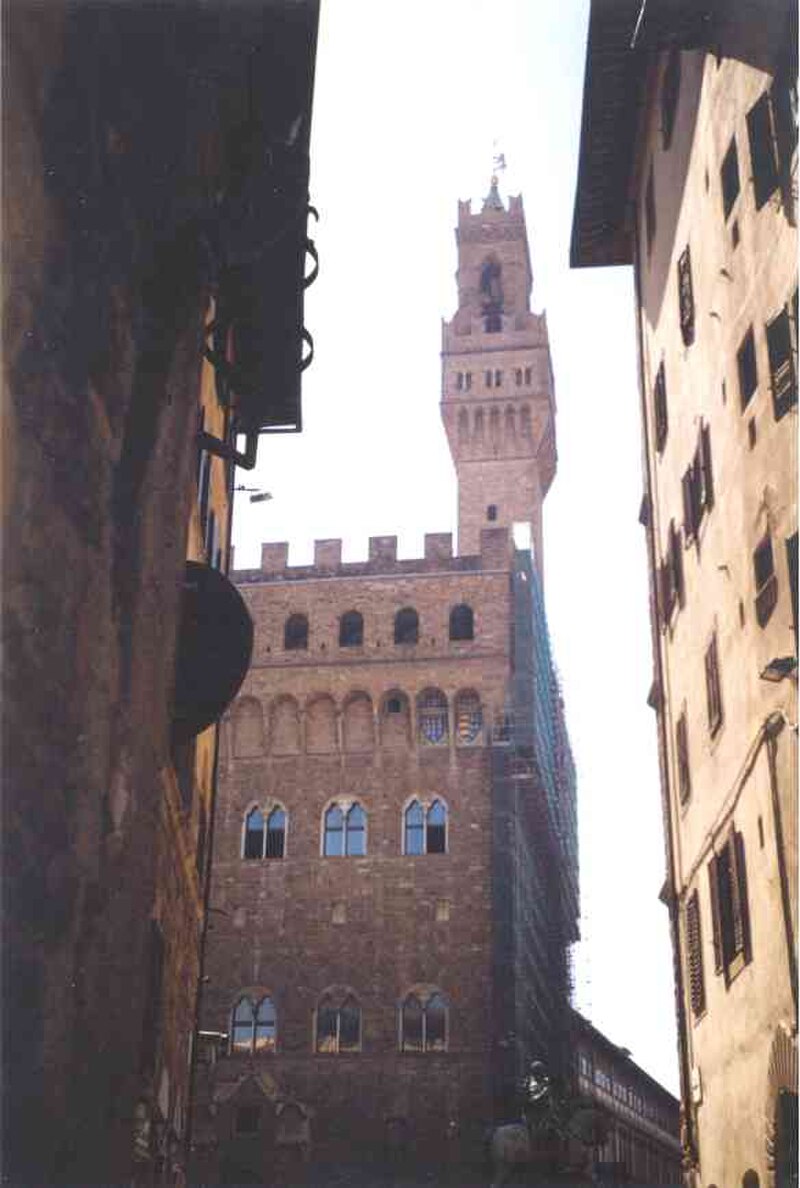
Photo · Wikimedia Commons Piazza della Signoria is the grand stage of Florentine civic theater. Enter through the crenellated fortress gate, passing the replica of David and Bandinelli massive marble figures, and climb Vasari monumental stone staircase directly into the Salone dei Cinquecento. The scale is intoxicating: gilded ceiling panels overhead glorify Cosimo I, while sweeping wall frescoes celebrate Tuscan victories. Behind one of these battle scenes lies the legendary lost mural of Leonardo da Vinci, who famously mixed wax into his pigments and tried drying the damp surface with coal braziers before abandoning the experiment. At the far corner, seek out the hidden doorway to the windowless Studiolo of Francesco I. Lined with dark Mannerist panels and bronzes, this jewel-box chamber features a discreet spyhole through which the prince observed ministers meeting in the great hall. For an unforgettable panorama, climb the ninety-four-meter Arnolfo Tower above the rooftops.
Stroll westward down Via dei Gondi past the high fashion boutiques to Piazza Santa Trinita.
- 1 min · on site
Sculpture for the Arch of the Foot

Photo: Ben · CC BY-SA 2.0 · Original file Arriving at Piazza Santa Trinita, gaze up at the formidable Gothic battlements of Palazzo Spini Feroni. In the nineteen thirties, shoemaker Salvatore Ferragamo purchased this medieval fortress, turning its vaulted stone basement into the epicentre of modern luxury. Descend the stairs into a temple dedicated to the architecture of the foot. Here rests an archive of ten thousand shoe models created between the nineteen twenties and nineteen sixty, alongside film reels and vintage sketches. Look closely at the patented cork wedges, rainbow heels, and the precision wooden lasts crafted for the feet of Hollywood royalty. Ferragamo understood that true glamour requires flawless structural engineering: balance, weight distribution, and pure line. Before you depart, admire how the medieval stone arches cradle these modernist leather silhouettes. Step back outside into the sunlight and walk toward the Santa Trinita bridge, pausing to gaze downstream at the shimmering reflections on the Arno.
Cross the Santa Trinita bridge into the Oltrarno quarter to reach the imposing front of Palazzo Pitti.
- 1 min · on site
The Grand Ducal Catwalk
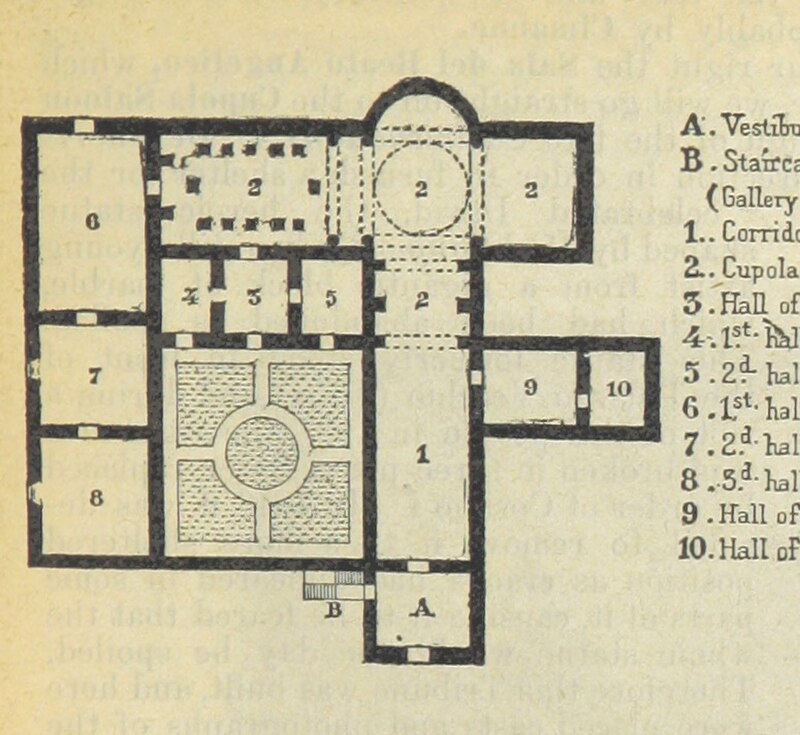
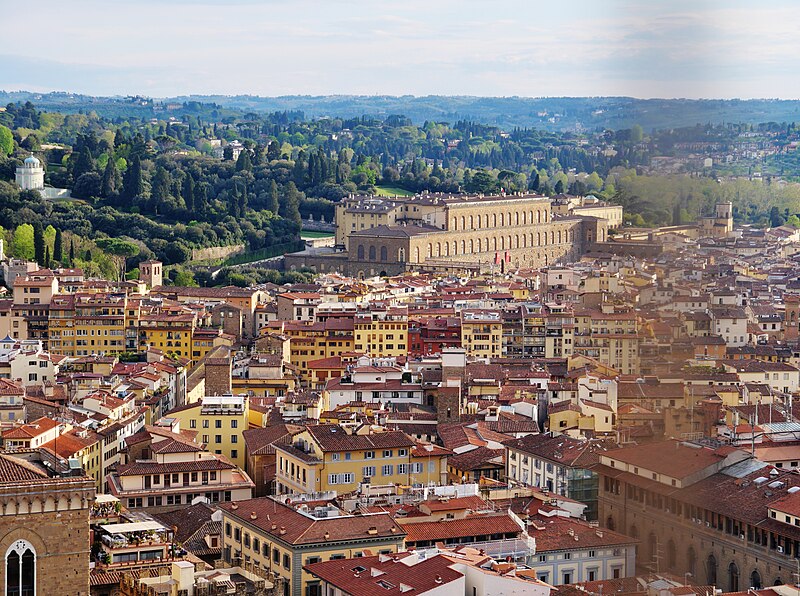
Photo · Wikimedia Commons Cross the river into Oltrarno and stand before the titanic rusticated stone arches of Palazzo Pitti. Commissioned by banker Luca Pitti to rival the Medici, its massive stonework was purchased in fifteen forty-nine by Duchess Eleonora di Toledo to become Tuscany royal palace. Climb Ammanati staircase into the Palatine Gallery, where over five hundred Renaissance masterworks hang shoulder-to-shoulder in gilded frame clusters, exactly as the dukes arranged them. In the Room of Jupiter, stop before Raphael portrait La Velata. The shimmering folds of her gathered silk sleeve reveal an obsession with luxurious textile craftsmanship. Further along in the Meridiana wing lies the Costume Gallery, the only museum in Italy tracing national fashion history, housing the rare sixteenth-century funeral garments of Cosimo and Eleonora. Allow extra time to walk from these grand gilded salons into the terraced greenery of the Boboli Gardens, letting the afternoon light settle over Florence.


When twilight settles over the Arno, Florence sheds its daytime museum decorum and returns to its true essence as an open-air theater of timeless form. The beauty preserved within these stone fortresses was never about nostalgia. It was a deliberate, audacious bid for immortality, sculpted in marble, stitched in silk, and cast in bronze. Carry this exacting vision with you as you step into the evening.
Take it further
Open the tour in the appThe tour in the app
The Florentine Silhouette: From Monastic Shadow to Ducal SplendorAn elegant walking trajectory flowing from the quiet monastic tranquility of Sant Apollonia down through the Accademia and Innocenti, across Piazza della Signoria, into Ferragamo medieval shoe vaults, and finally across the Arno to Palazzo Pitti grand ducal galleries and terraced gardens.
+ Add the tour to your planIf you have the app the tour opens right away; otherwise you go to the store.FAQ
- Why are paintings in the Palatine Gallery hung in clusters rather than chronologically?
- The Palatine Gallery in Palazzo Pitti deliberately preserves the historical arrangement of a grand ducal private collection, grouping works by visual harmony, frame balance, and thematic drama rather than modern academic chronology.
- What makes the architecture of the Spedale degli Innocenti so historically significant?
- Designed by Filippo Brunelleschi starting in 1419, it introduced the first true Renaissance classical modular system, using pietra serena columns and proportional bays based on ten Florentine braccia to establish visual harmony.
- How did Salvatore Ferragamo choose Palazzo Spini Feroni for his fashion house?
- Returning to Italy after crafting shoes for Hollywood in the 1920s, Ferragamo bought the fourteenth-century fortress in the 1930s, establishing his bespoke workshop and building an archive of ten thousand historic lasts and shoe models.
This piece was newly written based on the Wikipedia articles ‘Museums of Florence’, ‘Palazzo Vecchio’, ‘Palazzo Pitti’, ‘Galleria dell'Accademia’ · CC BY-SA 4.0