Morning arrives in Prague not as an abrupt dawn, but as a slow revelation of ancient stone. Before the streetlamps extinguish along the riverbank, the damp pavers retain the cool moisture of the night, glowing with the faint amber warmth of a curator's quiet reading room. Walk toward the historic center at this hour, and you begin to realize that this city was never designed merely to be observed from a respectful distance. It was drafted, bartered, and assembled piece by piece through the tactile ritual of daily exchange. Every passageway connecting the riverbank to the royal palaces originated as a bustling commercial artery, where timber carts hauled Baltic amber, Saxon silver, and southern wine into the heart of Bohemia. To wander through Prague with an eye for trade is not to indulge in trivial consumption. It is to step inside a living museum whose exhibits have never been cordoned off behind velvet stanchions or glass cases. Here, commerce is the very medium through which civic identity has been chiseled, tested, and preserved over ten centuries.
The Merchant's Threshold and the Mintmaster's Grid
In the autumn of the year nine hundred and sixty five, a Hispano Jewish merchant and diplomat named Abraham ben Jacob journeyed northward across the continent, following trade routes that linked the Mediterranean to Central Europe. When he crossed into the Bohemian valley, he encountered a vibrant town constructed of stone and lime, teeming with foreign traders who had traveled immense distances to exchange raw materials, forest pelts, and precious crafts. His chronicle preserves the earliest eyewitness portrait of Prague as a cosmopolitan market capital, an emporium where diverse tongues mingled in negotiation. Three centuries later, King Wenceslaus the First recognized that informal market gatherings could no longer accommodate the ambitions of the crown. He summoned a resourceful mining entrepreneur named Eberhard, later appointed royal mintmaster of Bohemia, and commissioned him to build an entirely new planned commercial town within the city fortifications. Eberhard laid out a vast precinct covering more than three hectares, paved the muddy ground with solid stone, and erected two monumental rows of permanent stalls for drapers, cloth shearers, and leather tanners. Here, urban statutes, uniform guild measures, and civic architecture converged to turn open air trade into an enduring royal institution.
The Living Strata of Exchange
This deep curatorial memory still defines Prague today, surviving beneath every wave of modern renewal. When developers broke ground for contemporary commercial galleries in recent decades, their excavations did not strike empty earth. Instead, they unearthed vaulted Gothic cellars, early medieval Jewish gravestones, and foundational masonry that compelled architects to adapt their plans. Modern retail in Prague is never an erasure of the past, but another archaeological stratum laid over medieval vaults and nineteenth century brick. Whether you are examining hand carved wooden marionettes under historic timber canopies, Bohemian glass reflecting the afternoon light, or regional tasting plates shared in open urban courtyards, you are participating in an exchange calibrated across eight hundred years. Consider each object you encounter today as an artifact with a lineage connecting back to royal mintmasters, guild inspectors, and intrepid travelers. The city does not merely sell its goods to visitors; it invites you to hold a physical fragment of its civic memory in your hands, a keepsake carrying the layered weight and quiet dignity of Central European craftsmanship. As you walk these avenues with a curator's patient gaze, you begin to see that each silver ingot, each bolt of linen, and each modern ceramic plate tells the same continuous tale of Bohemia's resilient commercial heart.
Want to walk it yourself? Plan a trip with these places
The walk
On site, play just that chapter
- 1 min · on site
The Barracks Reclaimed: A Sanctuary of Light and Commerce
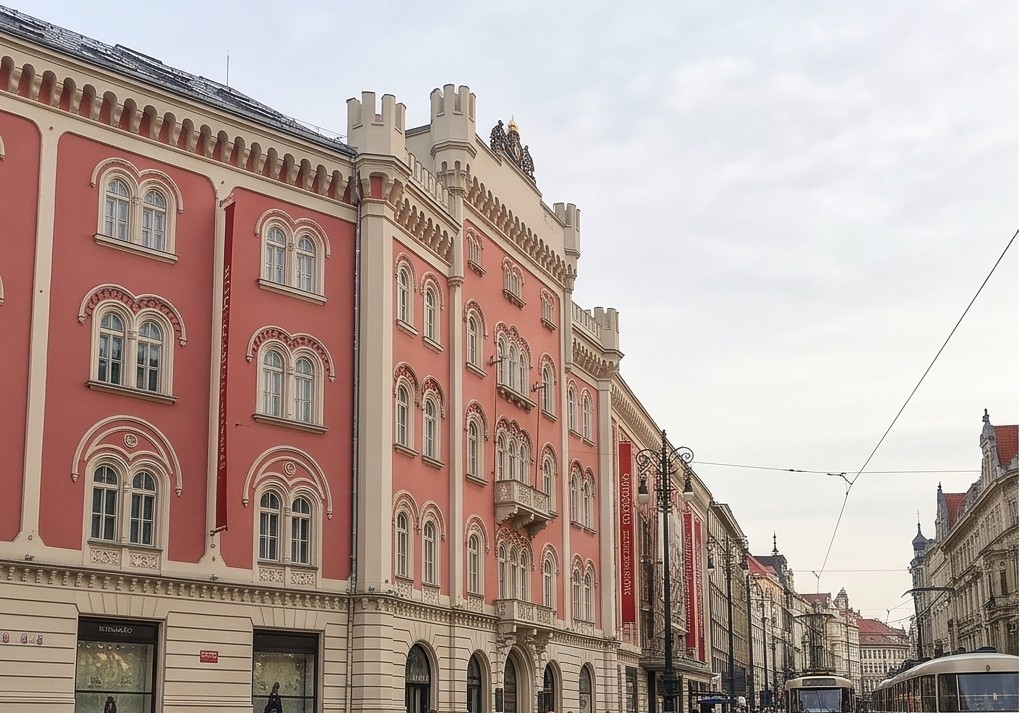
AI-generated image · may differ from the real place Stand before the apricot facade of Palladium on Náměstí Republiky and you are looking at layers of civic adaptation. This grand complex originated as nineteenth century army barracks, yet today its military austerity has been reimagined as a vibrant commercial sanctuary. The name itself echoes the lustrous chemical element discovered in 1802 by William Hyde Wollaston and named after Athena, long prized in jewelry for its enduring white sheen. Enter from the main square of Náměstí Republiky to step immediately into the soaring central atrium. As you move across the multi level gallery, look closely at where exposed historic masonry gracefully intersects with modern curves of steel and glass. Here, one stop fashion and dining thrive within walls that once housed soldiers, proving Prague's remarkable gift for domesticating its monuments and turning imperial fortifications into welcoming public halls.
Step outside into the plaza and follow the pedestrian curve of Celetná street westward toward Old Town Square.
- 1 min · on site
The Theater of Civic Time: Under the Gaze of the Astronomical Clock
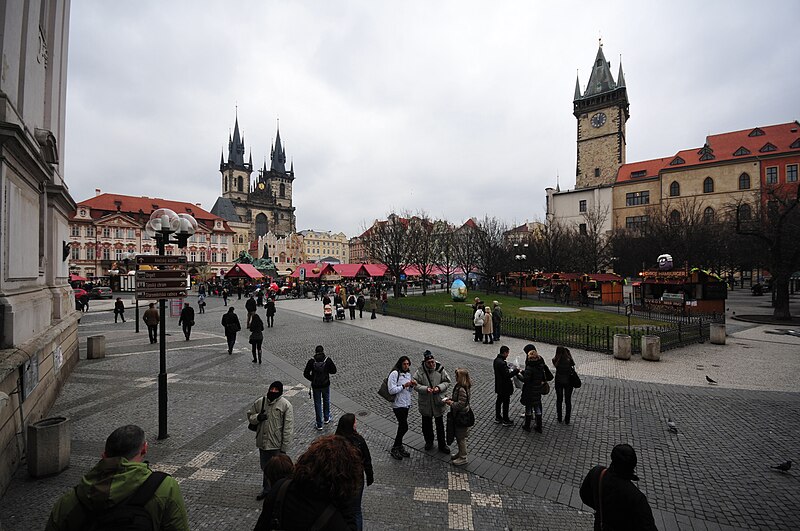
Photo · Wikimedia Commons Old Town Square has gathered merchants and travelers since the earliest medieval fairs took root in Bohemian soil. Framed by the dark twin towers of Týn Church and the intricate dial of the 1410 Astronomical Clock, the open plaza transforms through the seasons into a bustling market. Yet beneath the scent of roasted pastries and wooden counters lies solemn historical memory. In front of the Old Town Hall, twenty seven white paving crosses commemorate the martyrs of the 1621 execution, including scholar Jan Jesenius. Visit in the quiet morning hours to browse the timber market stalls without the midday crowds. Pause by the crafts to admire how civic festivity and monumentality coexist, with merchants trading where history was repeatedly decided, offering handcrafted decorations and Bohemian keepsakes against a backdrop of eight centuries of architecture.
From the southern flank of the square, turn down Melantrichova street and walk a few minutes into the lively passage of Havelská.
- 1 min · on site
The Mintmaster's Aisle: Eight Hundred Years of Market Stalls

Photo: Perituss · CC0 · Original file Havelské tržiště is the living remnant of Havelské město, the planned thirteenth century market founded by royal mintmaster Eberhard under King Wenceslaus the First. Centuries ago, this vast thoroughfare was lined with two stone rows of cloth kotce where guild inspectors examined fine wool and drapers measured woven textiles. Today, the market retains its linear rhythm beneath pitched wooden roofs, offering traditional Czech crafts, hand carved puppets, and seasonal fruit. Walk slowly down the central stone aisle between the dual rows of stalls. Take time to compare stalls before buying, lifting marionettes and wooden toys to inspect the grain and joint work up close. In every whittled pine figurine, you are touching an unbroken artisan lineage born in the Middle Ages, preserved along the very stones that linked medieval Prague's twin commercial hearts.
Walk south to the end of the market street, crossing 28. října and Jungmannovo náměstí to reach Spálená street, where Quadrio rises.
- 1 min · on site
The Kinetic Modern: Kafka's Steel and Gothic Foundations

Photo: Eliška Jindříšková · CC BY-SA 4.0 · Original file Rising above Národní třída, OC Quadrio presents a striking cloverleaf form that merges commercial vitality with deep archaeological strata. During excavation, builders uncovered Gothic cellars and early medieval Jewish gravestones, forcing the modern complex to respect its ancient foundations. Inside, sculptures by Maxim Velčovský honor the historic medieval houses that once stood here. Step into the open courtyard behind the center to witness artist David Černý's ten meter rotating head of Franz Kafka, its forty two stainless steel tiers continuously fracturing and aligning the author's likeness. Afterwards, take the elevator up to the panoramic rooftop terrace for a quiet photographic break, looking across Gothic spires toward Prague Castle and taking in the layered urban landscape. The juxtaposition is breathtaking, where avant-garde engineering pays tactile homage to centuries of urban life, reminding every shopper that modern retail in this city rests squarely upon deep historical foundations.
Walk west along Národní třída toward the river, cross the bridge into Smíchov, and stroll down Ostrovského street.
- 1 min · on site
The Contemporary Nomad: Culinary Craft in Smíchov
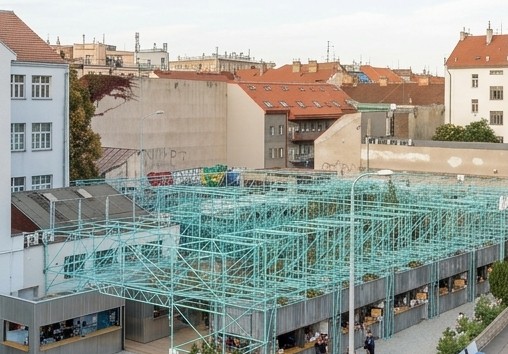
AI-generated image · may differ from the real place At Manifesto Market Anděl, Prague's market culture leaves stone arcades behind to embrace modern nomadic ingenuity. Constructed from repurposed shipping containers in the historic district of Smíchov, this open air food hub revitalizes the medieval concept of the pop up stall for the twenty first century. Festoon lights glow above communal wooden tables, where local food artisans and diners gather beneath the evening sky. Arrive with an appetite and take a seat in the central courtyard to share small plates from several rotating kitchens, sampling everything from local delicacies to global street fare. The shipping containers, industrial steel fittings, and aroma of craft cooking celebrate the living spirit of the neighborhood, showing how Bohemian market traditions continue to evolve and thrive in contemporary urban spaces while preserving the ancient spirit of shared hospitality.


To walk through Prague's markets and shopping galleries is to understand that commerce here was never merely an exchange of coins for merchandise. It is a continuous dialogue between human hands and enduring materials, between ancient opuka stone and polished stainless steel, between the traveler seeking memory and the artisan shaping identity. As you return across the river, the objects you carry are quiet custodians of Bohemian history, holding within their contours the spirit of a city that has curated its civic life for over a thousand years.
Take it further
Open the tour in the appThe tour in the app
From Medieval Guilds to Kinetic Steel: A Curator's Prague Shopping WalkThis curated walking tour threads through ten centuries of Bohemian trade, leading from the repurposed neoclassical halls of Palladium across the historic cobblestones of Old Town Square and Havelské tržiště to the kinetic modern art of Quadrio and the open-air culinary containers of Manifesto Market Anděl.
+ Add the tour to your planIf you have the app the tour opens right away; otherwise you go to the store.FAQ
- What distinguishes Prague's historic markets from typical tourist souvenir shops?
- Prague's open-air markets, especially Havelské tržiště, originate from medieval royal charters dating back to the thirteenth century. Look for stalls displaying authentic hand-carved marionettes, Bohemian crystal, and regional wooden toys, where the hand-chiselled grain and maker marks reflect centuries of guild craftsmanship.
- How can visitors experience both modern and historic shopping in a single walk?
- Start at Náměstí Republiky and walk through the historic core toward Smíchov. Along this route, former nineteenth-century army barracks and modern retail galleries sit directly atop medieval Gothic vaults and archaeological sites, allowing you to witness contemporary Czech design alongside intact medieval foundations.