Contents
History & cultureBY TELLBY2 sections · numbered as on the map01 The Curated City: A Thousand Years of Bohemian Commerce and Craft
Morning arrives in Prague not as an abrupt dawn, but as a slow revelation of ancient stone. Before the streetlamps extinguish along the riverbank, the damp pavers retain the cool moisture of the night, glowing with the faint amber warmth of a curator's quiet reading room. Walk toward the historic center at this hour, and you begin to realize that this city was never designed merely to be observed from a respectful distance. It was drafted, bartered, and assembled piece by piece through the tactile ritual of daily exchange. Every passageway connecting the riverbank to the royal palaces originated as a bustling commercial artery, where timber carts hauled Baltic amber, Saxon silver, and southern wine into the heart of Bohemia. To wander through Prague with an eye for trade is not to indulge in trivial consumption. It is to step inside a living museum whose exhibits have never been cordoned off behind velvet stanchions or glass cases. Here, commerce is the very medium through which civic identity has been chiseled, tested, and preserved over ten centuries.
The Merchant's Threshold and the Mintmaster's Grid
In the autumn of the year nine hundred and sixty five, a Hispano Jewish merchant and diplomat named Abraham ben Jacob journeyed northward across the continent, following trade routes that linked the Mediterranean to Central Europe. When he crossed into the Bohemian valley, he encountered a vibrant town constructed of stone and lime, teeming with foreign traders who had traveled immense distances to exchange raw materials, forest pelts, and precious crafts. His chronicle preserves the earliest eyewitness portrait of Prague as a cosmopolitan market capital, an emporium where diverse tongues mingled in negotiation. Three centuries later, King Wenceslaus the First recognized that informal market gatherings could no longer accommodate the ambitions of the crown. He summoned a resourceful mining entrepreneur named Eberhard, later appointed royal mintmaster of Bohemia, and commissioned him to build an entirely new planned commercial town within the city fortifications. Eberhard laid out a vast precinct covering more than three hectares, paved the muddy ground with solid stone, and erected two monumental rows of permanent stalls for drapers, cloth shearers, and leather tanners. Here, urban statutes, uniform guild measures, and civic architecture converged to turn open air trade into an enduring royal institution.
The Living Strata of Exchange
This deep curatorial memory still defines Prague today, surviving beneath every wave of modern renewal. When developers broke ground for contemporary commercial galleries in recent decades, their excavations did not strike empty earth. Instead, they unearthed vaulted Gothic cellars, early medieval Jewish gravestones, and foundational masonry that compelled architects to adapt their plans. Modern retail in Prague is never an erasure of the past, but another archaeological stratum laid over medieval vaults and nineteenth century brick. Whether you are examining hand carved wooden marionettes under historic timber canopies, Bohemian glass reflecting the afternoon light, or regional tasting plates shared in open urban courtyards, you are participating in an exchange calibrated across eight hundred years. Consider each object you encounter today as an artifact with a lineage connecting back to royal mintmasters, guild inspectors, and intrepid travelers. The city does not merely sell its goods to visitors; it invites you to hold a physical fragment of its civic memory in your hands, a keepsake carrying the layered weight and quiet dignity of Central European craftsmanship. As you walk these avenues with a curator's patient gaze, you begin to see that each silver ingot, each bolt of linen, and each modern ceramic plate tells the same continuous tale of Bohemia's resilient commercial heart.
02 The Barracks Reclaimed: A Sanctuary of Light and Commerce
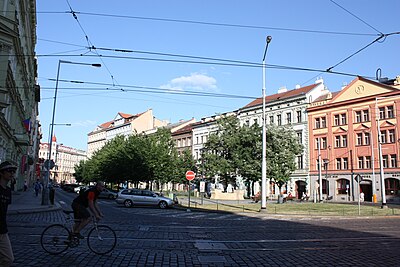
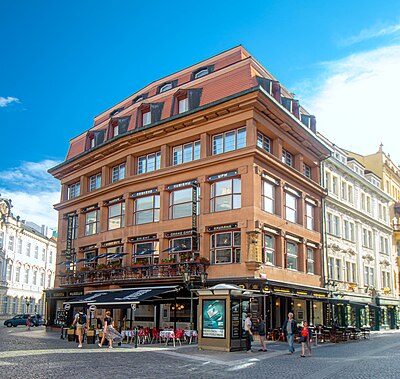
Stand before the apricot facade of Palladium on Náměstí Republiky and you are looking at layers of civic adaptation. This grand complex originated as nineteenth century army barracks, yet today its military austerity has been reimagined as a vibrant commercial sanctuary. The name itself echoes the lustrous chemical element discovered in 1802 by William Hyde Wollaston and named after Athena, long prized in jewelry for its enduring white sheen. …