Contents
History & cultureBY TELLBY7 sections · numbered as on the map01 Orientation
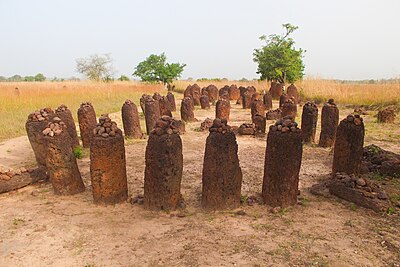
Welcome to the extraordinary sacred landscape of the Stone Circles of Senegambia, a remarkable World Heritage site preserving the ancient spiritual traditions of West Africa. You are standing at the entrance to one of the most extensive megalithic complexes on Earth, stretching across a band one hundred kilometers wide and three hundred and fifty kilometers long along the fertile banks of the Gambia River. Over a thousand stone circles and thousands of associated burial mounds form an astonishing concentration of monuments that reflects more than fifteen hundred years of continuous human devotion and social organization. Without relying on complex academic terminology, it is immediately clear upon viewing this landscape that it represents a monumental sanctuary created by a highly sophisticated and prosperous ancient society. From the third century before the common era through the sixteenth century of our era, local farming communities quarried dense red laterite rock, carefully shaped it into cylindrical monoliths, and erected them to mark the resting places of their revered ancestors. These stone structures were not merely decorative markers, but functioned as powerful territorial anchors and sacred hubs that bound living generations to their ancestral lands. As you gaze across the open savanna, the striking red pillars standing in precise circular arrangements convey an enduring sense of solemnity and permanence that has survived the passage of centuries. Today, archaeological research reveals that these monuments encapsulate a complex mortuary tradition involving elaborate multi-stage rituals, feasting, and deep reverence for the deceased. Local youth age-sets mobilized timber rollers and fiber ropes to haul heavy stones across the plain, while master artisans carved each monolith using forged iron chisels. As we begin our journey through this sacred environment, take a moment to absorb the quiet majesty of the surrounding plain. Please follow the designated path as we take our first physical steps from the entrance threshold toward the primary group of monoliths rising directly ahead. Together we will uncover the stories of the skilled stonecutters, valiant warriors, and devoted families whose memories remain carved into these timeless red stones along the historic river valley.
02 Monoliths of Wassu
The astonishing fact that massive laterite monoliths weighing up to seven tons were carved and erected using only forged iron tools demonstrates the extraordinary technical capability and social organization of ancient West African society. Look straight ahead at the magnificent scene before you, where reddish brown cylindrical pillars standing taller than a person form a precise and majestic circle. …
03 Eastern Solstice Stones
The astonishing fact that the frontal stones set apart on the eastern side of the monolith circles align precisely with the direction of the rising sun during the winter solstice reveals the profound astronomical knowledge and ritual sophistication of ancient West African communities. Look closely at the line of small frontal stones standing neatly on the eastern exterior of the main circular structure. …
04 The Bifid Lyre Stone
The remarkable fact that Y-shaped or lyre-shaped bifurcated monoliths are found exclusively in this Senegambian region and nowhere else in global megalithic culture demonstrates the absolute pinnacle of ancient African stone sculpture and ritual design. Lower your gaze slightly and look directly at the upper split portion of the standing stone positioned before you. …
05 Interim Burial Grounds
The remarkable fact that burial here was not a single event but a multi-stage purification ritual where the deceased was temporarily interred until the flesh decomposed before bones were collected reveals the profound spiritual worldview of ancient communities. Look carefully at the shallow excavated earth and the designated spots within this circular stone enclosure where large clay vessels were placed upside down. …
06 The Double Circle Warrior Tomb
The astonishing fact that this central double monolith circle served as an elite collective sanctuary where the reassembled skeletal remains of forty ancestors were interred across four distinct ritual cycles spanning seven hundred years reveals the complex social structure and enduring ancestral devotion of ancient Senegambian society. Gaze upon the majestic double ring of standing monoliths before you, where an inner circle of carved pillars is nested perfectly inside a larger outer ring. …
07 Closing
As we look out across the panoramic landscape where ancient stone circles and burial mounds stretch endlessly along the Gambia River valley, our audio guide tour comes to a thoughtful conclusion. The sacred environment you have explored today is far more than a collection of prehistoric stone monuments; it is an extraordinary testament to human resilience, spiritual devotion, and social continuity that endured for over fifteen hundred years in West Africa. …