 Photo Wikimedia Commons
Contents
History & cultureBY TELLBY7 sections · numbered as on the map01 Orientation
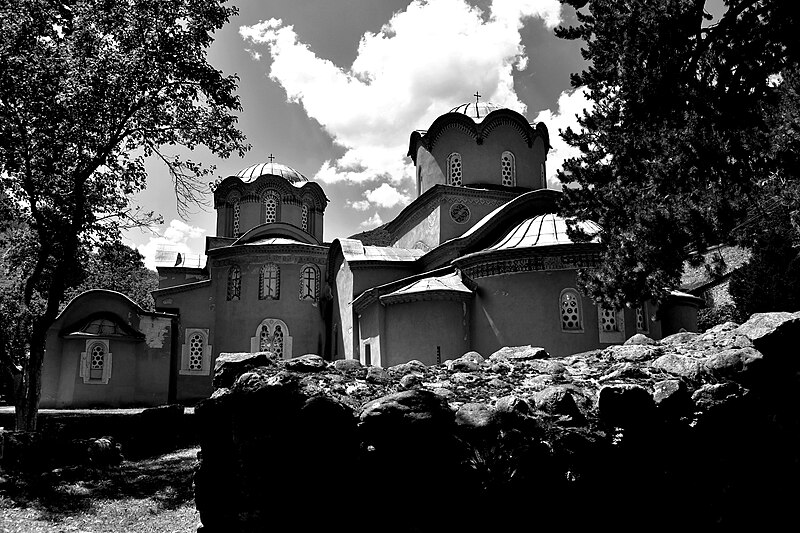
Welcome to the Patriarchate of Pec Monastery, located by the Pec Bistrica river right at the dramatic entrance of the Rugova Canyon. Set within the picturesque Metohija region near the Montenegrin border, this serene sanctuary stands on the edge of the ancient Roman and Byzantine settlement of Siperant. As the historic spiritual center of the Serbian Orthodox Church and the revered mausoleum for its archbishops and patriarchs, this complex holds profound cultural significance and is recognized as a UNESCO World Heritage site. As you step into the quiet monastery courtyard, the most striking architectural feature before you is the unique layout of four interconnected churches. Three grand vaulted churches featuring prominent domes stand side by side as a unified whole, accompanied by a fourth smaller church resting along the southern flank. Constructed sequentially across the 13th and 14th centuries, this ensemble represents an extraordinary structural achievement in Serbian medieval architecture. Originally established as a metochion of Zica Monastery during the lifetime of Saint Sava, the site became the permanent episcopal seat when Archbishop Arsenije I built the Church of the Holy Apostles to protect the church headship from foreign invasions. In 1346, during the reign of Emperor Stefan Dusan, the Serbian Archbishopric was raised to patriarchal status, elevating Pec into the supreme administrative and spiritual seat of the entire Serbian Church. Across many centuries, numerous eminent church leaders, including Arsenije I, Sava II, Nikodim, Danilo II, Spiridon, and Makarije, were laid to rest within these sacred walls. Even today, the traditional installation ceremony for newly elected Serbian patriarchs is solemnized right here, demonstrating an unbroken continuity with the historic throne. We now invite you to walk through the peaceful courtyard toward the grand monumental narthex that unifies the western facades of the three main churches. Built by Archbishop Danilo II, this monumental porch served as the primary gathering space for ecclesiastical assemblies. As you approach the entrance, take a moment to admire the vivid red walls and the enduring dignity of this medieval sanctuary. Please follow the pathway leading toward the grand narthex to begin our detailed exploration.
02 The Grand Monumental Narthex
Astonishingly, this single monumental narthex in which you are standing connects three separate medieval churches beneath one magnificent continuous western facade, unified through the architectural vision of Archbishop Danilo II. Look directly at the eastern wall near the entrance and up toward the vaulted ceilings to observe the remarkable interplay of structural masonry and surviving medieval wall paintings that line this vast interior. …
03 Church of the Holy Apostles
Remarkably, the Church of the Holy Apostles in which you are now standing is the oldest foundational core of the entire monastery complex, having stood continuously since the first third of the 13th century. Look up toward the central apse and high dome painted in deep medieval pigments to observe the solemn Serbo-Byzantine frescoes that illuminate this holy sanctuary. This venerable church was erected under the direction of Archbishop Arsenije I, the worthy successor to Saint Sava. …
04 Church of Saint Demetrius
Astonishingly, during comprehensive restoration works conducted in 2006, conservators working on the northern exterior facade of this Church of Saint Demetrius uncovered two previously unknown medieval frescoes depicting a Serbian queen and a prominent nobleman. Look closely at the northern interior wall and the vibrant layers of fresco painting that line the barrel vault above to appreciate the extraordinary artistic richness of this sanctuary. …
05 Church of the Virgin Hodegetria
Astonishingly, this magnificent Church of the Virgin Hodegetria standing on the southern side of the complex was constructed within a single energetic decade around 1330 alongside its adjoining structures. Look toward the wall space directly above the doorway and up into the soaring dome to marvel at the brilliant medieval wall paintings that adorn this sanctuary. …
06 Church of Saint Nicholas and the Ancient Mulberry Tree
Astonishingly, standing directly outside this modest chapel in the open courtyard is a living witness to history, an ancient black mulberry tree planted over seven hundred and fifty years ago. Step into this intimate, modest single-nave room, then look back out through the open entrance toward the sunlit courtyard to observe the leafy branches of this venerable botanical landmark. …
07 Closing
Today, the Patriarchate of Pec Monastery stands not merely as a museum of medieval antiquity, but as a living spiritual heart for the Serbian Orthodox Church. The unbroken tradition of holding the solemn installation ceremony for each newly elected patriarch right here within these walls demonstrates a powerful historical continuity linking the modern church directly back to the throne of Saint Sava. …