Contents
History & cultureBY TELLBY7 sections · numbered as on the map01 Orientation
Welcome to Dholavira, a magnificent Harappan city situated on the arid Khadir Island in the state of Gujarat, India. As you step onto this ancient land, you are entering one of the most remarkably preserved urban settlements of the Bronze Age Indus Valley Civilization. Unlike the famous sister cities of Harappa and Mohenjo-daro, which were built almost entirely of sun-dried mud bricks, Dholavira stands out as a grand stone-built fortress city. While most ancient settlements emerged along perennial riverbanks, Dholavira was strategically established on an isolated island surrounded by saline mud flats in the Great Rann of Kutch. In this harsh desert environment where rainfall was sparse and unpredictable, the survival and prosperity of the city depended entirely on human ingenuity. The inhabitants transformed their challenging surroundings through a masterclass in urban planning, monumental stone architecture, and sophisticated water management, creating a thriving regional metropolis that endured for over fifteen centuries.
To understand the layout of Dholavira, imagine a meticulously planned rectangular city laid out between two seasonal streams, the Mansar to the north and the Manhar to the south. The entire settlement was constructed according to a precise geometric plan, reflecting a highly organized and stratified society. At the southwestern heart of the city rises the Acropolis, consisting of a heavily fortified Castle and an adjacent Bailey where rulers and high officials resided. Adjacent to the Castle lies a broad Ceremonial Ground designed for public gatherings and civic rituals. Beyond these administrative heights extend the Middle Town and Lower Town, featuring grid-like street networks lined with residences and craft workshops. Encircling the inner city to the east and south lies a breathtaking series of massive stone-cut reservoirs designed to harvest every drop of precious rainwater. Further west, outside the city walls, lies an extensive cemetery containing unique memorial monuments.
Our walking tour will guide you through the defining highlights of this ancient metropolis. We will begin our journey at the towering Castle walls to marvel at the defensive masonry. Next, we will head to the Northern Gateway, where archaeologists uncovered a famous wooden signboard bearing ten monumental Indus script symbols. From there, we will explore the deep stone-cut reservoirs and hydraulic channels that showcase unmatched ancient engineering. Continuing forward, we will walk through the vibrant Middle Town to discover the bustling artisan workshops where precious stone beads and standard weights were crafted for long-distance trade. Finally, our tour will conclude at the western cemetery, where fascinating spoked wheel memorial structures offer a glimpse into the spiritual beliefs of the Harappans. Please follow the path as we embark on a memorable journey through four thousand years of history.
02 Castle and Fortifications
Unlike other major Harappan cities such as Harappa and Mohenjo-daro, which relied almost exclusively on sun-dried mud bricks for their monumental construction, Dholavira stands as a magnificent and unparalleled stone fortress built from dressed stone masonry. Look up now at the solid ramparts and double defense walls of the Castle towering before your eyes. …
03 Northern Gateway and Signboard
This Northern Gateway is the exact location of one of the most astonishing archaeological discoveries in world history: the world's oldest public signboard, featuring ten monumental symbols crafted from white gypsum mineral and arranged on a wooden board three meters in length. Look up and examine the finely dressed sandstone pillars and passage area flanking both sides of the corridor. …
04 Reservoirs and Hydraulic Engineering
Over four thousand five hundred years ago, the visionary engineers of Dholavira excavated a series of massive vertical rock-cut reservoirs and over a dozen water storage tanks across the city, including a grand stepwell three times larger than the famous Great Bath of Mohenjo-daro. Look down into the deep rock-cut basin to admire the descending stone steps and intricate drainage channels connecting the water network below. …
05 Middle Town and Bead Industry
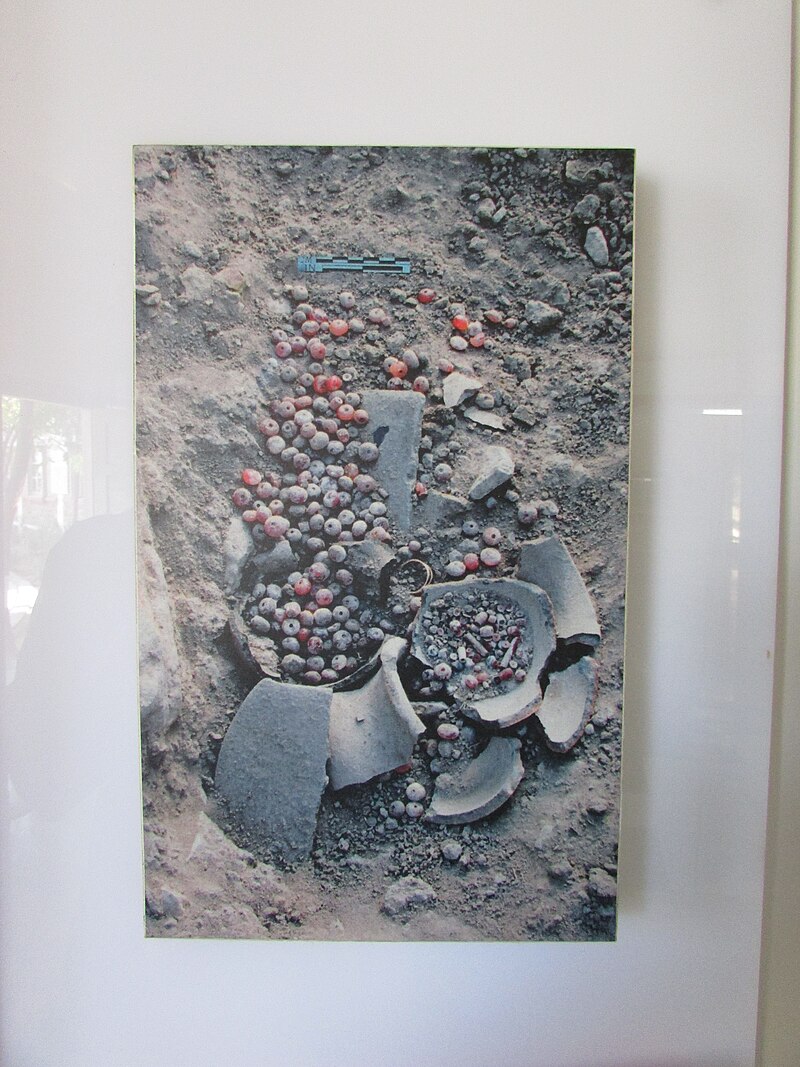
The Middle Town district served as a major industrial and craft manufacturing center where archaeologists unearthed roughly twelve thousand stone and metal beads alongside over fifteen hundred ancient stone drill bits, representing the largest assemblage of bead-drilling tools ever found in the Indus Valley Civilization. Follow the grid-like street network with your eyes, observing the excavated residential foundations and stone anvils at the workshop corners. …
06 Cemetery and Spoked Wheel Structures
The most captivating mystery of the western cemetery lies in the surprising fact that the vast majority of its monumental tombs contain no human skeletons, serving instead as memorial cenotaphs reflecting a unique ancient view of death. Slowly observe the mud-brick structures radiating outward like spoked wheels and the impressive hemispherical mounds rising above the desert plain. …
07 Closing
Today, we have journeyed together through the breathtaking stone ruins of Dholavira, a monumental metropolis that flourished on an arid island four thousand years ago. For over fifteen centuries, this remarkable city stood as a shining beacon of the Indus Valley Civilization, thriving through sophisticated urban planning, master stone architecture, and unmatched hydraulic engineering. …