Contents
History & cultureBY TELLBY8 sections · numbered as on the map01 Orientation
Welcome to the Lothal Archaeological Site, the ancient maritime gateway of the Indus Valley Civilization and home to one of the world's oldest known port structures. You are standing in a historic landmark located in the Bhal region of Gujarat, India, near the village of Saragwala in Dholka Taluka, Ahmedabad district. Situated approximately eighty-five kilometers southeast of Ahmedabad, the name Lothal translates in the local Gujarati language to the mound of the dead. This name mirrors that of Mohenjo-daro in the Sindhi language, reflecting how local villagers recognized the presence of ancient human remains buried beneath the earth long before official archaeological discoveries took place. As recently as the nineteenth century, sailing boats could navigate directly up to this mound, and silted creeks near modern Bholad reveal the ancient flow channel of a Bhogavo River tributary that once connected Lothal directly to the sea. The urban history of this remarkable settlement began around twenty-three hundred BCE. Long before the arrival of Harappan settlers, an indigenous pre-Harappan population inhabited this river basin. These native communities crafted distinctive micaceous red ware pottery using specialized firing techniques in partially oxidizing and reducing conditions to produce black-and-red ceramic vessels. They also traded worked copper objects and semi-precious stone beads. Attracted by the sheltered harbor, fertile soils suitable for cotton and rice cultivation, and an established bead-making tradition, Harappan pioneers integrated peacefully with the native residents. Together, they synthesized local skills with advanced urban planning and metallurgical techniques. Lothal expanded into a vital commercial hub connecting inland Indus settlements in Sindh and Punjab with overseas trade networks across West Asia and North Africa, including Bahrain, Sumer, Mesopotamia, and Egypt. Following the partition of British India in nineteen forty-seven, major Indus sites such as Harappa and Mohenjo-daro became part of Pakistan. In response, the Archaeological Survey of India initiated extensive explorations across northwestern India to discover new Harappan settlements. Under the leadership of archaeologist S. R. Rao, the official government agency discovered Lothal in nineteen fifty-four. Systematic excavation work commenced on February thirteen, nineteen fifty-five, and continued through May nineteen, nineteen sixty, unearthing a rich mound, planned township, marketplace, and dockyard. Spanning an area of seven hectares, Lothal represents a single-culture Harappan site that demonstrates extraordinary urban planning, administrative discipline, and engineering sophistication. As you move through the site, this audio guide will lead you through the citadel acropolis, the massive logistics warehouse, the bead factory workshops, and the famous dockyard basin. Please step forward as we journey together into the maritime legacy of the ancient Indus Valley Civilization.
02 The Flood Defense Walls and Main Entry Approach
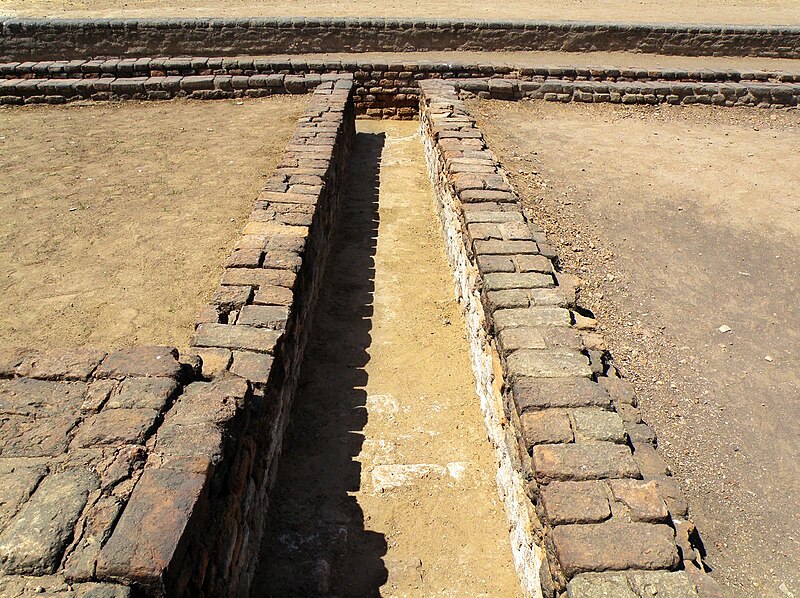
Welcome to the peripheral defense walls and the main approach of Lothal. The structural remains visible along this entry path provide remarkable architectural evidence of how ancient urban planners safeguarded their city against natural disasters four thousand years ago. Located in the low-lying Bhal region near the Gulf of Khambhat and the Sabarmati River basin, Lothal was constantly vulnerable to tropical storms, seasonal inundations, and catastrophic river flooding. …
03 The Acropolis and the Refined Drainage System of the Citadel
You are now standing in the Acropolis, also known as the Citadel, which formed the political, civic, and administrative heart of Lothal. Measuring one hundred twenty-seven point four meters from east to west and sixty point nine meters from north to south, this elevated district served as the residence of the city's rulers and high officials. …
04 The Great Warehouse, Logistics Hub of Ancient Trade
Located on the eastern flank of the Acropolis, this site contains the structural foundations of Lothal's Great Warehouse, the primary logistics and storage hub of the ancient port. This massive facility demonstrates the sophisticated cargo management and rigorous municipal oversight that characterized Lothal's international maritime trade. …
05 The Lower Town and Marketplace, Center of Commerce and Life
Descending from the Acropolis, you enter the Lower Town and Marketplace, which served as the vibrant commercial heart and residential sector for the citizens of Lothal. The Lower Town was organized into distinct commercial and residential zones, bisected by a major north-south arterial street measuring six to eight meters in width. …
06 The Bead Factory and Artisans' Workshops, Industrial Heart of Export
Located in the industrial district of the Lower Town, this site contains the Bead Factory and Artisans' Workshops, the economic powerhouse responsible for manufacturing Lothal's most famous export commodities. Lothal was world-renowned for its advanced lapidary art, metallurgy, and shell-working. Etched carnelian beads and polished gemstones produced in these workshops were highly prized across ancient trade routes, with examples excavated as far away as Kish, Ur, and Susa in modern Iraq and…
07 The World's Earliest Tidal Dockyard Basin
Stretching out before you is the grand trapezoidal basin of Lothal's Dockyard, recognized as one of the world's earliest known artificial dock structures and a crowning achievement of Harappan maritime engineering. Situated on the eastern edge of the township, away from the main river current to prevent silt accumulation, this massive burnt-brick basin averages two hundred fifteen meters in length from north to south and thirty-five meters in width from east to west. …
08 Closing
Welcome to the final stop of our audio tour, the Archaeological Museum and Preservation Zone of Lothal. Located adjacent to the excavated site, the Archaeological Museum displays one of India's most important collections of Harappan antiquities. Inside the galleries, visitors can observe two hundred thirteen excavated stamp seals used for cargo certification, realistic painted pottery depicting scenes reminiscent of classic fables like the fox and the crow or the thirsty crow, precision…