 Photo Wikimedia Commons
Contents
History & cultureBY TELLBY7 sections · numbered as on the map01 Orientation
Welcome to the magnificent Brihadisvara Temple, an architectural triumph resting gracefully on the southern bank of the sacred Kaveri River in the historic city of Thanjavur, Tamil Nadu. Standing for more than a millennium as the supreme crown of South Indian granite architecture and a radiant beacon of spiritual devotion, this revered sanctuary was commissioned by the legendary Chola emperor Rajaraja I between 1003 and 1010 CE. The sovereign originally named his monumental creation Rajarajesvaram, meaning the Temple of the Lord of Rajaraja. In later centuries, locals affectionately referred to it as Thanjai Periya Kovil, translating to the Great Temple of Thanjavur, and Peruvudaiyar Kovil, the Temple of the Great Lord. Revered in ancient texts as Dakshina Meru, or the Meru of the South, the sanctuary reflects the cosmic grandeur of the mythical abode of the gods and embodies the highest ideological and artistic aspirations of an empire that once commanded Southern India and the Indian Ocean trade routes.
The recognition of the Brihadisvara Temple as a UNESCO World Heritage Site rests upon a deeply compelling truth. It is the absolute pinnacle of Chola architectural and sculptural mastery, as well as an active, living monument where sacred rituals, floral offerings, and ancient devotional chants continue without interruption to this very day. UNESCO designated this sanctuary alongside its two sister monuments—the Brihadisvara Temple at Gangaikonda Cholapuram, located seventy kilometers to the northeast, and the Airavatesvara Temple at Darasuram, forty kilometers to the northeast—under the collective title of the Great Living Chola Temples. Positioned at the apex of the Kaveri delta, where the Cholas constructed sophisticated canal and irrigation networks linking agricultural heartlands to the Bay of Bengal, the temple complex was designed according to rigorous principles of axial geometry and absolute mathematical symmetry. The entire complex occupies a vast rectangular footprint measuring nearly two hundred and forty-one meters from east to west and one hundred and twenty-two meters from north to south.
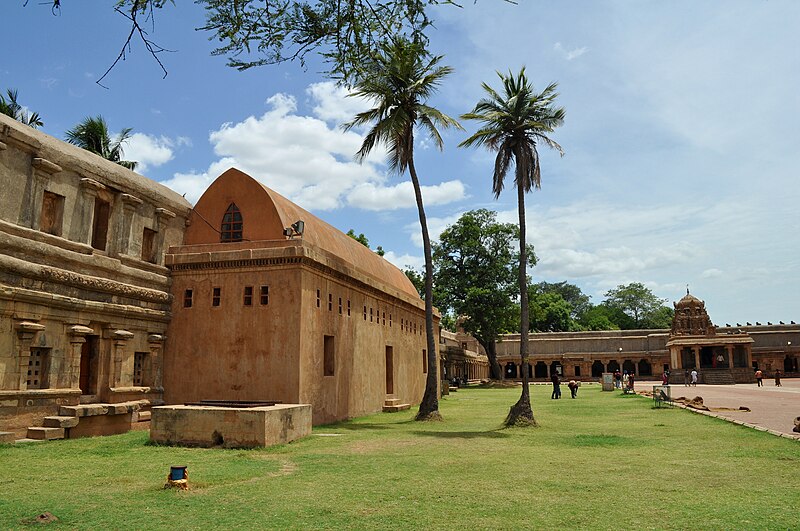
Surrounding the primary precinct are traces of an ancient water moat and fortified enclosure walls that bear witness to the complex's multifaceted history across changing dynasties. Passing through the monumental eastern gateway towers reveals a vast rectangular courtyard bounded by a continuous colonnaded veranda stretching roughly four hundred and fifty meters in perimeter. Arranged along the principal east-west axis sit the pavilion of the sacred bull Nandi, the great assembly halls, and ultimately the magnificent Sri-vimana, a solid granite tower soaring more than sixty-three meters into the sky directly over the inner sanctum. This complex was never merely a stone monument; it functioned as the political, economic, and spiritual heartland of the Chola realm. As we prepare to begin our walking journey, let your mind wander back ten centuries to an era when imperial patrons and master masons turned raw granite into a house of eternal light. Please follow the paved path toward the eastern gateway towers to commence our tour.
02 Gopurams
As you stand before the sacred eastern entrance of this monumental sanctuary and gaze upon the gateway towers ahead, you will discover a truly astonishing architectural secret: these massive stone twin gopurams were deliberately designed to be significantly lower in height than the principal vimana tower inside, a masterstroke of spatial planning calculated to dramatically heighten the visitor's sense of wonder and spiritual awe upon stepping into the inner courtyard. …
03 Nandi Mandapam
As you approach the center of the expansive temple courtyard, you will encounter the astonishing fact that this colossal sculpture of the sacred bull, weighing approximately twenty-five tonnes, was sculpted entirely out of a single solid block of dense granite. Look at the intense gaze of the gigantic black bull seated inside the open pavilion, looking steadfastly toward the main sanctum along the eastern axis. …
04 Maha-mandapa
As you step up the stone staircase and enter the grand portal of the Maha-mandapa, you will be struck by the remarkable fact that this imposing columned hall was once the vibrant center of royal ceremonies and sacred dances performed by devadasis a thousand years ago. Look up at the giant stone dvarapala statues guarding the entrance with fierce expressions on both sides of the hall. …
05 Sanctum & Sri-vimana
As you stand directly beneath this towering masterpiece and attempt to comprehend its scale, you will be astounded by the fact that the single granite capstone perched at the very summit weighs an astonishing eighty tons, placed at a height of over sixty meters using ancient inclined ramp engineering techniques long before modern machinery existed. Tilt your head back and trace the breathtaking lines of the Sri-vimana, soaring upward through thirteen tapering square storeys. …
06 Chola Frescoes
As you step into the shadowed circumambulatory passage surrounding the innermost sanctum, you will be fascinated by the astonishing fact that brilliant eleventh-century Chola fresco paintings lay hidden beneath layers of lamp soot and seventeenth-century Nayaka overpaintings for nearly a thousand years until their dramatic rediscovery in the twentieth century. …
07 Closing
Standing in the spacious outer courtyard surrounded by ancient pillared verandas, looking back at the majestic granite sanctum, one comes to appreciate that the Brihadisvara Temple is far more than a monument of a bygone era; it is a radiant, living heritage that has continuously breathed life for over ten centuries. …