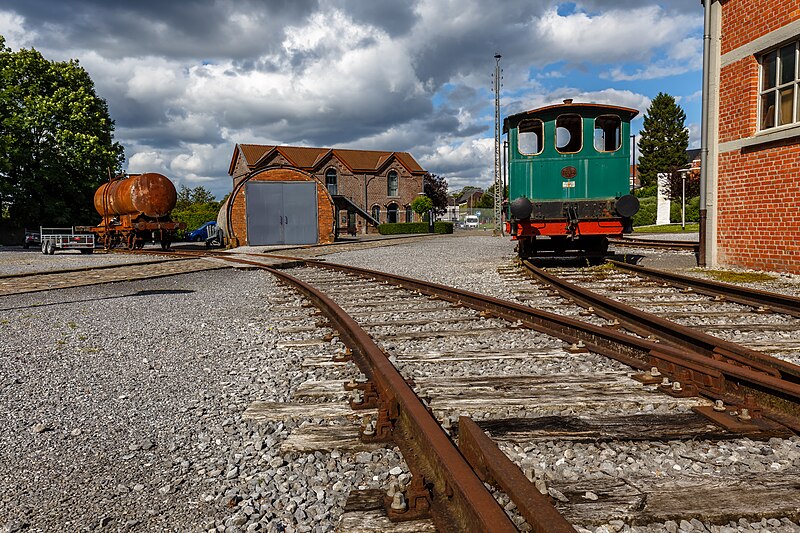
 Photo Wikimedia Commons
Contents
History & cultureBY TELLBY7 sections · numbered as on the map01 Orientation
Welcome to Bois du Cazier, a prominent industrial heritage landmark and a place deeply steeped in history, located in the Wallonia region of Belgium. Situated in Marcinelle, a historic district of the city of Charleroi within Hainaut Province, this former coal mine stands as a powerful testament to both the impressive economic progress driven by the coal industry during the nineteenth and twentieth centuries and one of the most tragic chapters in Europe's industrial history.
The site you are exploring today is far more than a collection of historic industrial structures. It is one of the best preserved coal mining sites in the entire Wallonian industrial valley, serving as a vital reference point for understanding the broader story of European industrialisation and its profound social impacts upon working families. Recognizing its immense historical, cultural, and architectural significance, UNESCO inscribed the site on the World Heritage List in twenty twelve. It forms part of a prestigious group of four major Wallonian mining sites recognized by UNESCO, alongside Grand Hornu, Bois du Luc, and Blegny Mine, with Bois du Cazier holding a uniquely moving place among them.
As a key stop along the European Route of Industrial Heritage, this location bridges the memory of the past with the mission of preserving Europe's industrial legacy for future generations. Today, as you walk through this open air museum and memorial complex, your journey will begin at the imposing red brick entrance complex. From there, you will look up at the soaring twin steel headframes and step inside the memorial space dedicated to honoring the two hundred and sixty two miners who lost their lives in the tragic underground fire of August eighth, nineteen fifty six.
Following the memorial space, your audio guide will lead you through the Industrial Museum, housed within the former mine workshops, where you can learn about coal extraction techniques, steam machinery, and the daily lives of the workers. You will also visit the Glass Museum, which showcases another essential branch of Charleroi's rich industrial heritage. Finally, your tour will conclude with a peaceful stroll through the surrounding woodland park, where nature has reclaimed the industrial landscape to create a tranquil sanctuary for reflection.
Where coal dust once settled and heavy machinery once thundered, there now exists a quiet space dedicated to remembrance and human dignity. Please follow the guided walking directions, take your time at each stop, and listen closely to the stories embedded within these grounds. Let us now begin our tour by moving toward the main red brick entrance complex.
02 The Main Entrance Complex and Mine Origins
Did you know that the name of this grand industrial heritage site, Bois du Cazier, originates from a nineteenth century baron who first discovered rich coal deposits buried deep beneath this land?
Please pause for a moment and look directly ahead at the neat red brick entrance building and its magnificent arched gateway. The warm, rustic tones of the aged red bricks and the orderly architectural design visually convey that this place was once a dynamic beating heart of Belgian heavy industry. …
03 Twin Headframes and the Day of the Disaster
Did you know that a single minor mechanical mistake and a severed electrical cable caused an uncontrollable fire that engulfed the entire mine shaft, taking the lives of two hundred and sixty two miners?
Now, please raise your eyes to look up at the two red steel headframes soaring high against the blue sky and the massive wheel mechanisms that once lowered cables deep into the earth. …
04 The 1956 Disaster Memorial and Italian Miners
Did you know that when rescue workers finally reached the deepest underground mine shaft two weeks after the disaster, they left behind the heartbreaking phrase Tutti cadaveri, which in Italian means all corpses?
Please stand in quiet reflection and look at the victim's faded personal belongings, family photographs, and solemn archival documents arranged along the walls of the memorial space. …
05 Industrial Museum and Mining Machinery Workshops
Did you know that after the mine closed in nineteen sixty seven, this entire complex was saved from being abandoned and demolished thanks to a persistent preservation campaign led by retired miners and Italian immigrants?
Now, please step inside the spacious mining machinery workshops and take a moment to look at the massive air compressors, steam engines, and heavy industrial equipment stationed throughout the hall. …
06 The Glass Museum of Charleroi
Did you know that Charleroi was not only a city of dark coal and heavy steel, but also a world renowned production center for Europe's finest transparent glass and glass craftsmanship?
Please direct your eyes toward the display cases, where exquisite glass artworks and delicate containers sparkle under warm gallery lighting.
The Glass Museum of Charleroi highlights the second major pillar of the region's industrial economy and culture alongside coal mining. …
07 Closing
Now, as we walk along the gentle woodland park trails that peacefully surround the Bois du Cazier complex, let us bring today's audio tour to a thoughtful conclusion.
Where loud machinery once thundered, coal dust once gathered, and the heartbreaking tragedy of August nineteen fifty six once unfolded, nature has quietly returned to create a serene memorial sanctuary. …