 Photo Wikimedia Commons
Contents
History & cultureBY TELLBY8 sections · numbered as on the map01 Orientation
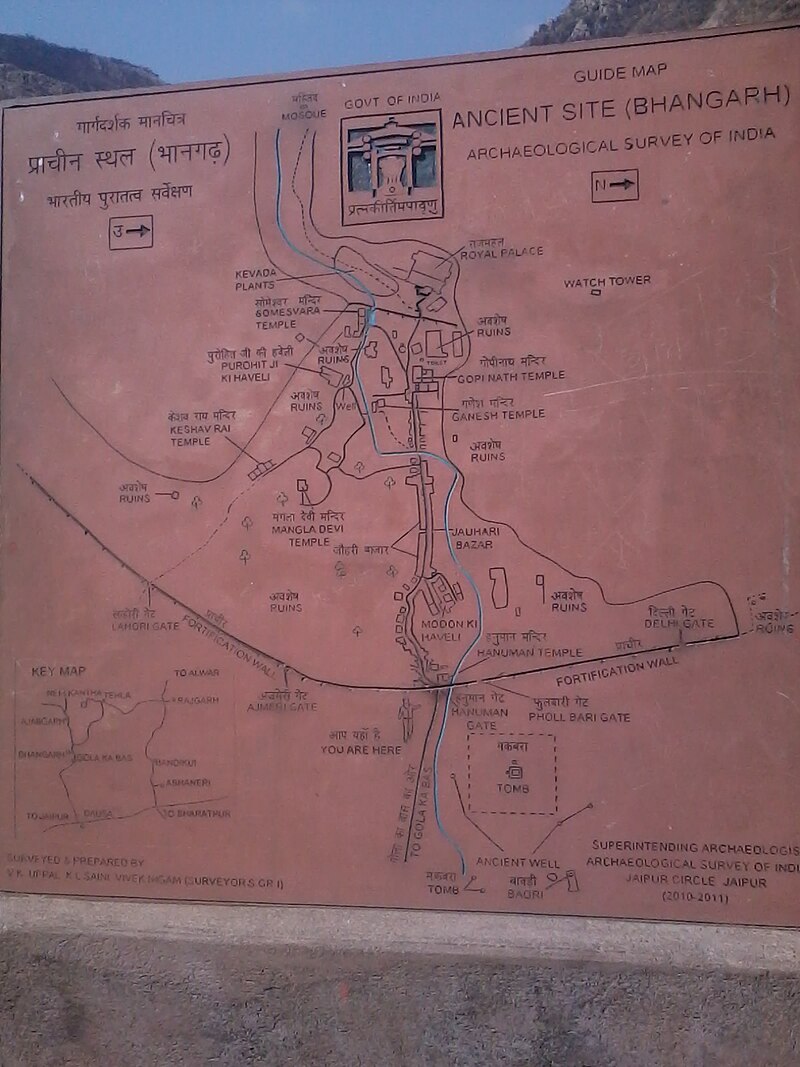
Welcome to the outer entrance of the forbidden fort city of Bhangarh. The historical monument before you is situated in the Rajgarh municipality of Alwar district within the northwestern state of Rajasthan, India. This ancient fortified complex lies directly on the boundary of the famous Sariska Tiger Reserve and is surrounded by the dramatic, rugged peaks of the ancient Aravalli Mountain Range. Geographically, Bhangarh is located approximately sixty-five kilometers away from the historic city of Jaipur, which translates to a scenic journey of about one and a half hours by road. It is also positioned fifty-five kilometers from Alwar Junction railway station and eighty-five kilometers from the bustling city center of Jaipur. Set at an elevation of three hundred and eighty-two meters above sea level, the settlement presents a striking landscape where ancient stone architecture seamlessly meets the raw, mountainous backdrop. The history of Bhangarh traces back to the sixteenth century. The town was founded in the year fifteen seventy-three, which corresponds to the year sixteen thirty-one in the regional Vikram Samvat calendar. It was established during the reign of King Bhagwant Das, the prominent Kachwaha Rajput ruler of Amber. King Bhagwant Das developed this fortified city as the royal residence for his second son, Madho Singh the First. Madho Singh the First was the younger brother of Raja Man Singh the First, who was one of the most distinguished military commanders and trusted counselors of the Mughal Emperor Akbar. Madho Singh the First actively participated in numerous strategic military campaigns alongside his father and brother, earning great distinction as a formidable Rajput general. Right near the entrance threshold, visitors are confronted with an official yellow warning signboard erected by the Archaeological Survey of India, the central governing body overseeing national heritage. Written in clear Hindi script, this signboard outlines strict legal instructions regarding public access to the monument. The notice explicitly specifies that entering the boundary of Bhangarh before sunrise and after sunset is strictly prohibited by federal law. Any individual who fails to comply with these statutory regulations will face immediate prosecution and legal action. Furthermore, local regulations strictly forbid villagers from grazing their livestock within the fort territory after dark. These precautions reflect deep-rooted local folk beliefs that supernatural spirits inhabit the ruins during the night, combined with practical safety protocols against nocturnal hazards. Official visiting hours are maintained strictly between six oclock in the morning and six oclock in the evening. Today your walking tour will lead you through the Bhoot Bangla entryway, past the ruined market street of Johari Bazar, toward the ornate Gopinath Temple and the sacred hermitage of Guru Balu Nath, ultimately ascending to the three-story royal palace complex. Please listen attentively to the narration as you begin this memorable historic journey.
02 Bhoot Bangla and the Outer Fortifications
You are now standing directly before Bhoot Bangla, which marks the outer threshold and primary entrance gateway to the ancient fortified city of Bhangarh. Commonly referred to by locals and visitors alike as the Haunted House or Spirit Bungalow, this prominent structure features an imposing arched stone doorway that historically served as the main security checkpoint into the town. …
03 Ruins of the Market and Merchant Havelis
As you step past the outer entrance gate and advance into the inner domain of the city, you find yourself walking along the primary commercial thoroughfare of Bhangarh, known historically as Johari Bazar. On both sides of this historic stone street stand extensive rows of roofless two-story stone shopfronts. …
04 Gopinath Temple and the Sacred Enclosure
You have now arrived at the sacred religious enclosure anchored by the magnificent Gopinath Temple. Among all the surviving architectural structures within the Bhangarh Fort complex, the Gopinath Temple stands out prominently for its extraordinary state of structural preservation and remarkable artistic grandeur. …
05 Hermitage of Guru Balu Nath and the Tantrik Curse
You are now standing in close proximity to the hermitage of Guru Balu Nath, a location deeply intertwined with the supernatural notoriety and haunting legends that shroud Bhangarh. The fame of Bhangarh as one of the most mysterious and haunting sites in India is firmly anchored in two famous folk legends passed down through centuries of oral storytelling. …
06 The Royal Palace Complex and Water Conservation
You are now standing before the Royal Palace complex and its sophisticated water conservation structures situated at the innermost section of the valley. Protected by two inner fortification walls constructed across the upper terrain, this palace functioned as the primary royal residence and the final defensive redoubt of Bhangarh. The royal palace was originally designed as a grand three-story structure built from locally sourced sandstone, limestone, and basalt masonry. …
07 Upper Palace Lookout and the View of Aravalli Range
You have reached the upper palace lookout, the highest elevated vantage point within the entire Bhangarh Fort complex. From this breathtaking platform, you can enjoy a panoramic view encompassing the ruined town layout below and the rugged, raw beauty of the surrounding Aravalli Mountain Range. Looking out across the collapsed upper walls and open stone courtyards highlights the stark contrast between the former urban prosperity of this city and its present state of solitude. …
08 Closing
We have reached the conclusion of our audio guide tour of Bhangarh Fort. As you prepare to exit through the main gates, please take a moment to reflect on the true historical significance of this extraordinary destination. Bhangarh is far more than a simple paranormal curiosity or a sensational haunted attraction. …