Contents
History & cultureBY TELLBY7 sections · numbered as on the map01 Orientation
Welcome to the sacred grounds of Visoki Decani Monastery. As you stand before the grand stone entryway, take a deep breath and allow the serene atmosphere of this ancient sanctuary to envelop you completely. Nestled quietly in a picturesque valley along the peaceful banks of the Bistrica river, this holy site is cradled by lush chestnut groves and the majestic foothills of the Prokletije mountains. The gentle rustle of leaves in the mountain breeze and the soft sound of flowing water create a deeply reflective mood that has welcomed travelers and pilgrims for hundreds of years. The natural greenery surrounding the entrance wall offers a sense of refuge, while the wooded mountain peaks frame this holy place in timeless beauty.
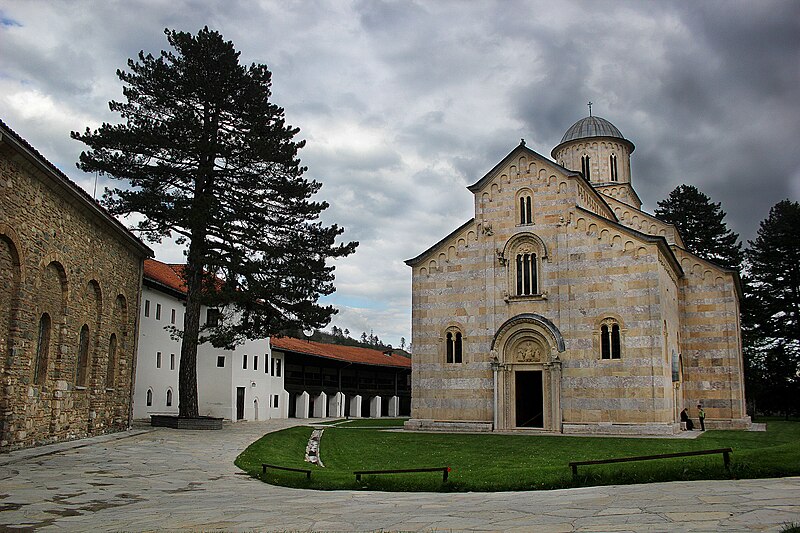
Visoki Decani is celebrated worldwide as a UNESCO World Heritage site because it represents an exceptional medieval encounter between two distinct artistic worlds. Here, the structural traditions of Western Romanesque architecture meet the brilliant visual patterns and spiritual iconography of the Eastern Byzantine world. This harmonious blending created a masterpiece of medieval art and architecture that remains unsurpassed in its beauty, scale, and state of preservation across the entire Balkan peninsula. Standing at this crossroads, one can appreciate how two grand heritage streams flowed together to forge an enduring monument of universal human value.
The vision for this magnificent monastery was conceived in the fourteenth century by King Stefan Uros the Third Decanski. Captivated by the natural beauty and spiritual tranquility of this secluded river valley, the king chose this specific location to construct a grand monastery dedicated to the Ascension of the Lord and Christ Pantocrator, serving as a house of communal prayer and his own eternal resting place. Although the king did not live to see every decorative detail finished, his profound devotion laid the foundation for what would become the largest medieval church building in the region.
As you prepare to step beyond the main entrance gate, imagine the centuries of history that have unfolded upon these very cobblestones. Monks have walked these paths continuously through generations, maintaining an uninterrupted life of prayer, chanting, and hospitality despite periods of historical upheaval. Take a moment to admire the mountain backdrop and surrounding groves before we begin our journey into the heart of the monastery. When you are ready, please walk forward slowly toward the main entrance of the extraordinary central church building.
02 The Two-Tone Marble Portal
It may surprise you to learn that this immense Orthodox monument, rising so majestically in the heart of the Balkans, was actually designed and constructed over a period of eight years by a Franciscan friar named Fra Vita, who journeyed here from the coastal Adriatic city of Kotor. While Orthodox monasteries of this era were typically built by regional guild stonemasons following strict local conventions, King Stefan Uros the Third made the bold decision to choose a Western Catholic master…
03 The Narthex and Royal Dynasty Tree
Stepping inside the narthex, you are immediately surrounded by one of the most astonishing artistic achievements of the entire medieval world: thousands of individual painted figures stretching continuously across every inch of the vaulted ceilings and stone walls. What is truly miraculous is that these frescoes were painted over a period of fifteen years during the fourteenth century and have preserved their original vibrant colors for nearly seven hundred years without major modern…
04 The Naos and High Cupola
Stepping through the inner doorway into the central nave, or naos, reveals an astounding historical reality: you are standing inside an entirely preserved medieval interior that remains exactly as a visitor in the mid-1300s would have experienced it. Unlike so many European cathedrals that suffered structural alterations, destruction during wars, iconoclasm, or heavy-handed modern restoration over the centuries, the central space of Visoki Decani has remained completely untouched. …
05 The Holy Altar and Royal Sarcophagus
As you approach the front sanctuary, you are coming face to face with the defining spiritual reason for this monastery's existence: the royal founder himself rests inside a wooden coffin right here at the head of the holy altar, making this entire architectural masterpiece a grand royal mausoleum. While many medieval European monarchs constructed grand tombs that were later destroyed, plundered, or emptied during centuries of historical conflict, the physical remains of King Stefan Uros the…
06 The Courtyard, Treasury, and Scriptorium
Stepping out onto the stone cobblestones of the courtyard, it is incredible to consider that despite surviving numerous fires, sieges, and regional wars across the centuries, this monastery managed to preserve one of the richest collections of handwritten medieval Cyrillic manuscripts in the entire world, second only to Mount Athos. …
07 Closing
As we bring our audio tour to a close near the perimeter wall overlooking the monastery gardens, take a quiet moment to absorb the profound atmosphere of this timeless sanctuary. Nestled gently between ancient pine trees and chestnut groves, Visoki Decani Monastery stands as a beacon of peace, spiritual resilience, and artistic brilliance. …