 Photo Wikimedia Commons
Contents
History & cultureBY TELLBY7 sections · numbered as on the map01 Orientation
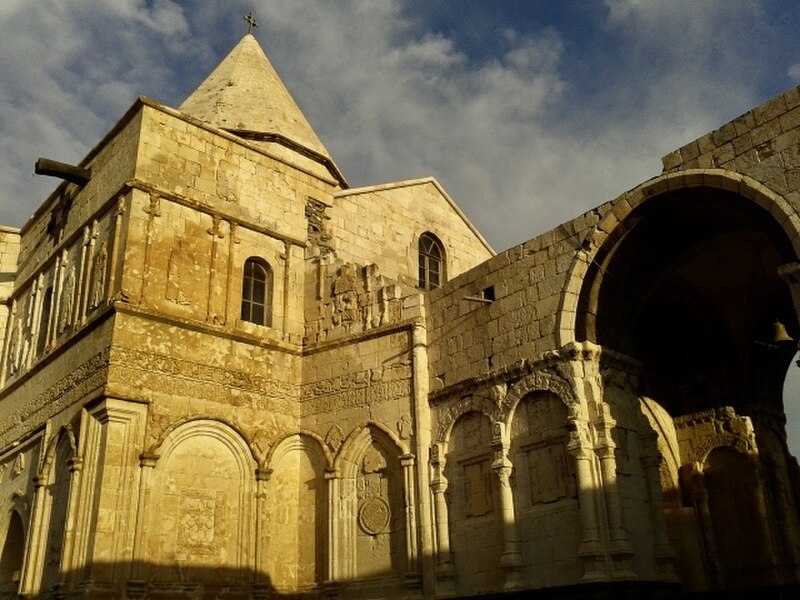
Welcome to the remote mountainous landscape of West Azerbaijan Province in northwestern Iran. Before you stands the Monastery of Saint Thaddeus, one of the oldest and most venerated sacred sites of the Armenian Apostolic Church. Located approximately twenty kilometers from the historic town of Chaldiran, this ancient sanctuary has endured for centuries amidst high plateau peaks and shifting imperial borders. As you approach, pause for a moment to gaze toward the vast mountain backdrop and observe the striking silhouette of the monastery soaring against the sky. The distinctive conical stone roofs rising above the fortified perimeter are classic hallmarks of traditional Armenian ecclesiastical architecture, engineered to be visible from vast distances across the high plateau. Locally, this complex is widely known as Qareh Kelisa or Kare Kilisa, which translates directly to the Black Church or Stone Made Church. In recognition of its extraordinary historical continuity and its living testimony to centuries of Armenian religious and architectural traditions amidst shifting regional powers, UNESCO designated this sacred ensemble as a World Heritage site. Throughout its long history, the monastery served not only as a place of spiritual retreat but also as a resilient cultural anchor for communities living across the Armenian Highlands. Our guided walking tour today will take you step by step through the key spatial and historic highlights of this stone sanctuary. We will begin at the fortified outer defensive walls and heavy main entrance gate, which give the monastery the commanding appearance of a medieval military stronghold. From there, we will admire the luminous nineteenth-century western extension with its ornate carved stone figures and high reliefs. We will then step into the cool interior to inspect the dramatic junction where dark fourteenth-century stone meets lighter masonry under the central crossing dome. Afterward, we will visit the solemn altar apse, traditionally venerated as the resting place of Apostle Thaddeus, before exploring the surrounding valley grounds that host thousands of pilgrims every summer for an annual gathering inscribed on UNESCO Intangible Cultural Heritage list. Finally, we will ascend to a hillside overlook for a farewell reflection upon this historic landscape. Please take your time as you begin walking toward the main entrance.
02 The Fortified Walls and Main Entrance
Opening your tour at this massive threshold, one striking reality immediately confronts the observer: this sacred place of worship resembles a medieval military fortress designed to withstand mountain sieges and severe natural disasters. Throughout the Middle Ages and early modern period, this high mountain frontier was repeatedly swept by regional conflicts, imperial rivalries, and foreign invasions, compelling the monastic community to enclose its sanctuary within formidable defenses. …
03 The Western Extension and Ornate Reliefs
As you step into the main inner courtyard, pause to look at the striking light-colored stone structure extending westward: this bright western hall is an intentional architectural duplicate of Etchmiadzin Cathedral, the mother church of the Armenian Apostolic Church located hundreds of kilometers away. …
04 The Central Dome and Stone Junction
Stepping under the central crossing of the sanctuary, you stand at a location defined by a catastrophic moment in history: in thirteen nineteen, a devastating earthquake flattened the medieval church, killing seventy-five monks who were gathered inside the sanctuary. This tragic natural disaster altered the structural destiny of the complex, reducing its ancient halls to rubble and forcing an ambitious rebuilding effort by the surviving community. …
05 The Sanctuary Altar Apse & Shrine of Saint Thaddeus
Arriving at the easternmost extremity of the sanctuary, you are standing before the spiritual heart of the entire monastery complex: beneath this ancient stone altar rests the traditional burial place of Apostle Thaddeus, who brought Christianity to this region in the first century. Known also as Saint Jude, Thaddeus evangelized across Armenia and ancient Persia, establishing the foundational apostolic roots of the Armenian Apostolic Church. …
06 The Annual Pilgrimage Grounds
Stepping out into the crisp mountain air beyond the fortress walls, you encounter a landscape shaped by an extraordinary living tradition: every July, thousands of pilgrims travel over seven hundred kilometers across international borders to transform these empty grassy slopes into a bustling temporary tent city. For three days each summer, this quiet mountain valley bursts into vibrant life as families gather to commemorate the historic legacy of Saint Thaddeus and Princess Sandokht. …
07 Closing
Reaching this high hillside viewpoint above the complex, pause to take in the breathtaking panoramic view of Saint Thaddeus Monastery set against the vast, rugged expanses of the Armenian Highlands. From this elevated vantage point, the striking visual contrast between the dark fourteenth-century crossing dome and the bright nineteenth-century white stone extension creates a unified architectural masterpiece rising dramatically from the mountain floor. …