 Photo Wikimedia Commons
Contents
History & cultureBY TELLBY7 sections · numbered as on the map01 Orientation
Welcome to Laughing Bird Caye National Park, a true jewel of Belize and a crowning achievement of tropical marine conservation. I am your chief docent, and it is my absolute privilege to guide you through the ecological, historical, and geological wonders of this pristine coral island. As you stand here today, you are situated on a charming, coconut-studded island covering just one point eight acres, located approximately twelve miles, or nineteen kilometers, off the coast of Placencia Village in the Stann Creek District of Belize. Positioned on the western side of the Victoria Channel, this isolated sanctuary represents the southernmost island in the central lagoon of the magnificent Belize Barrier Reef.
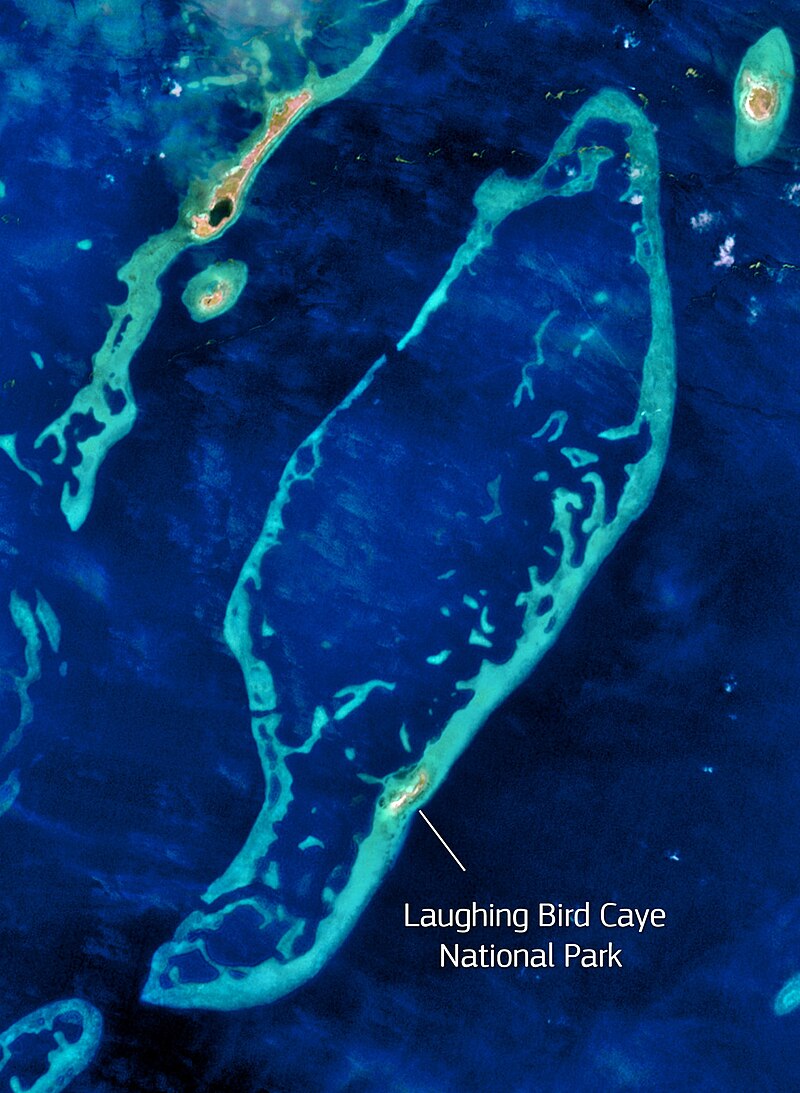
In nineteen ninety-six, this remarkable national park was inscribed as one of the seven primary protected areas within the Belize Barrier Reef Reserve System UNESCO World Heritage Site. Rather than dwelling on complex designation criteria or formal legal jargon, consider this place as a miraculous haven of biodiversity resting upon a rare geological structure. While traditional oceanic atolls form around sinking volcanic peaks in the deep ocean, Laughing Bird Caye rests upon an unusually long and narrow ridge of reef known as a faro, or a shelf atoll. This angular atoll developed directly on the continental shelf, where coral growth built upon submarine platforms over thousands of years. Steep drop-offs encircle a shallow central lagoon, creating a sheltered underwater world isolated from the mainland and outer reefs by deep channels.
The island derives its memorable name from the laughing gull, known scientifically as Larus atricilla, which historically bred here in vast, noisy colonies. The bird earned its name from its distinctive vocalization, which sounds remarkably like human laughter. In earlier decades, as human visitation, fishing camps, and unmanaged tourism increased, the growing human presence disturbed the nesting birds, forcing the laughing gull colonies to abandon the caye and relocate to more deserted offshore islands. Recognizing the urgent need to preserve this delicate ecosystem, the government of Belize declared the caye a protected area under the National Parks System Act in nineteen eighty-one, followed by its official designation as a National Park on December twenty-first, nineteen ninety-one.
Through rigorous co-management led by the Belize Forest Department and the Southern Environmental Association, alongside permanent park ranger presence, human impacts have been carefully controlled. Today, the island stands as a testament to environmental resilience, where native wildlife thrives and breeding seabirds have begun their gradual return. As we begin our journey together across these soft white sands and crystal waters, prepare to discover how community dedication, ecological restoration, and natural wonder unite to create one of the most celebrated marine sanctuaries in the entire Caribbean Sea.
02 Arrival Beach and Coastal Vegetation
It is an astonishing ecological truth that this fragile, isolated island resting in the open ocean is held together and anchored against constant wave action by a mere seven recorded coastal plant species. In an environment dominated by intense saltwater spray, nutrient-deficient sand, and powerful storm surges, the ability of such a limited plant community to stabilize the land substrate and sustain a terrestrial ecosystem is nothing short of miraculous. …
03 The Shallow Central Lagoon of the Faro
It is a brilliant geological revelation that this tranquil expanse of water before us is not formed by a volcanic atoll, but is instead an elevated marine sanctuary constructed over centuries as continental shelf corals built their own limestone walls. Known to geologists as a faro, or shelf atoll, this rare structure features steep outer slopes that drop into deep surrounding channels, while completely enclosing a protected central lagoon on the shallow continental shelf platform. …
04 Restored Coral Gardens of Fragments of Hope
It is an astonishing marine conservation milestone that over ninety-two thousand nursery-grown coral fragments have been individually outplanted by hand to fully restore this degraded underwater garden into a flourishing reef ecosystem. Where storm damage and ocean warming once left vast stretches of broken coral rubble, dedicated restoration workers have achieved one of the most successful Caribbean reef rehabilitation projects in history. …
05 Inner Island Bird Sanctuary and Vegetation
It is a deeply moving ecological victory that the iconic laughing gulls, which once completely abandoned this island due to unmanaged human intrusion, have begun nesting here once again thanks to persistent conservation enforcement. The return of these namesake birds offers definitive proof that when human pressure is properly regulated, degraded wildlife habitats can successfully regain their natural balance. …
06 Park Ranger Station and Marine Protection
It is an inspiring conservation reality that on this remote island with no municipal electricity or running water, park rangers maintain a permanent, twenty-four-hour presence using self-sufficient solar power generation, rainwater harvesting, and composting systems to safeguard this marine paradise. Operating far from mainland comforts, these dedicated guardians provide continuous protection for the delicate marine and terrestrial ecosystems of the national park. …
07 Closing
As we stand here at the edge of the island, looking out across the vast, shimmering turquoise horizon toward the distant mainland of Placencia, our journey through Laughing Bird Caye National Park comes to a memorable close. The journey we have shared today across these soft white beaches, calm faro lagoon waters, restored coral gardens, and peaceful avian nesting grounds has revealed far more than scenic tropical beauty. …