Contents
History & cultureBY TELLBY7 sections · numbered as on the map01 Orientation
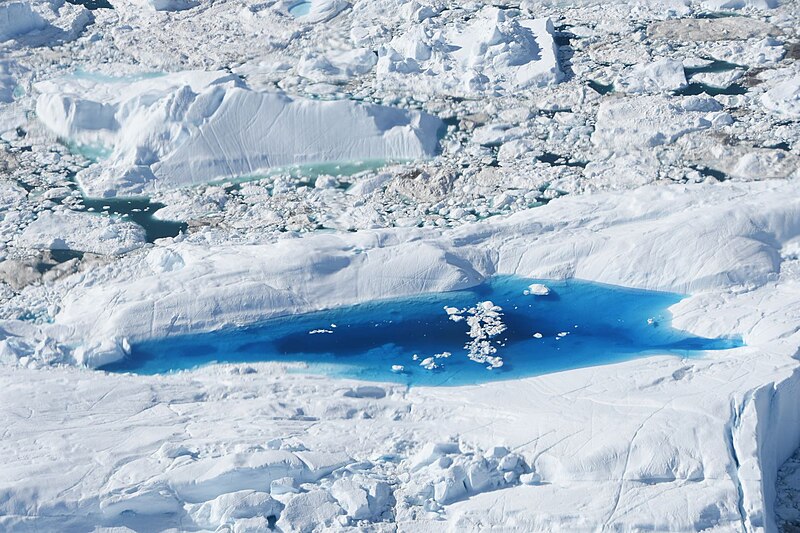
Welcome to the Ilulissat Icefjord, an outstanding UNESCO World Heritage site situated two hundred and fifty kilometers north of the Arctic Circle on the rugged western coast of Greenland. Known in the indigenous Greenlandic language as Kangiata Sullua or simply Kangia, this extraordinary marine fjord represents one of the rare places on Earth where the vast Greenland ice sheet directly meets the ocean through a hyperactive glacial ice stream. Unlike the ancient landscapes formed over millions of years elsewhere, this polar wilderness is a prime remnant of the Quaternary Ice Age from the Cenozoic Era. Stored deep within its layers of solid ice is an uninterrupted physical paleoclimate record stretching back two hundred and fifty thousand years, offering critical baseline insights into past atmospheric conditions, greenhouse gas variations, and global climate stability. Covering an area of nearly four hundred thousand hectares, the immense Greenland ice cap exerts such colossal gravitational mass that it depresses the central bedrock of the island into a broad basin while simultaneously driving ongoing isostatic rebound processes as regional ice thickness fluctuates. At the inland head of this drowned glacial valley lies Sermeq Kujalleq, also historically known as the Jakobshavn Glacier. Moving forward at an astonishing velocity of up to forty meters per day, Sermeq Kujalleq is one of the fastest and most productive glaciers in the world outside Antarctica. This singular ice stream functions as a primary drainage outlet for the inland ice sheet, discharging over thirty-five cubic kilometers of calf ice annually—accounting for approximately ten percent of all iceberg production originating from Greenland. As immense sections of the glacier front fracture and collapse into the sea, the resulting acoustic thunder and seismic vibrations reverberate across the fjord, providing visitors with an unforgettable sensory encounter with raw natural power. The wild visual synthesis of dark coastal bedrock, ancient blue glacial ice, and open ocean presents a dynamic landscape where dynamic glaciological forces continuously reshape the environment. Beyond its physical grandeur, the Icefjord embodies a deep historical synthesis between human culture and marine ecology. Subglacial erosion and nutrient upwelling churned up by the fast-moving ice stream fertilize the water column, supporting abundant populations of Greenland halibut and ringed seals. This biological richness made the shores of Kangia a vital haven for indigenous hunter cultures—including the Saqqaq, Early Dorset, and Thule peoples—for over four thousand five hundred years. Today, as a living climate archive and world heritage site, the fjord continues to serve as an irreplaceable natural laboratory for global scientists. As you begin your journey along the wooden boardwalk, pause to listen to the distant echo of shifting ice masses and absorb the timeless scale of this wild Arctic realm.
02 Sermermiut Valley: Traces of Four Thousand Years
Human beings have continuously survived and adapted within this formidable freezing Arctic environment for over four thousand years. Look down towards the grassy valley stretching out on your left, where the quiet terrain guides your eyes down to the icy shoreline of the fjord. Located just two point three kilometers southeast of the modern town of Ilulissat, this historic depression is Sermermiut—one of the most significant archaeological locations in Greenland. …
03 Isfjordsbanken: The Underwater Iceberg Trap
Immense icebergs measuring up to a kilometer in total vertical height regularly become trapped underwater on an invisible subsea ridge for months or even years. Look straight ahead at the massive, wall-like concentration of packed ice resting quietly in the water at the mouth of the fjord. What you are witnessing is an extraordinary geological phenomenon caused by a submerged threshold known as Isfjordsbanken—a monumental glacial moraine bar deposited over thousands of years by the advancing…
04 Sermeq Kujalleq: The Engine of Moving Ice
This astonishing glacier moves forward at an exceptional speed of up to forty meters per day, making it one of the fastest and most productive ice streams in the world outside Antarctica. Turn your gaze to the far eastern end of the fjord, where the vast inland ice sheet cascades down through a narrow bedrock trough directly into the sea. …
05 Sculptures of Ice: The Sounds and Shadows of Melting
The ancient compressed ice within these floating icebergs traps microscopic air bubbles from two hundred and fifty thousand years ago, which crackle and pop as they escape into the Arctic air. Look closely at the jagged, spire-like pinnacle of the iceberg floating near the rocky shore. These sculptured ice forms are not static monuments; they are dynamic, thermodynamic structures undergoing continuous transformation driven by solar radiation, ambient air temperatures, and ocean currents. …
06 Disko Bay: The Gateway to the Open Ocean
Icebergs calved right here at Ilulissat travel thousands of kilometers south to the latitude of New York City, between forty and forty-five degrees north, before finally melting away into the open ocean. Look out toward the open horizon where the narrow, rock-walled fjord broadens dramatically into the expansive waters of Disko Bay. …
07 Closing
The Ilulissat Icefjord stands as a world-renowned living laboratory that has shaped the scientific understanding of glaciology and climate science for over two hundred and fifty years. Since the first formal scientific descriptions were recorded in the eighteenth century, generations of polar researchers, geologists, and meteorologists have journeyed to these remote shores to study the mechanics of ice stream flow, subglacial erosion, and glacier calving. …