 Photo Wikimedia Commons
Contents
History & cultureBY TELLBY8 sections · numbered as on the map01 Orientation
You are standing at the entrance to the Badami Cave Temples, a site where the raw majesty of the Deccan Plateau meets the highest achievements of ancient Indian craftsmanship. Before you rise the towering red sandstone cliffs, mirroring their deep hues in the serene waters of Agastya Lake below. Known in antiquity as Vatapi, this historic landscape served as the capital of the Early Chalukya dynasty from the sixth to the eighth centuries. Here, Chalukya monarchs transformed natural cliff faces into monumental sanctuaries, carving their religious devotion and political authority directly into the living rock. Nestled in a dramatic ravine within the Malaprabha River valley, the soft sandstone formations provided both a natural defensive fortification and a sacred canvas for royal ambition.
According to the extensive scholarship of architectural historian George Michell, the Malaprabha River valley, anchored by Badami, represents the true birthplace of South Indian temple design. Michell demonstrates how the artistic and structural experiments conducted within these rock-cut cave sanctuaries catalyzed a vital evolutionary shift, transitioning from monolithic excavations to sophisticated, free-standing masonry structures. This structural and stylistic progression profoundly influenced the trajectory of temple architecture across the Indian subcontinent and the Deccan region, shaping renowned regional rock-cut sites such as Ellora and Ajanta.
As you follow the stepped pathway ascending along the cliff face, you will encounter four principal cave sanctuaries arranged in an ascending sequence according to their vertical elevation. The lowest level houses Cave 1, a magnificent sanctuary dedicated to Shiva. Climbing further up the stone stairs brings you to Cave 2 and Cave 3, both devoted to the glory of Vishnu. Among these, Cave 3 stands as the largest, most elaborately sculpted, and most precisely dated monument in the entire complex. At the highest point of the path sits Cave 4, a serene hall honoring the revered Tirthankaras of the Jain tradition.
This walking route along the cliff terrace offers a continuous dialogue between architecture, topography, and sacred geography. Looking across the waters of Agastya Lake, you can see the historic stone-stepped ghats and the Bhutanatha group of temples standing gracefully on the opposite shore. Together, these elements form a unified urban and religious landscape where water, stone, and royal statecraft converged. Let us now begin our journey into this ancient stone world by moving toward the entrance of the first cave.
02 Cave 1 Dancing Shiva Nataraja and Shaivite Sculptures
As you ascend to the entrance of Cave 1, positioned roughly fifty-nine feet above the valley floor, your eyes are immediately drawn to the base of the rock facade. Here, rows of dwarfish spirits known as ganas are sculpted in various lively postures, appearing to physically support the immense weight of the cave structure on their shoulders. …
03 Cave 2 Vishnu Trivikrama and Varaha Reliefs
Climbing sixty-four stone steps upward from Cave 1 brings you to the entrance of Cave 2, which faces north toward the open valley. Constructed during the late sixth or early seventh century, this cave shares a structural layout similar to its predecessor but is dedicated primarily to the cosmic narrative of Vishnu. …
04 Cave 3 The Grand Vaishnavite Cave and Mangalesha Inscription
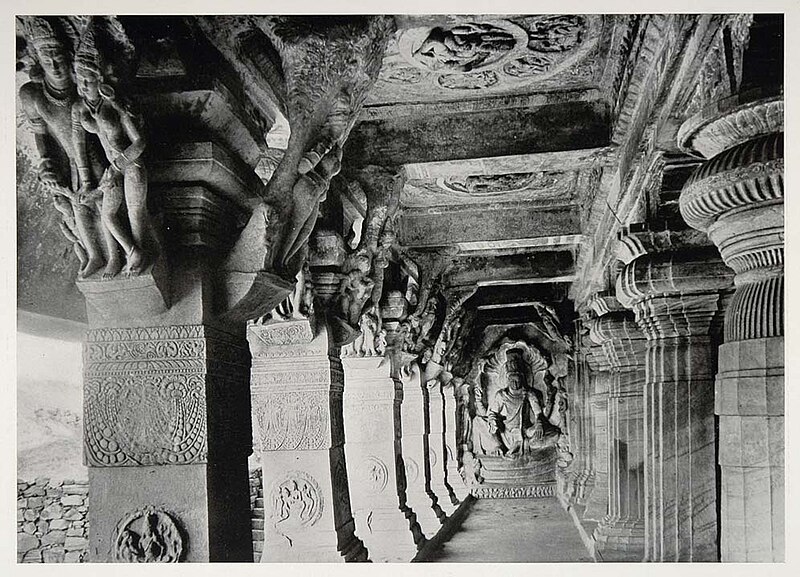
A short walk of sixty steps upward from Cave 2 brings you to Cave 3, the largest, most magnificent, and historically significant monument within the Badami cave complex. Carved deep into the red cliff face, this Vaishnavite sanctuary contains a crucial inscription written in Old Kannada on one of its porch pillars. The text records that King Mangalesha dedicated this shrine on the full moon day of Saka 500, corresponding to November 1, 578 CE. …
05 Cave 4 Jain Tirthankaras and the Asceticism of Bahubali
Located immediately east of Cave 3, with its floor level set about ten feet lower, sits Cave 4, the smallest of the four numbered cave temples. Constructed during the late seventh to eighth centuries under the patronage of Hindu monarchs, this cave is dedicated entirely to the revered Tirthankaras of Jainism. Additional embellishments were carved into its stone walls through the eleventh and twelfth centuries. …
06 Bhutanatha Group of Temples and Agastya Lake Shore
Descending the stone pathway from the four main cave temples brings you directly to the tranquil shores of Agastya Lake. Standing on the ancient stone-stepped ghats, you can look across the water to encounter one of the most picturesque architectural ensembles in South India, the Bhutanatha Group of Temples. …
07 Badami Fort Ascent and Upper Shivalaya Viewpoint
Crossing to the northern side of Agastya Lake leads you to the base of Badami Fort, where a steep stone staircase cuts through a narrow ravine in the sandstone cliffs. As you begin the ascent up this rugged pathway, you are treading upon the historic defense line of the Early Chalukya capital. The soaring red rock walls framing the path offer an immediate sense of the natural fortress that protected Vatapi for centuries, demonstrating how Chalukya strategists cleverly utilized the formidable…
08 Closing
Our journey through the Badami Cave Temples, surrounded by red sandstone cliffs and the peaceful waters of Agastya Lake, now comes to its natural conclusion. The extraordinary rock-cut sanctuaries we have explored today stand as enduring testaments to the vision of the Early Chalukya dynasty and the unmatched skill of sixth-century sculptors. …