 Photo Wikimedia Commons
Contents
History & cultureBY TELLBY7 sections · numbered as on the map01 Orientation
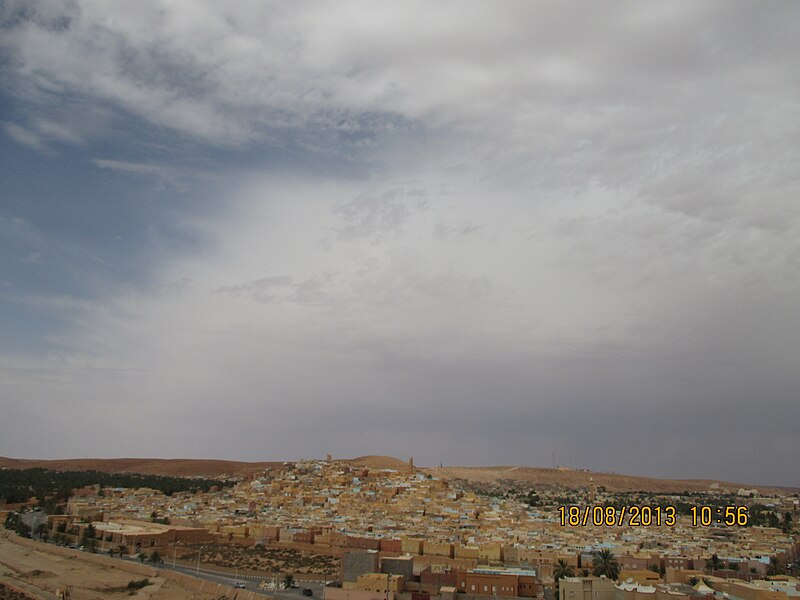
Designated as a UNESCO World Heritage Site in nineteen eighty two, the M'zab Valley represents an extraordinary and remarkably intact example of a traditional human habitat perfectly adapted to the unforgiving Saharan environment. Located six hundred kilometers south of Algiers in the heart of the arid desert, this secluded valley has preserved its unique social cohesion, religious organization, and defensive architectural heritage throughout many centuries. Ksar Beni Isguen, founded in thirteen fifty, is one of the five historic fortified towns, or ksour, that form this remarkable oasis ensemble alongside El Atteuf, Bounoura, Melika, and Ghardaia. Positioned strategically on the slope of a rocky peak halfway between the historic ksour of Melika and Bounoura, Beni Isguen sits at the confluence of Wadi M'zab and Wadi N'tissa, with the latter forming its natural geographical boundary. Since its original foundation in the middle of the fourteenth century, Beni Isguen has preserved its complete urban layout and organizational model, enclosed by continuous fortified outer walls that are lined along the inner perimeter by a specialized patrol alley and defensive watchtowers. The Ibadi community inhabiting this holy city developed a settlement structure centered around a central fortress mosque, whose towering minaret historically served as an elevated watchtower, alarm signal post, and final sanctuary during periods of regional conflict. Surrounding this central religious and defensive core, residential dwellings, storehouses, and winding narrow streets expand in clustered concentric circles, emphasizing family privacy, social cohesion, and egalitarian communal values. Despite its austere and reserved facade presented to the outside world, Ksar Beni Isguen maintains a vibrant living tradition of hospitality for visitors who honor its religious and cultural rules. As we begin our walking audio tour through this walled Saharan sanctuary, we will explore its intact outer fortifications, vibrant market square, ingenious managed aquifer recharge networks, private manuscript libraries, and breathtaking panoramic vantage points, discovering how human resilience, spiritual devotion, and communal wisdom transformed a barren desert landscape into a flourishing oasis home.
02 Bab Gherbi Gate and the Outer Fortified Walls
Remarkably, this entire desert fortress city has maintained its complete fourteenth-century defensive perimeter wall and internal perimeter alleyway intact for over six hundred years without losing its structural integrity or traditional urban layout. Direct your gaze upward toward the thick clay plaster finished arched gate and the narrow alleyway stretching directly behind the wall. …
03 The Triangular Market Square and Daily Auction
In this extraordinary Saharan market, unlike almost anywhere else in North Africa, modern haggling is strictly forbidden and considered deeply impolite, with all commercial transactions governed by strict Ibadi principles that ensure the poorest community members are never outbid or priced out. Direct your eyes downward to the irregular stone paving beneath your feet and look across the wide triangular plaza surrounding you. …
04 The Water Steward Network and Recharge Well Abar Balouàa
Remarkably, the rare floodwaters rushing through this dry desert valley are captured directly from the surface and swallowed straight into the ground through specialized recharge wells engineered by communal water stewards over seven hundred years ago. Direct your eyes to the stone well opening elevated slightly above ground level and observe the small earthen channel, known as a seguia, running directly alongside it. …
05 Traditional Houses and Private Manuscript Libraries
Behind the unassuming earthen facades of these ordinary desert homes lie extraordinary private library rooms preserving centuries-old handwritten manuscripts on customary law, hydrography, traditional architecture, and Islamic jurisprudence. Look closely at the entrance of this modest mud-brick house, featuring small high-set windows and wooden window frames painted in vibrant shade of blue. …
06 Bordj Boulila Watchtower and Panoramic Vista
Modern architectural pioneer Le Corbusier visited the M'zab Valley in nineteen thirty one and drew direct, radical inspiration from this austere, functional urban layout for his contemporary urban planning theories and the formulation of his famous Athens Charter. Look out beyond the open ramparts of the tower, gazing down at the high minaret of the central mosque towering above a sea of warm, earth-toned rooftops clustered tightly together beneath your feet. …
07 Closing
Today we have journeyed through the historic gates, vibrant triangular market plaza, private manuscript libraries, and ingenious hydraulic recharge networks of Ksar Beni Isguen—a living desert fortress city that has preserved its unique cultural and architectural identity across many generations. Beni Isguen stands as an extraordinary testament to human resilience, demonstrating how a human community can flourish within a severe Saharan environment through social cohesion, moral discipline, and…