Contents
History & cultureBY TELLBY8 sections · numbered as on the map01 Orientation
Welcome to the breathtaking realm of Bandhavgarh Tiger Reserve, an extraordinary wilderness sanctuary nestled within the Umaria district of Madhya Pradesh, set against the majestic contours of the Vindhyachal Ranges. Celebrated around the globe as one of India's most important habitats for the Royal Bengal tiger, this reserve invites you to step directly into an untamed world where raw nature and ancient heritage intertw. Most travelers begin their journey by arriving at Jabalpur Airport followed by a scenic drive through rural landscapes, or by taking a overnight sleeper train to Umaria railway station located just forty kilometers away. As you step into the jungle, the cool forest air, rich aroma of damp earth, and gentle rustle of dry foliage instantly set the stage for an unforgettable safari expedition.
Spanning a total protected territory of 1,536 square kilometers, Bandhavgarh is divided into a strictly preserved core zone of 716 square kilometers and an encircling buffer area covering 820 square kilometers. This vast green domain is dramatically framed by 32 wooded hills and steep sandstone ridges, creating a sheltered basin where natural ecosystems have flourished undisturbed for centuries. The history of Bandhavgarh is deeply rooted in royal tradition. For generations, these dense Sal forests served as the exclusive private hunting reserves for the Maharajas of Rewa. Recognizing the vital need to safeguard this precious habitat, the territory was officially declared a national park in 1968. Subsequently, in 1993, it was brought under the protective umbrella of Project Tiger, transforming a former royal hunting ground into a world renowned conservation stronghold supported by responsible operators certified under Travel Operators For Tigers standards.
To experience the wilderness firsthand, visitors embark on carefully regulated open jeep safaris that operate twice daily during the crisp hours of early morning and late afternoon. The core tourism area is partitioned into three iconic zones. The Tala zone is the oldest and most famous, celebrated for its ancient monuments and classic jungle terrain. The Magdhi zone features open bamboo thickets and sweeping meadows ideal for tracking big cats, while the Khitauli zone offers serene forest tracks perfect for birdwatching and observing herbivores. In order to preserve the delicate forest environment, the park administration enforces strict rules. Notably, starting in February 2026, mobile phone usage has been completely prohibited inside the core boundaries. This essential measure eliminates digital distractions and artificial noise, allowing wildlife to remain undisturbed while empowering visitors to immerse their senses fully in the natural rhythms, subtle calls, and quiet majesty of Bandhavgarh.
02 Spot 1: Tala Safari Gate & The Gateway to the Core Forest
We are currently standing at the historic Tala Gate, the oldest and most legendary entrance into the heart of Bandhavgarh National Park. As your open four-wheel-drive safari jeep idles near the wooden barrier, the sensory transition from settled human habitat to pristine jungle is immediate and absolute. The moment your vehicle crosses the boundary line onto the dusty, unpaved tracks, the mechanical noises of modern civilization instantly dissolve. …
03 Spot 2: Bandhavgarh Fort Lookout Point
Welcome to the Bandhavgarh Fort Lookout Point, an elevated vantage area that reveals one of the most breathtaking historical and natural vistas in central India. Looking up toward the horizon, your eyes are immediately drawn to the imposing ruins of Bandhavgarh Fort, perched atop a massive sandstone cliff that reaches an elevation of 811 meters above sea level. …
04 Spot 3: Badi Gufa & Ancient Manmade Caves
We now direct our attention to Badi Gufa and the extraordinary cluster of ancient manmade caves carved directly into the sandstone hillsides surrounding Bandhavgarh Fort. Throughout the rugged rock faces of this reserve, archaeologists have documented 39 distinct artificial caves. Historical and epigraphic analysis indicates that the earliest of these rock-cut structures date back to the 1st century, revealing that human communities have inhabited, worshipped, and sought shelter within these…
05 Spot 4: Shesh Shaiya Monument
Hidden deep within a shaded sandstone ravine of the core forest lies Shesh Shaiya, one of the most spiritually profound and visually breathtaking monuments in Bandhavgarh National Park. Here, carved meticulously out of a single horizontal sandstone outcrop, rests an imposing ten-meter-long statue of Lord Vishnu. The deity is depicted reclining in absolute serenity upon the coiled body of Sheshnag, the legendary multi-headed serpent of Hindu mythology. …
06 Spot 5: Chakradhara Meadow & Charanganga Basin
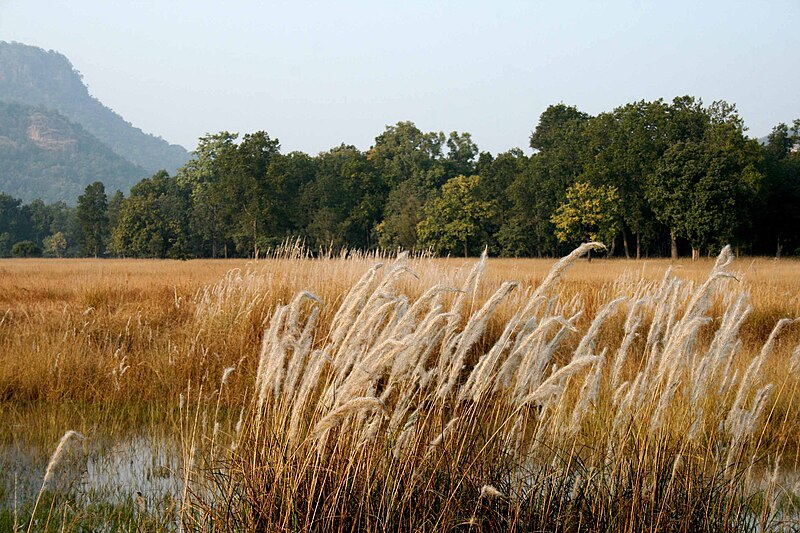
We now arrive at the Chakradhara Meadow, a broad and picturesque marshy grassland situated in the heart of the Tala Zone. Nourished by the perennial flow of the Charanganga River, which meanders gracefully through the valley floor, this expansive open plain creates a striking visual contrast with the surrounding dense Sal forest. …
07 Spot 6: Gopalpur Pond
Our sixth location brings us to Gopalpur Pond, a vital wetland waterhole tucked within the forest interior of the Tala Zone. Serving as an essential aquatic refuge, this natural pond collects rainwater and surface runoff, sustaining a rich wetland habitat surrounded by dry deciduous woodland. The calm, reflective surface of the water, bordered by reeds and aquatic plants, offers a serene environment that forms a cornerstone of the reserve's moisture ecosystem. …
08 Closing
As our audio journey through Bandhavgarh Tiger Reserve comes to an end, we reflect upon a landscape where ancient human history and wildlife conservation are inextricably bound together. Bandhavgarh stands not merely as a premier sanctuary for the Royal Bengal tiger, but as a shining international symbol of ecological restoration and successful species protection across central India.
The reserve history is marked by extraordinary conservation achievements. …