 Photo Wikimedia Commons
Contents
History & cultureBY TELLBY7 sections · numbered as on the map01 Orientation
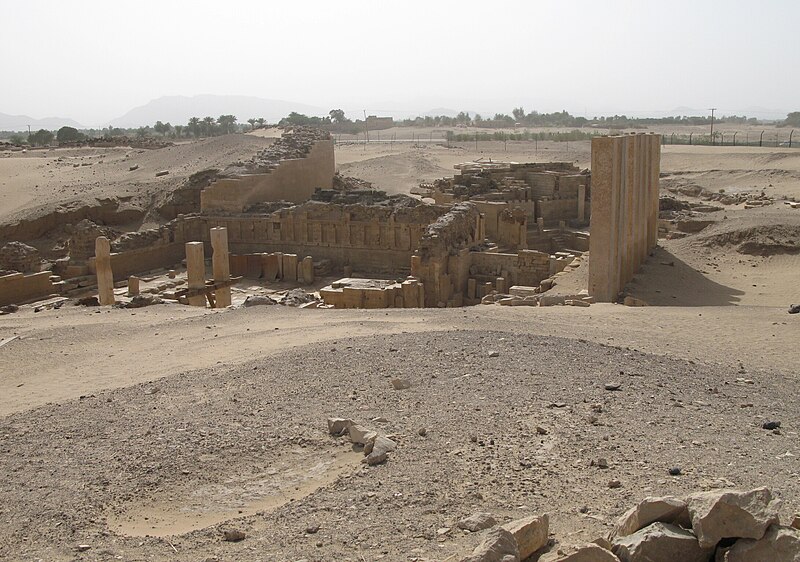
Welcome to the Sanctuary of the Queen of Sheba, also known as the Awwam Temple, one of the most magnificent religious monuments of the ancient world. Located near Marib in central Yemen, amidst a semi-arid landscape of valleys and desert sands, this grand complex stands as an extraordinary testament to the affluent Kingdom of Saba. The Sabaeans triumphed over the harsh desert environment by developing sophisticated hydrological engineering and agricultural irrigation systems, creating the largest ancient man-made oasis in South Arabia. Through their control of the lucrative incense trade route linking South Arabia with the Mediterranean and East Africa, the Sabaeans flourished as a major regional power from the first millennium BCE until the arrival of Islam around 630 CE. In recognition of these extraordinary architectural, technological, and cultural achievements, this sacred site was officially inscribed on the UNESCO World Heritage List in 2023.
For millennia, this sanctuary has been wrapped in the legendary lore of the biblical Queen of Sheba. As recorded in the First Book of Kings, a powerful monarch journeyed from a distant land with vast caravans of spices, gold, and precious stones to test the wisdom of King Solomon. Her praise of the God of Israel stands out as a memorable account of a foreign ruler recognizing monotheism, while Solomon granted her all that she requested. Local traditions in Yemen have long honored this site as Mahram Bilqis, or the Sanctuary of Bilqis, referencing the Queen of Sheba. However, extensive archaeological evidence confirms that this monumental complex was built as the primary national sanctuary dedicated to Almaqah, the supreme god of the Sabaeans, who was frequently invoked as the Lord of Awwam.
Constructed on an elevated natural platform seven kilometers southeast of the ancient capital city of Marib, the Awwam Temple was deliberately placed on the outskirts of the urban center. This strategic isolated location ensured religious privacy for sacred rites while providing sufficient space to accommodate thousands of arriving pilgrims from remote regions across the Arabian Peninsula. Containing nearly one thousand pre-Islamic South Arabian inscriptions, the Awwam Temple preserves the single most important epigraphic collection for reconstructing the political, social, and religious history of ancient Yemen. As you stand before this ancient threshold, prepare to walk in the footsteps of ancient pilgrims into the sacred realm of Saba.
02 The Eight Monolithic Pillars of the Propylaeum
The breathtaking realization that eight monumental stone pillars, each carved entirely from a single massive block of limestone, have stood erect amidst the shifting desert sands for nearly three thousand years without collapsing provides an unforgettable opening encounter with antiquity. Rising majestically above the arid desert landscape, these colossal monoliths stand as an enduring physical testament to the sophisticated stone quarrying, precision shaping, and architectural engineering…
03 The Peristyle Hall and the Alabaster Purification Conduit
The astonishing revelation that this grand peristyle hall served as a monumental ancient library and sacred purification sanctuary, filled to capacity with hundreds of inscribed stone blocks, bronze plaques, stone altars, and votive statues dedicated by pilgrims over centuries, offers a captivating entry into Sabaean devotion. …
04 The Great Oval Wall and the Inscription of Yada'il Dharih
The overwhelming revelation that this massive oval enclosure wall, measuring over four meters thick at its foundation, reaching nearly ten meters in preserved height, and stretching roughly three hundred meters in total circumference, represents the single largest temple wall in the entire Arabian Peninsula provides a truly breathtaking sight. …
05 Precinct Area A and the Oracle Courtyard
The mesmerizing realization that this sacred precinct area was not merely a venue for passive prayer, but an active, mystical site where pilgrims spent the night sleeping inside sanctuary chambers to receive direct divine oracles and prophetic dreams from the god Almaqah offers a profound glimpse into ancient Arabian spirituality. …
06 The City of the Dead: The Mahram Gnztn Cemetery
The astonishing discovery that this secluded cemetery, accessible exclusively through a restricted third gate situated inside the oval sanctuary, houses the remains of over twenty thousand individuals in multi-storey, apartment-style stone tombs reaching up to four storeys high reveals a breathtaking city of the dead. …
07 Closing
The transcontinental legacy that began millennia ago with the legendary encounter between King Solomon and the Queen of Sheba remains forever etched into the monumental stone walls and soaring pillars of the Awwam Sanctuary. Flourishing along the lucrative frankincense trade routes in the arid heart of southern Arabia, the Kingdom of Saba served as a radiant bridge between civilizations, planting early seeds of monotheism across the Red Sea and shaping the enduring cultural foundations of…