Contents
History & cultureBY TELLBY7 sections · numbered as on the map01 Orientation: The Living Mountain Heritage of Hawraman
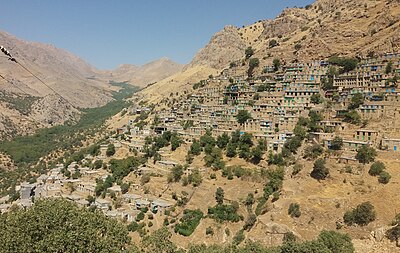
Welcome to the Cultural Landscape of Hawraman Uramanat, an extraordinary mountain sanctuary nestled in the heart of the Zagros Mountains along the western border of Iran. In twenty twenty-one, during the forty-fourth session of the UNESCO World Heritage Committee, this remarkable region was officially recognized as Iran's twenty-sixth tangible cultural heritage site. The property spans across Kurdistan Province and Kermanshah Province in Iran, extending into Halabja Governorate in Iraqi Kurdistan. This rugged landscape stands as a testament to the enduring traditions of the Hawrami people, an agropastoral Kurdish tribe that has continuously inhabited these steep valleys since approximately three thousand BCE. Over thousands of years, the Hawrami people have developed an exceptional cultural ecosystem, adapting their architecture, social structures, and agricultural practices to one of the most challenging geographical environments on Earth. Archaeological evidence reveals that human history in Hawraman reaches back far deeper than recorded antiquity. Finds from the Middle Paleolithic period, dating back more than forty thousand years, were discovered near Hajij village, between Naw and Asparez in the Sirwan valley, and at the Darai Rockshelter. Upper Paleolithic artifacts were unearthed in Kenacheh Cave within the Perdi Mala valley during the Darian Dam Archaeological Salvage Program, alongside Iron Age tombs at Ruwar, Chalcolithic settlements at Sar Cham, and nineteenth century remains at Barda Mar. The region also holds significant historical monuments from ancient empires. Near Tang-i Var village, the royal rock inscription of Sargon the Second, King of Assyria, who reigned from seven hundred twenty-one to seven hundred five BCE, confirms Assyrian military presence in the Zagros Mountains. Furthermore, in nineteen hundred nine, the famous Parchments of Avroman were discovered inside a cave on Kuh-e Salan Mountain near Shar Hawraman village. Dating from eighty-eight BCE to thirty-three CE during the Seleucid and Parthian eras, these three documents written in Greek and Parthian record ancient vineyard land sales mentioning individuals such as Pataspak, son of Tiren, and Awil, son of Baenin. As you stand here in the valley today, look around at the dramatic rock slopes where human homes merge seamlessly with nature, setting the stage for an unforgettable journey into an ancient living heritage.
02 Roofs as Courtyards: The Stepped Mountain Architecture
In the extraordinary stepped villages of Hawraman, the flat earthen roof of every lower house serves directly as the open front courtyard and primary public walkway for the house constructed immediately above it. Look up at the steep mountain slope directly in front of you, where hundreds of handcrafted stone dwellings are stacked tightly together like a giant natural staircase clinging to the precipitous cliff face. …
03 Shielded Passages: The Stone Corridors of Dalan
These covered stone corridors, known locally as Dalan or Mare, create protected vaulted passageways beneath residential rooms that shield villagers from severe winter snowstorms and scorching summer heat. Step under the stone archway and glance down the cool, narrow corridor that stretches before you into the heart of the village fabric. …
04 Earthquake-Resistant Mastery: Dimak and Marola
These massive dry-stone walls feature an ancient, highly effective seismic jointing system made of horizontal wooden beams that absorb destructive shockwaves during severe earthquakes. Examine the middle section of the stone wall on your left, where long wooden beams and small circular log ends are embedded directly between the natural limestone courses. …
05 Echoes and Nature: Door Knockers and Vibrant Windows
Traditional Hawrami entrance doors feature two distinct wooden knockers that produce completely different pitch sounds, enabling residents inside to instantly know whether an approaching visitor is male or female before opening the gate. Look closely at the carved double-leaf wooden door in front of you and observe the vibrant blue and green paint adorning the surrounding window frames. …
06 Layered Protection: Earthen Roofs and Bantlin Rollers
During heavy mountain rainstorms and winter snows, residents roll massive cylindrical stone rollers across their flat clay roofs to compact the soil layers and prevent water from seeping into living quarters below. Look up at the edge of the flat earthen roof extending overhead, where a heavy cylindrical stone roller rests on the corner ledge. …
07 Closing: The Enduring Harmony of Hawraman
As our walking tour of Hawraman comes to an end, take a quiet moment to look out across the steep valley where stone, wood, soil, and human ingenuity stand merged into a single harmonious cultural landscape. For thousands of years, the Hawrami people have maintained an unbroken organic connection with their mountainous environment. Their unique architecture is not merely a collection of historic stone dwellings, but a profound cultural philosophy translated directly into masonry and timber. …