 Photo Wikimedia Commons
Contents
History & cultureBY TELLBY7 sections · numbered as on the map01 Orientation
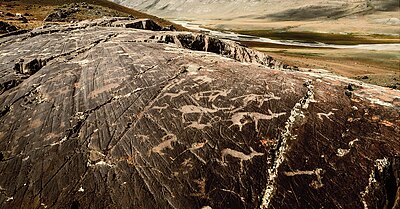
Welcome to the high plateau of the Altai Mountains. Standing at this breathtaking vantage point high above the river valley, you are stepping directly into a vast open-air museum where thousands of years of human history, environmental transformation, and spiritual belief are deeply layered upon the ancient stone landscape. Take a moment to pause and absorb the magnificent natural panorama before you. Looking due south across the vast valley, you can gaze upon the impressive, snow-crested peak of Taldagiin Ikh Uul rising majestically against the clear sky. Turning your eyes toward the east, the wide, sweeping valley of Baga Oigor Gol unfolds beneath the terrace, stretching into the distant horizon. This extraordinary physical setting forms a central portion of the World Heritage rock art complexes of the Mongolian Altai. This cultural landscape was honored with World Heritage status because it serves as an incomparable open-air gallery where successive generations of hunter-gatherers and pastoral nomads, living on this high plateau across millennia, recorded their changing environment, climate shifts, and spiritual lives directly upon the stone surfaces without relying on written text. The very canvas of this extraordinary artistic tradition was created by profound geological forces. Tens of thousands of years ago, during the Pleistocene epoch, massive continental glaciers carved through these high mountain valleys. As these heavy ice sheets entrained, ground, and polished the metamorphic rock formations, they left smoothed, rounded boulders resting along the terrace edges. When prehistoric people first entered these valleys, they recognized these glacier-polished stones as ideal surfaces for carving. Over thousands of years, as the regional climate shifted from postglacial forest-steppe to dense mid-Holocene boreal forests, and finally to the cooler, drier steppes of the late Holocene, the rock art recorded every step of human adaptation. Today, you will explore five key locations that reveal how prehistoric artistic expressions transformed from monumental realism to dynamic hunting narratives, and ultimately to stylized symbols of status, lineage, and clan identity. Please step forward thoughtfully along the path, minding your footing, and prepare to listen to the ancient voices preserved forever upon these rocks.
02 Spot 1: The Bird-Beaked Elk on Glacial Boulder (TS IV Area)
Three thousand years ago, the large stag carved into this boulder was rendered not as a simple forest deer, but as a mythical creature with a long bird's beak and antlers unfolding like soaring wings. Please direct your gaze to the center of this massive, glacier-scraped boulder resting at the very edge of the terrace. On its smoothed upper surface, you can see the detailed figure of a large bull elk carved with extraordinarily fine, dense, and shallow pecking. …
03 Spot 2: Bronze Age Archer and the Fur-Tipped Wand (BO IV Area)
Ancient Altai hunters used not only powerful bows and arrows when tracking stags, but also a mysterious fur-tipped wand designed specifically to distract the attention of wild animals. Please look carefully at the left face of this small rock panel located in the section designated BO IV. You can clearly see the small figure of an archer pulling his bowstring taut as he aims directly at a large, mature bull elk. …
04 Spot 3: Fleeing Elk and the Load-Bearing Horse (Tsagaan Gol SK_C5 Area)
This rock panel testifies to the decisive historical moment when humans began taming horses not merely for hunting or meat, but as working animals to carry heavy pack loads across the mountains. Please look at the center of this dark, vertical rock outcrop located in the Tsagaan Gol section designated SK_C5. On this steep rock face, you can observe a grand narrative scene featuring a herd of elk racing in sudden alarm toward the right. …
05 Spot 4: Two Worlds on One Cliff and the Arzhan Style (Tsagaan Gol SK_K4 Area)
Separated by only a few meters on the upper and lower faces of this single cliff, two completely different artistic styles from distinct eras present a striking visual contrast. Please cast your eyes first toward the upper panel of this cliff in the Tsagaan Gol section SK_K4, where a realistic scene shows a pack of wolves attacking a herd of elk. Now, lower your gaze to the panel carved directly beneath it on the exact same rock face. …
06 Spot 5: Camel-Riding Hunter and the Stag as Emblem (TS IV Camel Rock)
While early rock art depicted real animals of the forest, by the early Iron Age the stag had transformed into a formalized emblem representing clan identity, social rank, and status. Please look closely at the lower right section of this massive boulder in the section designated TS IV. You can clearly see the distinct figure of a hunter mounted high upon a two-humped Bactrian camel, aiming his bow at a stylized elk. …
07 Closing
Our journey through the rock art of Tsagaan Salaa now reaches its conclusion. Standing here on this elevated terrace overlooking the vast river valley, take a moment to reflect upon the immense epic of human history preserved upon these stones. From the end of the last Ice Age twelve thousand years ago, when early hunters carved monumental profiles of wild beasts onto glacier-scraped rocks, through the Bronze Age when archers tracked real stags across lush mountain forests, down to the early…