Contents
History & cultureBY TELLBY7 sections · numbered as on the map01 Orientation
Hello and a very warm welcome to the breathtaking Trnovo Bridge, nestled gracefully in Ljubljana, the capital city of Slovenia. I am your audio guide presenter, and today I am honored to accompany you on an insightful walking tour through this extraordinary UNESCO World Heritage landmark. The site where you are currently standing is a remarkably harmonious urban realm where gentle river currents, quiet suburban scenery, and master architect Joze Plecnik's visionary spatial artistry converge into an unforgettable cultural experience.
Trnovo Bridge represents one of the most significant and iconic components of the UNESCO World Heritage property inscribed in August two thousand twenty-one under the official title, The works of Joze Plecnik in Ljubljana – Human Centred Urban Design. Rather than constructing a conventional civil engineering crossing over the water, Joze Plecnik envisioned this structure as the symbolic origin point of a monumental urban axis that stretches northward from the southern residential outskirts toward Congress Square in the heart of the city. During the interwar period, Plecnik subverted the cold, utilitarian nature of concrete infrastructure by infusing it with living botanical elements and transforming the bridge into an inviting, human-scaled public plaza that deeply honors the local identity of the surrounding historic neighborhoods.
Beneath where we stand flows the serene current of the Gradascica River, bordered by stone-clad embankments and gently terraced green slopes that bring a tranquil, park-like atmosphere to the urban landscape. For generations, this crossing served as a vital, level artery connecting Krakovo, an ancient suburb historically famous for its lush market gardens, with Trnovo, a quiet residential community anchored by its iconic parish church.
Our walking tour begins on the upper garden platform of Trnovo Bridge, before guiding you past the four corner stone pyramids, the expressive statue of Saint John the Baptist, the Zois obelisk, the historic district name tablets, and finally to the charming waterfront park in front of the rectory. At each designated spot, please follow the audio prompts and take your time as you move from one viewpoint to the next. As you walk across the stone paving, beneath the canopy of living birches, and admire the hand-carved masonry details, you will experience Plecnik's profound design philosophy firsthand. Now, let us step forward onto the main platform to begin our first detailed chapter.
02 Living Trees on the Bridge
Everyone, the Trnovo Bridge on which we are standing today holds a truly astonishing architectural secret and design originality that sets it apart from almost any other crossing in the world. When most people imagine a bridge, they picture a cold, utilitarian civil engineering structure made of heavy concrete or rigid steel spanning over water. …
03 Pyramids and the Church View
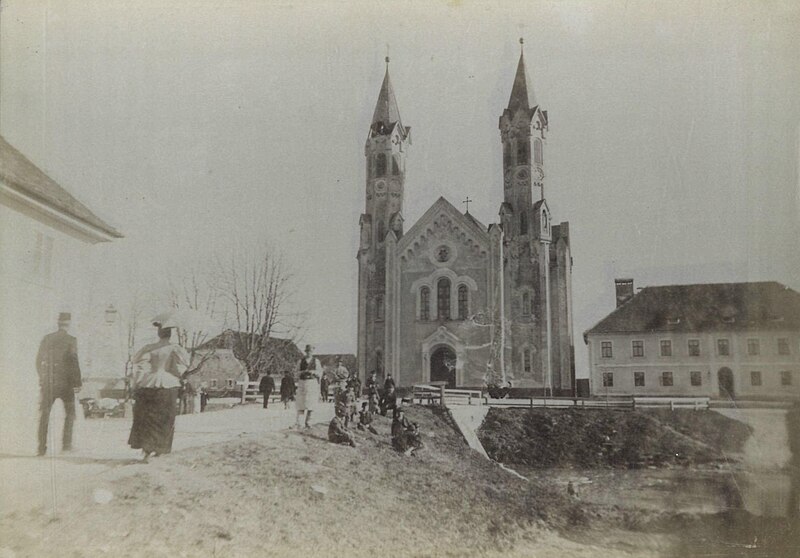
As you reach the corners of Trnovo Bridge, you will discover a fascinating architectural riddle and a brilliant visual dialogue. Remarkably, the low stone pyramids adorning each of the four corners of this bridge were created as an ingenious architectural homage by Joze Plecnik, designed to mirror the exact pointed spires of the historic Saint John the Baptist Church standing just across the crossing. …
04 Statue of Saint John the Baptist
When you reach the central platform of Trnovo Bridge, you encounter a remarkable historical episode filled with sacred dignity and the joyful celebration of local residents. When this bridge was finally completed in the summer of nineteen thirty-two, the residents of Krakovo and Trnovo gathered alongside their parish priest to hold a grand festival on Midsummer Sunday, blessing both the bridge and its sacred statue to pray for the peace and wellbeing of the entire community. …
05 Sigmund Zois Obelisk & District Names
As you stroll quietly across Trnovo Bridge, you discover the surprising truth that this structure is far more than a simple physical crossing; it serves as a symbolic boundary line where the names of two historic neighborhoods are permanently inscribed into stone. Krakovo and Trnovo, two districts that developed their own distinct community identities along the river for centuries, forged a lasting bond by having their names carved onto the stone faces of this bridge. …
06 Gradaščica Riverbank and Park
As you arrive at the banks of the Gradascica River and the park in front of the Trnovo Rectory, you encounter a dramatic reversal of history and a fascinating glimpse into the past of this waterfront area. While this location is today a tranquil and picturesque riverbank promenade, it was historically a bustling horse bath where horses brought from the inner city were driven into the river on Sunday mornings to be bathed, washed, and cooled down alongside lightweight carts. …
07 Closing
How did you enjoy our walking tour across Trnovo Bridge today? This remarkable bridge is far more than a static engineering structure built simply to cross a stream; it stands as a brilliant testament to master architect Joze Plecnik, who harmoniously bound together water, urban life, human spirit, and living nature. …