Contents
History & cultureBY TELLBY8 sections · numbered as on the map01 Orientation
Welcome to the historic Allahabad Fort. I am your docent, and it is my distinct privilege to guide you through one of the most imposing military and spiritual monuments in the Indian subcontinent. As you stand here near the outer riverfront approach, cast your eyes toward the majestic expanse where the calm blue waters of the Yamuna River meet the sweeping currents of the sacred Ganges River. This celebrated location lies directly adjacent to Triveni Sangam, the legendary three river confluence that includes the invisible, mythical Saraswati River. For thousands of years, pilgrims and ascetics from across India have journeyed to this precise location to perform sacred bathing rituals seeking spiritual liberation. In the year 1583, the Great Mughal Emperor Akbar recognized both the profound spiritual aura and the unmatched military potential of this geographical junction, establishing here a colossal stone fortress. Akbar originally named this royal stronghold Illahabas, meaning blessed by Allah, a name that gradually evolved over centuries into Allahabad. In 2018, the Government of Uttar Pradesh officially renamed the city to Prayagraj, restoring its ancient Vedic name Prayag or Piyag as recorded in classical texts. The grand imperial motivation behind founding this fortress is recorded in vivid detail by Akbar court historian and official biographer, Abu'l-Fazl, in his celebrated chronicle, the Akbarnama. Abu'l-Fazl recorded that for a very long time, Emperor Akbar possessed a deep desire to found a great city at the town of Piyag, where the rivers Ganges and Yamuna unite, a place regarded by the people of India with much reverence and frequented by ascetics as a vital pilgrimage center, and to construct a choice fortress there. Situated in the southern region of Uttar Pradesh, approximately one hundred kilometers west-northwest of Varanasi, this remarkable citadel is designated by the Archaeological Survey of India as a monument of national importance. Throughout its long history, the fort has stood as a guardian of sacred traditions and an anchor of imperial power. Our walking tour today will take us through the principal gateway, past ancient carved monoliths, along the riverfront defensive walls, into the sacred inner enclosures, and toward courtly quarters where royal intrigues unfolded. Please take a moment to admire the sheer scale of the red sandstone ramparts rising before you, and let us take our first steps toward the grand entrance gateway.
02 The Grand Gateway and Ashoka's Ancient Pillar
As you step through the monumental archway of the main gate into the inner courtyard, pause for a moment and look directly ahead at the soaring, exquisitely polished stone monolith standing proudly within the portal entrance. Please direct your gaze along its smooth surface to appreciate the extraordinary craftsmanship that has survived millennia. This magnificent monument is the world famous Ashoka Pillar, an irreplaceable masterpiece of ancient Indian heritage. …
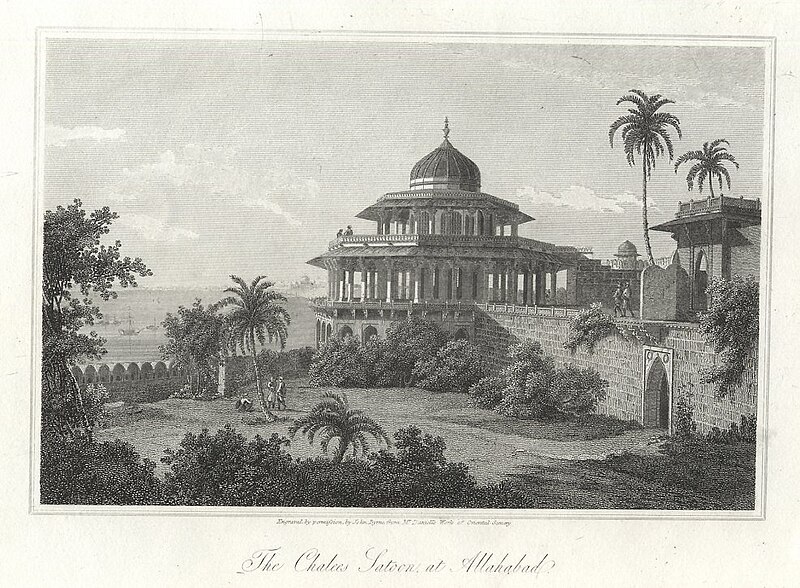
03 Akbar's Massive Fortifications and the Chalees Satoon
Leaving the ancient monolith behind, please walk along the stone pathway toward the elevated ramparts overlooking the Yamuna River. As you reach the defensive terrace, turn your eyes toward the sweeping sandstone outer walls and admire the formidable bastions rising dramatically above the water. The Allahabad Fort holds the proud distinction of being the largest and most expansive military fortification ever constructed by Emperor Akbar. …
04 The Undying Tree and Local Sacred Legends
Turning away from the riverfront walls, please follow me into the inner shaded precinct of the fortress. As we walk through these cool stone corridors into the tranquil interior courtyard, notice how the atmosphere shifts from military power to deep spiritual reverence. When Emperor Akbar planned the expansive layout of this fort, he intentionally configured the outer red sandstone walls to enclose the sacred Akshayavata, the legendary undying banyan tree. …
05 Royal Intrigue and Prince Salim's Rebel Court
Moving out from the sacred precinct into the courtly inner quarters of the fortress, pause beneath the arched stone colonnade and admire the delicate carved geometry on the red sandstone pavilions. This aristocratic setting was the backdrop for one of the most dramatic power struggles in Mughal history. …
06 Siege of Shah Jahan and the Fall to Aurangzeb
Leaving the courtly quarters behind, please follow me toward the massive western defensive parapets and artillery bastions facing the river. As you stand beside these heavy sandstone embrasures, look down along the sheer wall face where cannons were once positioned to command the surrounding terrain. This setting was the focal point for violent military sieges and strategic betrayals during the seventeenth century Mughal wars of succession. …
07 The Treaty of Allahabad and British Military Control
Walking past the defensive bastions into the western garrison courtyard, pause near the spacious brick and stone quarters that once served as military barracks. Look around this wide expanse, which marks the dramatic eighteenth century shift when the declining authority of the Mughal Empire yielded to the aggressive expansion of the British East India Company. …
08 Closing
We now conclude our audio tour standing at this breathtaking elevated vantage point overlooking the sacred Triveni Sangam, the holy confluence where the deep blue waters of the Yamuna River meet the sweeping currents of the sacred Ganges River alongside the mythical, invisible Saraswati River. Resting your hands on the stone parapet, look out across this vast liquid horizon that has served as the spiritual and political heart of India for over three millennia. …