 Photo Wikimedia Commons
Contents
History & cultureBY TELLBY7 sections · numbered as on the map01 Orientation
Welcome to the Müstair Valley in the Canton of Graubünden at the easternmost edge of Switzerland, where high Alpine passes and deep valleys gracefully intersect. This serene and peaceful village holds a unique geographical distinction as the only Swiss territory situated within the Adige Basin, lying in exceptionally close proximity to the Italian border in South Tyrol as well as the Austrian border at Nauders. Since antiquity, this region served as a vital strategic node along historic trade and pilgrimage routes that crossed the daunting Alpine barrier between Switzerland, Germany, Austria, and Italy. The Benedictine Monastery of Saint John, where you are standing today, is a sacred sanctuary that has preserved its profound spiritual atmosphere for over a thousand years since its initial establishment during the Early Middle Ages. It is recognized globally as a world-renowned treasure where priceless murals painted around the year 800 and remarkably preserved medieval monastic architecture come together in one unified location.
Behind the origins of this tranquil sanctuary lies an extraordinary historical figure and a captivating founding legend. Charlemagne, King of the Franks, was returning over the rugged Umbrail Pass after his historic coronation as King of the Lombards in Italy. Caught in a sudden and terrifying Alpine snowstorm that threatened his entire entourage, Charlemagne miraculously survived the perilous ordeal. Filled with profound gratitude for his divine deliverance, he commanded that a sacred monastery be erected upon this very site. Modern scientific dendrochronology confirms that the structural timber used in the monastery was felled around the year 775, demonstrating that this legendary narrative is rooted in historical fact. The actual founding process was executed under the royal authority of the Bishop of Chur, using the site as a secular residence and administrative hub while providing a welcoming hospice for weary pilgrims and travelers traversing the mountains.
As time progressed, the institution underwent a significant transformation, evolving into a women's abbey during the middle of the twelfth century. Over subsequent centuries, under the wise governance and dedicated stewardship of successive abbesses, magnificent new structures were erected and splendid artistic embellishments were added, gradually shaping the harmonious architectural ensemble we admire today. Through devastating wars, regional conflicts, and sweeping historical upheavals across Europe, the sacred tradition of continuous monastic prayer within these venerable stone walls has never been broken, and Benedictine nuns continue to live and pray here to this day. Now, let us begin our journey along the designated walking route, stepping through centuries of living heritage and immersing ourselves in the timeless sanctity of this UNESCO World Heritage site.
02 The Secret of Europe's Oldest Timber Ceiling
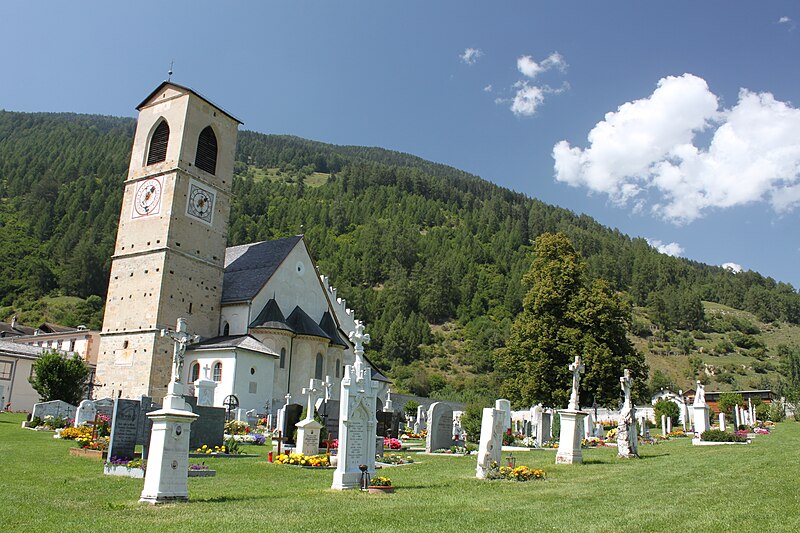
Please step towards the entrance of the tranquil cemetery and stand directly before the Chapel of the Holy Cross. Above the upper floor of this compact chapel, a wooden beam ceiling from the Carolingian era, recognized as the oldest surviving timber ceiling in all of Europe, continues to support the structure with remarkable strength to this day. …
03 The Gate Towers and the Bagpipe-Playing Donkey
As you walk past the cemetery into the western courtyard, the convent's expansive agricultural yard and the gate towers guarding it come into view. Above the main entrance of this remarkably solemn abbey, a humorous painting of a donkey playing a nobleman's bagpipe is hidden. The presence of a cheerful and satirical donkey painting carved into the portal of a holy abbey dedicated strictly to silent prayer and religious devotion offers a delightful surprise and brings a lighthearted smile to…
04 The Oldest Fortified Residential Tower in the Alps
Moving past the western courtyard into the heart of the convent complex, a grand stone tower stands with imposing dignity. First constructed by monks around the year 960 under Bishop Hartpert of Chur, this tower is recognized as the oldest fortified residential tower in the entire Alpine region. Standing firm against the fierce Alpine winds and heavy blizzards for over a millennium, this massive stone tower serves as a living witness to the long, storied history of the abbey. …
05 Stucco Angels and the Abbess's Private Chapel
Nestled quietly beside the Planta Tower, the double chapel is a sacred two-story sanctuary dedicated to Saint Ulrich and Saint Nicholas. Inside this two-story structure, four stucco angels clad in ancient classical attire sculpted around the year 1100 greet visitors. The sight of these plaster angels gazing down from the chapel dome across a millennium reflects the extraordinary elegance of ancient classical art preserved in this holy space. …
06 The Carolingian Frescoes Hidden for a Millennium
Stepping inside the main conventual church, one is immediately enveloped by the overwhelming awe of the world's most magnificent cycle of early medieval mural paintings covering the interior walls. Hidden beneath a lower Gothic vaulted ceiling installed in 1492, the extensive series of Carolingian frescoes painted around the year 800 was brought back to light only in 1947. …
07 Closing
Stepping out into the monastery courtyard and breathing in the crisp Alpine air, we bring our audio guide tour to a close. Since its initial foundation during the Carolingian era, the Monastery of Saint John has stood as a sacred cradle of faith where the lamp of prayer has burned without interruption for over a thousand years. …