Contents
History & cultureBY TELLBY8 sections · numbered as on the map01 Orientation
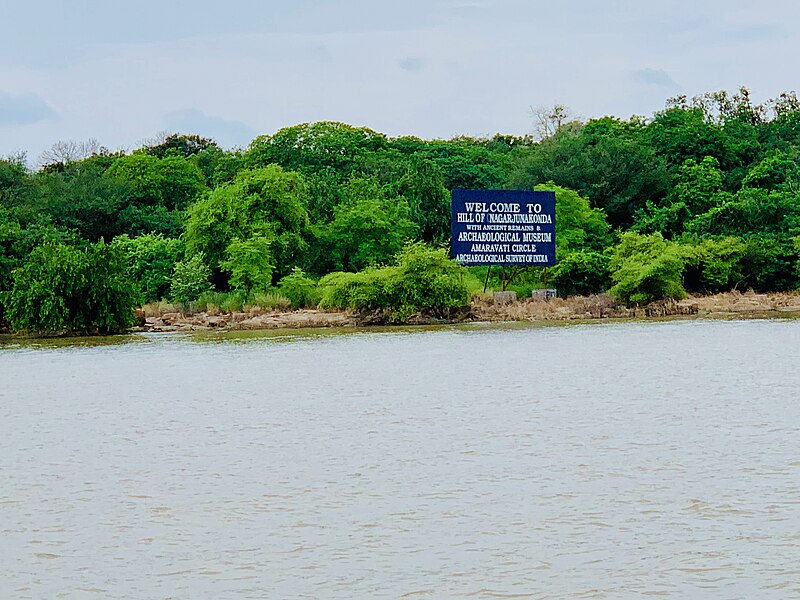
Welcome honored visitors. A warm and heartfelt welcome to all of you who have traveled across the sparkling blue waters of Lake Nagarjunasagar by ferry to arrive on this remarkable island. The beautiful land beneath your feet today is far more than a scenic retreat. It is the miraculous resurrection of Vijayapuri, the sacred ancient capital of the Ikshvaku dynasty, which flourished along the Krishna River valley seventeen hundred years ago.
Originally Vijayapuri meant the City of Victory. Nestled safely within a twenty three square kilometer valley bounded by the rugged Nallamalai mountain range on three sides and the roaring Krishna River on the other side, this land was known in ancient Ikshvaku inscriptions as Sriparvata or the Sacred Mountain. Over time the site became widely known as Nagarjunakonda, meaning Nagarjuna Hill, named after the famed second century Mahayana Buddhist philosopher Master Nagarjuna who systematized the concept of emptiness. Although direct archaeological proof linking the philosopher himself to this specific hill remains subtle, the breathtaking ruins scattered across the site leave no doubt about its standing as a grand spiritual center for both Buddhism and Hinduism.
However this glorious ancient capital faced a dramatic turning point in the mid twentieth century. With the construction of the massive Nagarjunasagar Dam to power modern India, the entire valley faced imminent submergence under a newly created reservoir. At that critical moment when a vast ancient civilization was nearly lost forever, one of the most heroic salvage archaeology operations in human history was launched.
Between 1954 and 1960 a dedicated team led by Professor Al Subrahmanyam of the Archaeological Survey of India conducted an exhaustive survey across the entire valley. Excavating one hundred and twenty seven distinct sites across fifteen square kilometers, archaeologists unearthed priceless artifacts and architectural structures spanning from the Stone Age through the Ikshvaku golden age to the medieval period. This miraculous effort became a historic milestone in global archaeology, celebrated alongside the UNESCO rescue of the Nubian monuments during the construction of the Aswan Dam on the Nile River in Egypt.
Working against time as the reservoir waters rose, archaeologists and engineers meticulously dismantled fourteen major monument complexes stone by stone and brick by brick. They transported them to the highest peak in the valley, which now forms this very island, reconstructing them with absolute historical precision above the dam level. Thanks to their extraordinary devotion, the sunken capital rose once more above the waters to live on for future generations.
Today your journey will take you through the ancient river wharf that once welcomed foreign trade, the royal citadel with its sacred horse sacrifice altar, a Roman style amphitheatre, the Great Stupa holding the sacred relics of the Lord Buddha, early Brahmanical temples, and the island museum housing salvaged masterpieces. As you walk among these resplendent ruins, may you feel the deep breath of history and the enduring spirit of this resurrected sanctuary.
02 The Ancient River Wharf and Maritime Trade Center
Ladies and gentlemen, please pause your steps here before the informational display and look closely at the stone remains before you. You are standing at the reconstructed ruins of the ancient river wharf, where merchant vessels navigating the mighty Krishna River once dropped their anchors. Although the original riverbank terrain now lies deep beneath the calm surface of the reservoir, during the third century under the Ikshvaku dynasty, this very spot was a bustling maritime port filled day…
03 The Royal Citadel and the Sacred Ashvamedha Altar
Ladies and gentlemen, following the outline of the outer fortifications, we have now arrived at the royal citadel and the sacred Ashvamedha altar site, which once formed the political heart and supreme spiritual seat of the Ikshvaku Kingdom. Look closely at the solid foundation stones surrounding your path. This area served as the fortified residence of the royal family and the command center where crucial state decisions were made. …
04 The Roman-Style Amphitheatre and Public Court
Ladies and gentlemen, passing through the central plaza and moving toward the base of the gentle hill before you, please look at the remarkable stone structure at Site 17. The monument before us now is a Roman style tiered amphitheatre and public court, which stands as one of the most unique and exceptional architectural discoveries in all of ancient Indian history. …
05 The Great Stupa Maha Chaitya and Monastic Hub
Ladies and gentlemen, moving across the sacred central sanctuary and stepping toward the grand circular brick platform before you, we now stand before the crowning jewel of Buddhist heritage at Nagarjunakonda, the Maha Chaitya Great Stupa and Monastic Hub. Meaning the Great Stupa, the Maha Chaitya represents the pinnacle of third century South Indian Buddhist art and architecture. …
06 The Sacred Brahmanical Temple Complex of Pushpabhadrasvami
Ladies and gentlemen, leaving the Great Stupa complex and walking toward the stone foundation ruins arranged along the eastern riverward section, please stand facing the temple basements before you. We have now reached the Sacred Brahmanical Temple Complex of Pushpabhadrasvami, a site of paramount historic importance in the evolution of South Indian temple architecture. …
07 The Island Museum and Craftsmen Artifacts
Ladies and gentlemen, leaving the outdoor ruin fields and walking toward the main entrance of the museum situated at the center of the island, please step inside the main reception foyer. We now arrive at the Island Museum, the grand climax of our tour and a magnificent repository housing the priceless ancient treasures rescued from the threat of submergence. …
08 Closing
Ladies and gentlemen, let us now step out onto the museum viewpoint terrace together and look across the vast, tranquil blue waters of Lake Nagarjunasagar. As the refreshing breeze sweeps across the reservoir, we bring our audio guide tour of Nagarjunakonda to a gentle conclusion.
Beneath the cool, shimmering surface of the lake you see before you today lies the original site of Vijayapuri, sleeping in quiet serenity seventeen hundred years after its golden age. …