Contents
History & cultureBY TELLBY7 sections · numbered as on the map01 Orientation
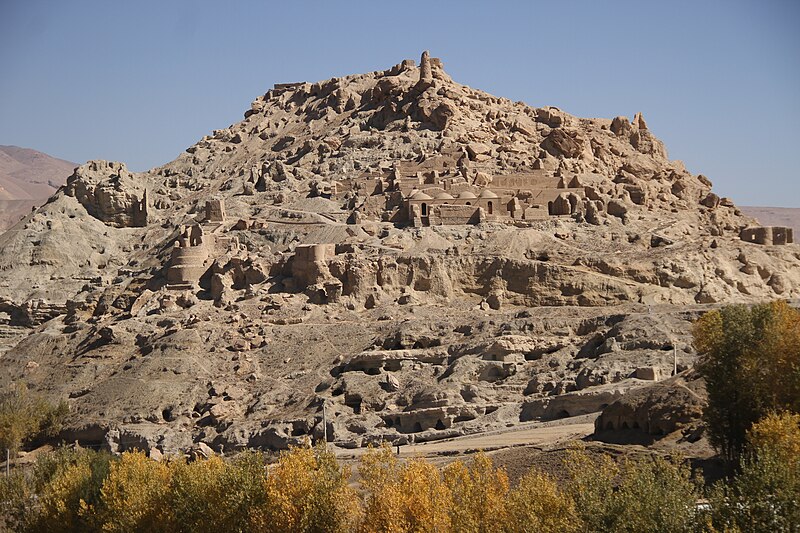
Welcome to Shahr-e Gholghola, one of the eight historic component sites that collectively form the Cultural Landscape and Archaeological Remains of the Bamiyan Valley World Heritage property. Situated in the majestic central highlands of Afghanistan, this extraordinary region is framed by the soaring, snow-capped peaks of the Hindu Kush mountain range. As you look around from this elevated vantage point, you can see how the Bamiyan Valley opens out into a broad and fertile basin, bordered to the north by an immense wall of sheer, golden-tinted rocky cliffs. Positioned right in the very center of this breathtaking valley basin stands the elevated natural rock citadel of Shahr-e Gholghola, commanding an unobstructed view over the surrounding landscape and ancient trade routes.
This ancient site holds a position of paramount importance in the shared history of human civilization. Without needing to rely on complex architectural terminology or academic formulas, its true historical essence is easily understood. Shahr-e Gholghola was once a vibrant and thriving crossroads where travelers, merchants, and scholars from disparate corners of the ancient world met. It functioned as a vital strategic stopping point on a prominent mountain branch of the Silk Route that connected China and India through ancient Bactria. Across many centuries, dynamic commercial trade flourished here alongside profound spiritual and intellectual exchanges. The valley served as a major sanctuary for Buddhist culture and monastic pilgrimage between the first and ninth centuries, while subsequent eras brought the distinctive artistic and architectural contributions of medieval Islamic dynasties, including the Ghaznavids and Ghurids. This unique location represents a profound cultural synthesis where diverse artistic traditions met, adapted, and enriched one another.
Yet, alongside its artistic brilliance, this fortified citadel is deeply remembered for a devastating historical tragedy. The local Dari name, Shahr-e Gholghola, translates directly into English as the City of Screams, or the City of Woe. This haunting title originates from the catastrophic siege of twelve twenty-one, when the expanding armies of the Mongol Empire descended upon the Bamiyan Valley. During the merciless conflict that followed, the fortress was utterly dismantled and its entire population was systematically slaughtered, leaving behind only the haunting echoes of grief across the silent valley.
In recognition of both its extraordinary cultural heritage and its highly fragile physical condition, UNESCO inscribed the property as a World Heritage site in two thousand three, while concurrently adding it to the List of World Heritage in Danger. As you walk along these ancient earthen pathways today, remember that you are treading on ground that witnessed both the golden zenith of Silk Road commerce and the darkest depths of wartime devastation. Please step forward with reverence as we begin our exploration of this sacred historic sanctuary.
02 East Entry and Outer Walls
This section of the historic site was once the primary eastern gateway through which weary Silk Road merchants, official diplomatic envoys, and traveling Buddhist monks first paused before entering the fortified urban center of Bamiyan. Imagine the vibrant sounds of incoming caravans arriving after arduous multi-month journeys across the high, ice-bound mountain passes of the Hindu Kush range. …
03 Lower Settlement and Courtyard
Though serene and silent today, this broad open space was once a densely populated urban courtyard during the eleventh and twelfth centuries under the rule of the Islamic Ghaznavid and Ghurid dynasties. Today, only the soft mountain breeze and silent stone lines remain on this elevated earthen terrace. However, many centuries ago, this very ground vibrated with the lively voices of Asian merchants, the bustling energy of daily market trades, and the warm domestic sounds of civilian townspeople. …
04 Middle Fortress and Citadel Wall
In twelve twenty-one, one of the most tragic and decisive sieges in medieval military history took place right along this steep defensive slope. The Mongol army, advancing relentlessly across Central Asia in pursuit of Jalal al-Din Mangburni, the last ruler of the Khwarazmian Empire, surrounded the fortified city of Bamiyan and launched a furious assault against these very citadel walls. …
05 Upper Citadel Observation Point
Standing here at the highest summit of Shahr-e Gholghola, you are positioned at the ultimate vantage point of the entire Bamiyan Valley. From this commanding height, ancient rulers and military commanders held an unobstructed line of sight over all incoming trade routes, tributary valleys, and defensive positions across the central basin. …
06 South Conservation Area
After enduring centuries of conflict, neglect, and natural erosion, Shahr-e Gholghola is entering a vital new era of scientific preservation and community renewal. Where destruction once defined these historic slopes, international collaboration and local craftsmanship are now united to protect the surviving earthen architecture and ensure its survival for future generations. …
07 Closing
As we complete our guided audio tour of Shahr-e Gholghola, please pause for a moment near the site exit to look back at the grand profile of this ancient rock citadel rising high above the valley floor. The weathered earthen ramparts and silent stone pathways you walked today bear profound witness to the full arc of human history across Central Asia. …