Contents
History & cultureBY TELLBY7 sections · numbered as on the map01 Orientation
Welcome to Sarmizegetusa Regia, the historic heart and sacred capital of the ancient Dacian Kingdom. Situated at an altitude of twelve hundred meters deep within the dense forests of the Șureanu Mountains, this extraordinary mountain fortress forms the unassailable center of a massive one hundred fifty square kilometer defensive ring. In nineteen ninety-nine, UNESCO recognized the outstanding universal value of this stronghold alongside five surrounding Dacian fortresses—Costești-Cetățuie, Costești-Blidaru, Luncani-Piatra Roșie, Bănița, and Căpâlna—designating them as a World Heritage site. What makes this site so remarkable is its exceptional fusion of classical Mediterranean architectural techniques with the native engineering concepts of the late European Iron Age, creating a unique system of military and religious monuments found nowhere else in the ancient world. Sarmizegetusa Regia served as the political, religious, and military epicenter of Dacia during its golden age from the first century BC to the beginning of the second century AD. Positioned strategically on Grădiștea Hill along the Apa Grădiștei river system, the capital was protected by a sophisticated network of outer citadels, watchtowers, and natural mountain barriers that rendered direct enemy assault almost impossible. Long before it expanded into a sprawling royal capital, this revered height was identified in the first century BC as Kogaionon, the Sacred Mountain of the Dacians, where supreme priests performed holy rites and communed with the divine. As you begin your journey through this ancient city, you are entering a landscape transformed by immense human labor. High on these steep mountain ridges, Dacian builders constructed nearly one hundred artificial stepped terraces across several kilometers to accommodate monumental sanctuaries, thriving artisan workshops, elaborate water management systems, and royal residences. This sophisticated layout reflects the advanced socio-economic organization and high technological capabilities of Geto-Dacian civilization. Although the kingdom was eventually conquered by the Roman Empire under Emperor Trajan in one hundred six AD, the monumental stone foundations, paved processional pathways, and circular sanctuaries that endure today offer a dramatic testament to a vigorous and innovative civilization. As you explore this timeless landscape, let the quiet majesty of the beech forest transport you back two millennia to the age of kings, priests, and master metalsmiths. Please follow the path ahead as we begin our detailed exploration of the remarkable structures that defined this ancient capital.
02 Murus Dacicus - The Stone Fortress Wall
Look directly at the massive, finely dressed stone wall standing before you. We begin our exploration with a breathtaking fact: this monumental fortification wall, known as Murus Dacicus, measures three meters in thickness and reached original heights of five to over ten meters, wrapping around an area of nearly three hectares in an irregular hexagonal contour that follows the natural ridge of the mountain. …
03 Paved Andesite Road - Pathway to the Sacred Area
Look down at the broad, smooth slabs of paved stone right beneath your feet. We begin this section with an astonishing historical truth: two thousand years ago, the ancient Dacians carved and laid a magnificent stone-paved avenue extending from the main gate of the mountain citadel all the way to the sacred sanctuary precinct, and this ancient road remains remarkably intact to this day. …
04 Great Circular Sanctuary - Astronomical and Spiritual Center
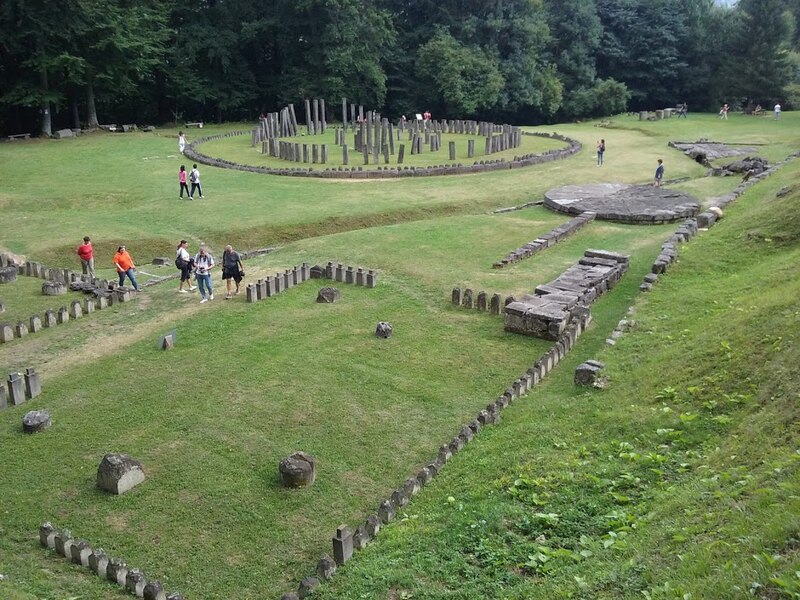
Look at the concentric rings of standing andesite plinths and the circle of wooden post-setting markers surrounding the central chamber. We open our contemplation of this site with an awe-inspiring revelation: this Great Circular Sanctuary was far more than a conventional temple for prayer; it functioned as a highly accurate astronomical calendar, engineered by ancient Dacian scholars to measure the cosmic cycles of the heavens. …
05 Andesite Solar Disc - Sacrificial Cult Altar
Look at the fan-shaped solar disc carved of stone, resting horizontally in the middle of the gently sloping terrace yard. We open our reflection on this monument with a stunning fact: here stands a sacrificial cult altar measuring several meters in diameter, expertly assembled from massive, fan-shaped cut blocks of volcanic andesite to form a complete solar emblem, remarkably preserved through two millennia. …
06 Civil Settlement Terraces - Daily Life and Metallurgy
Look down at the broad, stepped artificial terraces carved systematically into the lower slopes of the mountain. We begin this part of our journey with an incredible urban reality: on these steep mountain slopes, ancient Dacian engineers constructed over one hundred artificial terraces across an area of three kilometers, creating an urban center that supported approximately five thousand residents, thriving ironworking complexes, and ceramic workshops. …
07 Closing
As we conclude our tour of Sarmizegetusa Regia, we reflect upon the dramatic final days and enduring legacy of this legendary Dacian capital. In one hundred six AD, the ancient Dacian Kingdom faced its final reckoning during the second Dacian War waged by the Roman Emperor Trajan. After prolonged sieges and fierce fighting throughout the Șureanu Mountains, the Roman legions breached the defenses of Sarmizegetusa Regia. …