Contents
History & cultureBY TELLBY7 sections · numbered as on the map01 Orientation
Welcome to Horezu Monastery, an extraordinary spiritual sanctuary and artistic haven nestled beneath the tranquil forest slopes of the Căpăţânii Mountains in the historical region of Wallachia, Romania. Globally revered and designated as a UNESCO World Heritage Site, this vast monastic complex represents one of the most brilliant cultural achievements in Eastern Orthodox history. The very name of the monastery, historically written as Hurezi, carries a deeply poetic origin, born from the haunting nocturnal calls of owls echoing through the silent mountain valleys. The foundation of this holy complex was laid in 1690 by Prince Constantin Brâncoveanu during a precarious geopolitical era when Wallachia was trapped in the crossfire of rival regional empires. Rather than prioritizing military force alone, the visionary prince chose to elevate national culture, faith, and artistic excellence as the ultimate shield for his people's historical identity. Bringing together the most accomplished master builders, stonemasons, and icon painters of the age, Prince Constantin guided the construction until the main cathedral was triumphantly consecrated in 1693. UNESCO inscribed Horezu Monastery on the World Heritage List because it stands as the absolute, purest masterpiece of the Brâncovenesc architectural style, an original Romanian artistic synthesis that harmoniously fuses the decorative splendor of the European Late Renaissance with the solemn structural balance and spiritual purity of Byzantine traditions. Beyond its architectural brilliance, the monastic school of mural and icon painting established within these walls during the 18th century became a renowned artistic beacon that radiated creative influence across the entire Balkan region. Today, your audio guide tour will lead you through the landmark highlights of this sacred sanctuary. You will begin at the monumental southern entrance gate and bell tower, pass into the spacious central courtyard to admire the ornate carved stone pillars of the main cathedral porch, step inside the narthex to discover the noble votive wall paintings and the founder's empty tomb, explore the famous historical library and the elegant Dionisie gazebo, and conclude your journey at the compassionate outer infirmary church. Please walk with unhurried steps and open your senses to the timeless peace of this sacred UNESCO World Heritage Site.
02 Main Entrance Gate and Bell Tower
The monumental entrance gate and bell tower guarding the southern wall of Horezu Monastery were conceived not merely as a defensive fortification, but as a majestic artistic portal built to safeguard spiritual enlightenment and cultural heritage during an era of relentless military conflicts. As you stand directly before this imposing structure, please tilt your visual focus upward to observe the grand bell tower rising above the heavy stone archway. …
03 Main Church Porch and Pillars
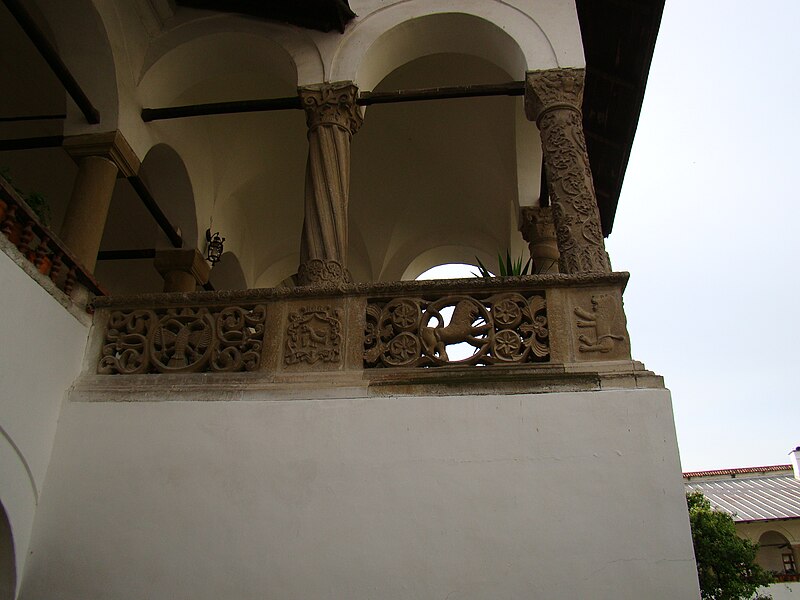
The magnificent open porch framing the entrance of the main cathedral stands as the defining masterpiece of the Brâncovenesc architectural style, where the exuberant decorative refinement of the European Late Renaissance converges with the sacred structural traditions of Byzantine design. As you stand directly in front of the main church dedicated to Holy Sovereigns Constantine and Helen, please direct your attention to the ten grand stone pillars that support the vaulted arcades. …
04 Pronaos Murals and Unused Tomb of Prince Constantin
Upon entering the narthex of the main cathedral, visitors encounter a profound historical tragedy, inside this sacred hall rests an exquisitely carved marble tomb constructed specifically for the monastery founder, Prince Constantin Brâncoveanu, yet the tomb remains entirely empty because the prince was never buried here. …
05 The Library of Constantin Brâncoveanu and Gazebo
The historical library building and the elegant open pavilion situated along the courtyard edge stand as the intellectual nerve center of Enlightenment-era Wallachia, a magnificent treasure house of human wisdom that stored thousands of rare manuscripts to nourish the souls of Eastern European scholars. As you approach this building, please examine the carved stone plaque mounted above the library portal and admire the graceful architectural lines of Dionisie's Gazebo standing nearby. …
06 Infirmary Church of the Dormition
Tucked away peacefully outside the main fortified enclosure of the monastery, the Infirmary Church of the Dormition of the Virgin stands in quiet contrast to the grandiose royal architecture of the central courtyard, offering a compassionate sanctuary built specifically to heal the sick, comfort the elderly, and grant spiritual peace to the suffering. …
07 Closing
This brings us to the conclusion of our audio guide tour of Horezu Monastery, a radiant crown jewel of Wallachian architecture and a cherished UNESCO World Heritage Site. The sacred monastic complex we have explored together today is far more than an impressive ensemble of historic seventeenth-century stone structures. …