Contents
History & cultureBY TELLBY8 sections · numbered as on the map01 Orientation
Welcome to Chaman Mahal, a historically resonant landmark situated in Jagdishpur, approximately eleven kilometers away from Bhopal, the vibrant capital city of Madhya Pradesh in India. Jagdishpur, which was historically known as Islamnagar, served as the foundational capital of the region before Bhopal became the primary seat of power for the ruling dynasty. As you arrive at this serene site after stepping away from the bustling atmosphere of the Berasiya Road, you immediately sense a quiet, majestic shift in environment. The palace you see before you was commissioned and constructed in the year 1715 by the formidable Afghan commander Dost Mohammad Khan, who ruled Islamnagar during that pivotal period of Central Indian history. In regional linguistic and literary traditions, the word Chaman translates directly to garden. For this reason, Chaman Mahal is widely and affectionately referred to across the country as the Garden Palace.
During the early eighteenth century, as the imperial power of the Mughal Empire began to decline and fragment across the subcontinent, Dost Mohammad Khan, who was originally a chieftain under Mughal authority, asserted his independence and laid the enduring foundations for the ruling dynasty of the Nawabs of Bhopal. Recognizing the exceptional strategic and defensive advantages of Jagdishpur, he fortified the settlement to serve as his primary military stronghold and administrative residence. Its geographical positioning along the historic Berasiya Road was vital for monitoring commercial traffic, trade caravans, and troop movements passing between the fertile Malwa plateau and the expansive northern plains. Furthermore, this heritage site gained deep sacred and ancestral importance through the establishment of the royal tombs of Nawab Yaar Muhammad Khan and Nawab Gaus Muhammad Khan, effectively elevating this fortress palace into a revered ancestral ground for the Bhopal royal line.
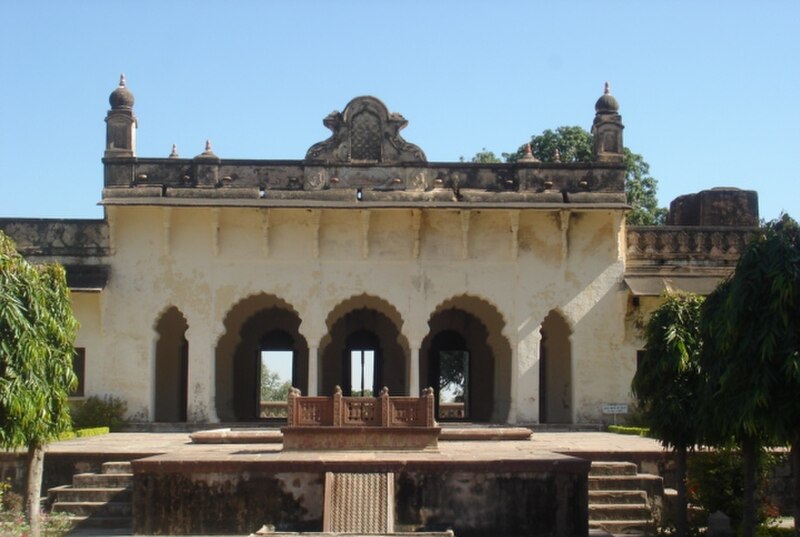
Chaman Mahal is built primarily from rich local red sandstone, which absorbs the radiant sunlight of Central India and reflects a warm, earthy hue. Architecturally, the palace represents an eloquent physical synthesis of the cross-cultural transitions taking place in the region during the early eighteenth century, reflecting the historic shift from Gond and Rajput rule into the Nawabi period. It features a seamless architectural fusion of grand Mughal structural principles alongside indigenous Malwa and Rajput aesthetic elements. The vivid visual harmony created by the warm red sandstone masonry set against the lush green lawns and tranquil water features establishes an atmosphere of timeless elegance.
Today, through the ongoing preservation efforts of the State Archaeological Department, Chaman Mahal stands fully protected as a peaceful retreat. As we begin our audio tour, we invite you to walk along the designated paths and immerse yourself in the rich history, sophisticated hydraulic engineering, and artistic splendor of this eighteenth-century red sandstone sanctuary.
02 Palace Entrance Approach and the Twelve Gates
As you walk along the primary entrance path of Chaman Mahal and prepare to enter the palace complex, your attention is immediately captured by the grand sequence of red sandstone structures that define the outer perimeter. The most defining architectural highlight of this approach is the impressive series of twelve entrance gates. …
03 Central Charbagh Garden and Fountains
Passing through the sequence of twelve entrance gates brings you directly into the central expanse of Chaman Mahal, where a breathtaking geometric garden unfolds before your eyes. This is the central Charbagh garden, the very heart of the complex that earned Chaman Mahal its celebrated title as the Garden Palace. The term Charbagh originates from traditional Persian and Islamic garden design, combining the word for four with the word for garden. …
04 Red Sandstone Baradari Pavilion
Moving forward from the central garden into the heart of the palace complex, you arrive at an open stone pavilion that serves as the architectural crown jewel of Chaman Mahal: the red sandstone Baradari. The term Baradari is derived from the Hindi and Persian words for twelve and doors or pillars, designating an open pavilion structured with twelve prominent pillars or arched openings. …
05 Mughal Hammam on the West
As you proceed from the central pavilion toward the western wing of the palace complex, you come upon one of the most technologically sophisticated structural features of Chaman Mahal: the western Mughal-style Hammam, or Turkish bathhouse. In Islamic royal tradition, a hammam was far more than a simple venue for personal hygiene. It served as a refined sanctuary for relaxation, private diplomatic conversation, and physical rejuvenation for the monarch and members of the court. …
06 Terraced Water Channels and Cascades
As you leave the hammam area and follow the water channels toward the sloped gradients of the garden, you arrive at one of the most sophisticated hydraulic installations at Chaman Mahal: the terraced water channels and narrow cascades known as abshars. The term abshar is a Persian architectural designation for small artificial waterfalls or stepped water chutes. …
07 Elevated Outdoor Terrace Lookout and Rani Mahal
Following the designated tour route upward toward the elevated sections of the palace, you ascend onto the outdoor terrace lookout. This intentionally raised terrace platform was engineered to fulfill a dual purpose within the Chaman Mahal complex: providing an elevated vantage point for visual enjoyment and serving as a strategic command post for military surveillance. …
08 Closing
With our visit to the outdoor terrace lookout complete, we conclude our eight-step audio guide tour of Chaman Mahal. Today, we have journeyed together through a remarkable eighteenth-century red sandstone garden palace constructed in 1715 by the Afghan commander Dost Mohammad Khan. From the imposing entrance sequence formed by twelve red sandstone gates with Bengali drooping eaves to the geometric perfection of the central Charbagh garden and its refreshing hydraulic fountains, every element of…