 Photo Wikimedia Commons
Contents
History & cultureBY TELLBY4 sections · numbered as on the map01 Orientation
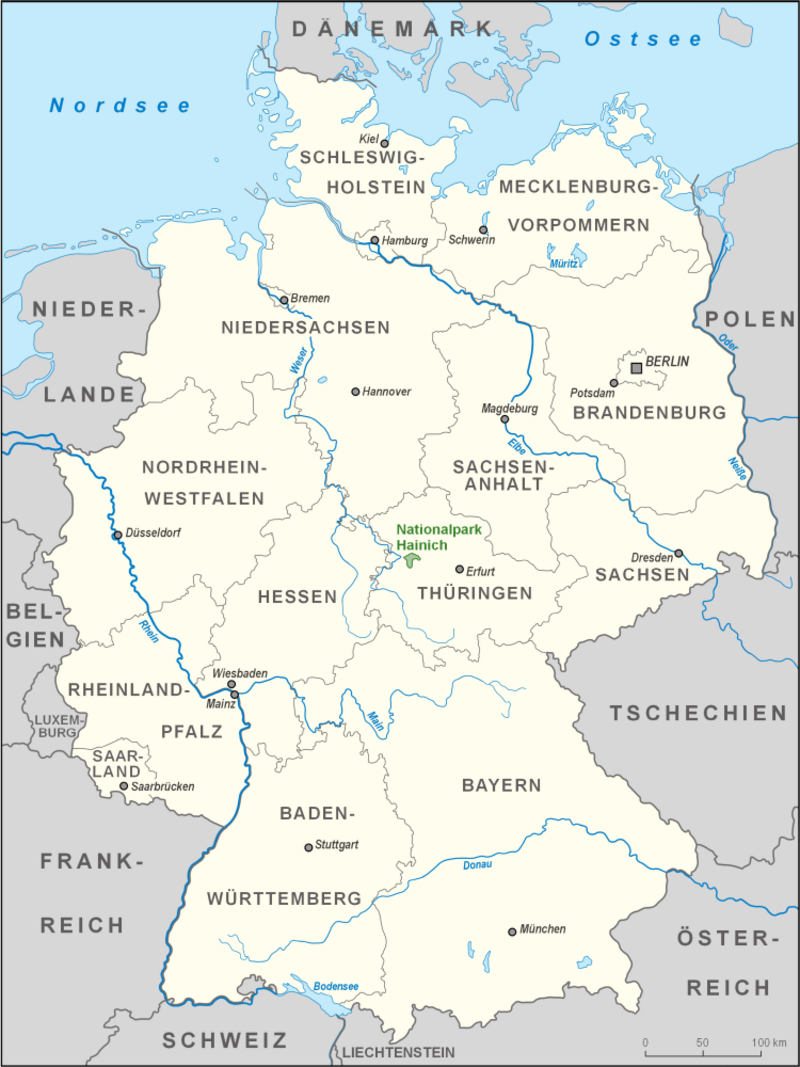
Welcome to Hainich National Park. I am your audio docent, honored to accompany you through this extraordinary sanctuary of ancient life. Hainich is a landscape where nature has spent centuries writing its own epic story without human intervention. Nestled within the picturesque historic triangle formed by the towns of Eisenach, Mühlhausen, and Bad Langensalza in western Thuringia, this vast green treasure protects the southern portion of the Hainich region, which represents the largest contiguous deciduous forest in all of Germany.
This national park stands as an irreplaceable living testament to the ecological history of European beech forests and their natural dynamics since the Last Glacial Period. While most of Central Europe's primeval woodlands vanished over millennia of agricultural development and human settlement, this magnificent forest preserved its primordial character, offering a remarkably rare ecological refuge on our planet.
Designated on December 31, 1997, Hainich became the 13th national park in Germany and remains the sole national park in the state of Thuringia. Covering 75 square kilometers, it forms the ecological core of the broader Eichsfeld-Hainich-Werratal Nature Park, protecting an unbroken expanse of native broadleaf woodland.
Behind this tranquil greenery lies a fascinating history of paradox. For many decades, large sections of this forest were enclosed as a restricted military zone. The German Wehrmacht first established a shooting range here in 1935, and following the Second World War, the Soviet military expanded these facilities into a major armored training ground. Yet because public entry was strictly forbidden and commercial forestry ceased entirely, the woodland was shielded from industrial exploitation. The military perimeter unwittingly created an absolute sanctuary where ancient forest dynamics could quietly reemerge.
When the military surrendered the land for civil use in 1991, conservationists embraced a visionary philosophy of non-intervention, allowing natural succession to guide the woodland's restoration. Recognizing its outstanding universal value, UNESCO added Hainich National Park to the Ancient and Primeval Beech Forests World Heritage Site in 2011.
During our tour, you will journey from the suspended canopy walkway above the high tree crowns to the subterranean world of fungal root networks, explore reconstructed ancient Germanic sanctuaries, witness former target grounds transforming into vibrant young woods, and visit outdoor wilderness camps for future generations. Please step into the peaceful rhythm of Hainich as we begin our journey.
02 Traces of Ancient Faith: Germanic Cult Path
Welcome to the Germanic Cult Path along the shores of Hünenteich pond, known in German as the Germanischer Kultpfad. Here, within the tranquil depths of the forest, stands a remarkable reconstruction of ancient sanctuaries where Germanic tribes offered sacrifices to nature deities more than a thousand years ago.
Take a moment to look at the carved wooden idols standing quietly along the pond and the altars constructed from natural stone. …
03 Wilderness Experience for Future Generations: Urwald-Life-Camp
Welcome to the Urwald-Life-Camp on the Harsberg hill near Lauterbach. Located on the western boundary of the national park, this facility serves as an outdoor educational center opened in 2006 where youth and school groups immerse themselves in the wilderness to become future stewards of the forest.
Take a look around at the eco-friendly wooden youth hostel and the open-air classroom areas set directly against the forest edge. …
04 Closing
This brings us to the conclusion of our tour through Hainich National Park. Together, we have traveled through many layers of time and ecology: from walking among the high tree canopy at Thiemsburg to exploring the subterranean root systems of the Wurzelhöhle, visiting the ancient Germanic sanctuaries at Hünenteich, taking in the panoramic views of reclaimed wilderness at Hainichblick, and seeing environmental stewardship in action at the Urwald-Life-Camp. …