Contents
History & cultureBY TELLBY7 sections · numbered as on the map01 Orientation
Welcome to the Las Médulas Cultural Landscape, an extraordinary testament to ancient engineering where the Roman Empire harnessed the immense force of water to collapse entire mountains in search of gold two thousand years ago. Located in the El Bierzo region within the province of León in northwest Spain, this expansive archaeological and natural site spans over one hundred square kilometers across the municipalities of Borrenes, Carucedo, and Puente de Domingo Flórez. During the first and second centuries AD, the Roman Imperial authorities developed this site into the largest open pit gold mine in the entire empire. UNESCO recognized the Archaeological Zone of Las Médulas as a World Heritage site in 1997, honoring it as a monumental work of human creative genius and an exceptional cultural landscape where ancient Roman hydraulic technology reshaped the natural terrain. The Romans employed a dramatic technique known as ruina montium, or the wrecking of mountains, which involved channeling vast quantities of water through intricate networks of mountain aqueducts and tunnels cut deep into the rock. When the water was released from elevated reservoirs into closed galleries, the resulting hydraulic pressure and compressed air caused whole mountain faces to explode and wash away. Over two centuries of continuous operation, the Romans excavated nearly one hundred million cubic meters of earth. When the gold deposits were exhausted in the early third century AD, the Roman presence vanished, leaving behind a strikingly transformed environment characterized by sheer red sandstone cliffs, deep ravines, and vast fields of sterile tailings. Because no subsequent industrial activity ever took place in this region, the ancient mining structures, dams, gravity canals, and domestic settlements remained extraordinarily intact over the centuries. Over time, native vegetation returned, and chestnut and oak groves spread across the eroded valley floor, giving rise to an organic cultural landscape where dramatic human intervention and natural regeneration coexist in complete harmony. Formally protected as a Historic Monument in 1931, a Bien de Interés Cultural in 1998, a Natural Monument in 2002, and a designated Espacio Cultural in 2010, Las Médulas offers visitors a unique glimpse into the administrative power, technological innovation, and environmental legacy of classical antiquity. As you follow this guided audio tour, you will walk along ancient footpaths, peer into gaping tunnel openings, gaze across vast panoramic viewpoints, and discover how this once devastated industrial ground became one of Europe's most beautiful and historic landscapes. Enjoy your journey through time and nature.
02 Senda de las Valiñas
Beneath the serene canopy of this ancient chestnut forest lies a hidden history of military conquest and imperial ambition that permanently reshaped the topography of the region to supply the mints of the Roman Empire. Look directly around you at the massive gnarled trunks of centuries old chestnut trees lining the path, where the vibrant green foliage contrasts dramatically with the reddish sand underfoot. …
03 La Cuevona and La Encantada
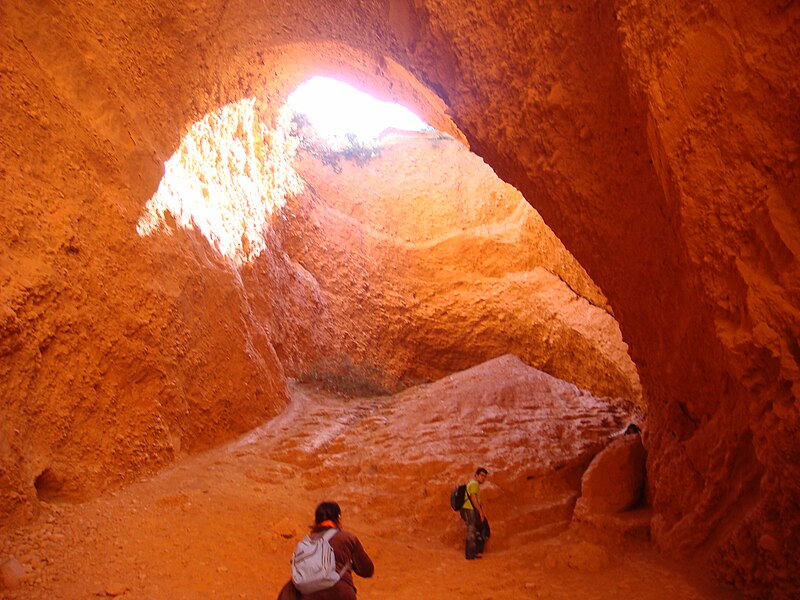
The gaping red cavern before you is not a natural creation of geology, but the startling result of Roman engineering that literally blew mountains apart from the inside using compressed hydraulic power. Look up directly at the sheer red sandstone cliff face and the enormous arching entrance of La Cuevona and the neighboring gallery of La Encantada. …
04 Mirador de Orellán
The breathtaking panorama of jagged red spires and dramatic clay towers before you is in reality a monumental artificial sculpture carved into the earth by the explosive force of water delivered through individual aqueducts extending over one hundred kilometers each, forming a vast Roman network exceeding three hundred kilometers. Stand directly at the railing of the Mirador de Orellán and look down across the vast basin. …
05 Galería de Orellán
This damp, echoing subterranean passage through which you are walking was hand carved inside a vertical cliff face two thousand years ago by a labor force of sixty thousand workers to extract twenty thousand Roman pounds of gold every single year. Walk carefully along this one hundred meter long tunnel carved directly through the solid bedrock. As you follow the dimly lit pathway toward the end of the gallery, you will reach a dramatic opening carved into the sheer outer cliff wall. …
06 Lago de Carucedo
The serene and picturesque body of water expanding before you, Lake Carucedo, is not a natural mountain lake, but an artificial hydrological environment born directly from the massive accumulation of mining silt and debris deposited during Roman gold extraction. Stand by the peaceful lakeshore path and look out across the calm, reflective surface framed by lush riparian trees and gentle marshlands. …
07 Closing
As you walk along the exit trail, our audio guide journey through the historic and natural wonder of Las Médulas comes to a close. Today we have explored towering red sandstone cliffs formed by compressed hydraulic power, walked through rock cut subterranean aqueducts, gazed across vast panoramas from elevated viewpoints, and discovered a serene lake born from ancient industrial silt. When the gold deposits were exhausted in the early third century AD, the Roman authorities abandoned the site. …