Contents
History & cultureBY TELLBY8 sections · numbered as on the map01 Orientation
Welcome to the Bombay High Court, an extraordinary monument to law and constitutional justice situated in the heart of the historic Fort precinct in South Mumbai, Maharashtra. As one of the oldest and most prestigious judicial institutions in the Republic of India, this high court exercises extensive original and appellate jurisdiction over the states of Maharashtra and Goa, as well as the Union Territory of Dadra and Nagar Haveli and Daman and Diu. The institution was formally established on August 14, 1862, pursuant to the letters patent issued by Queen Victoria on June 26, 1862, under the authority granted by the Indian High Courts Act of 1861. Alongside its sister institutions in Calcutta and Madras, it stands as one of the three original High Courts established in the historic Presidency Towns, serving as a foundational pillar upon which India's modern legal framework was constructed.
Although the official name of the city was changed from Bombay to Mumbai in 1995, the court retained its historic title as the Bombay High Court to preserve its legal lineage, institutional identity, and uninterrupted constitutional continuity. Although a bill proposing to rename the institution as the Mumbai High Court was approved by the Union Cabinet in July 2016 alongside name change proposals for the Calcutta and Madras High Courts, the court continues to operate under its venerable original designation. In 2018, the physical presence of the high court received global acclaim when it was inscribed as a central component of the UNESCO World Heritage Site known as The Victorian and Art Deco Ensemble of Mumbai. Situated amidst a lush urban landscape, the court shares its immediate surroundings with iconic nineteenth-century landmarks, including the historic campus of the University of Mumbai and the famous Rajabai Clock Tower.
Beyond its striking architectural footprint, the Bombay High Court is celebrated for its unmatched contributions to Indian legal jurisprudence and leadership. Independent India's very first Chief Justice of the Supreme Court, Harilal Jekisundas Kania, began his distinguished judicial career within these walls, while the nation's first Attorney General and first Solicitor General also emerged from this court's esteemed bar and bench. Over the decades, 27 judges from the Bombay High Court have been elevated to the Supreme Court of India, with 10 ascending to the apex office of Chief Justice of India. As you walk through these historic corridors, you are stepping into a living sanctuary where colonial history, constitutional evolution, and active modern judiciary seamlessly converge. We invite you to begin your journey through this magnificent complex and experience the enduring judicial legacy of the Bombay High Court.
02 Gothic Revival Architecture and Exterior Dimensions
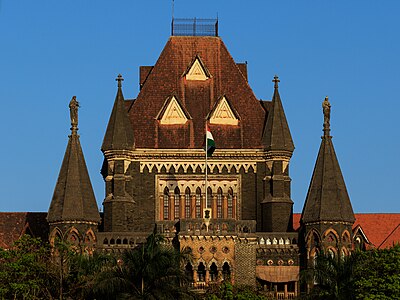
Standing before the grand main entrance of the Bombay High Court, one is instantly captivated by the sheer scale, imposing elevation, and meticulous stone craftsmanship of its exterior facade. Designed by the distinguished British engineer Colonel James A. Fuller, this monumental judicial structure stands as one of the finest and most intact surviving examples of Early English Gothic Revival architecture in South Asia. …
03 Central Tower and Allegorical Sculptures
As you direct your gaze upward toward the roofline and central elevation of the Bombay High Court, you will discover the most visually dramatic and symbolically profound architectural features of the entire complex: the Central Tower and its allegorical sculptures. Flanking the main central tower to its west are two intricately proportioned octagonal towers. …
04 Central Court Hall and Historical Milestones
Stepping into the central interior core of the building brings you to the historic Central Court Hall, a space resonant with the rich legal history and constitutional milestones of India. For well over a century, this solemn hall has served as the primary arena for landmark judicial proceedings that directly shaped the trajectory of the nation. Most famously, this court hall was the site of the legendary 1916 sedition trial, Emperor versus Bal Gangadhar Tilak. …
05 The Inner Courtyard and Architectural Layout
Passing through the vaulted stone corridors of the High Court leads you into the inner sanctum of the architectural complex: the serene Central Garden Courtyard. Intentionally integrated into the core layout of the building under Colonel James A. Fuller's 1870s design plan, this lush open-air courtyard provides a tranquil green oasis amidst the formidable stone structures housing the active court chambers. …
06 Regional Benches across Maharashtra and Goa
The Bombay High Court exercises an extraordinarily vast territorial jurisdiction that extends far beyond the metropolis of Mumbai, encompassing the states of Maharashtra and Goa, as well as the Union Territory of Dadra and Nagar Haveli and Daman and Diu. To deliver accessible and efficient justice across these expansive regions, the High Court operates four key circuit benches located in Nagpur, Aurangabad, Porvorim in Goa, and Kolhapur. …
07 Legal Luminaries and Judicial Legacy
Walking through the historic stone corridors of the Bombay High Court brings you face-to-face with an unmatched legacy of legal leadership that fundamentally shaped the constitutional democracy of modern India. This institution has served as the cradle for many of the nation's most illustrious jurists, who played pivotal roles in establishing India's legal architecture and judicial independence. …
08 Closing
As our audio tour of the Bombay High Court comes to a close, we reflect on standing before a living monument where historical heritage and active modern jurisprudence seamlessly intersect. Since its inauguration in 1862 under Queen Victoria's letters patent, this high court has borne witness to the dramatic evolution of modern India, standing firm through colonial rule, the independence movement, and the birth of a constitutional democracy. …