Contents
History & cultureBY TELLBY7 sections · numbered as on the map01 Orientation
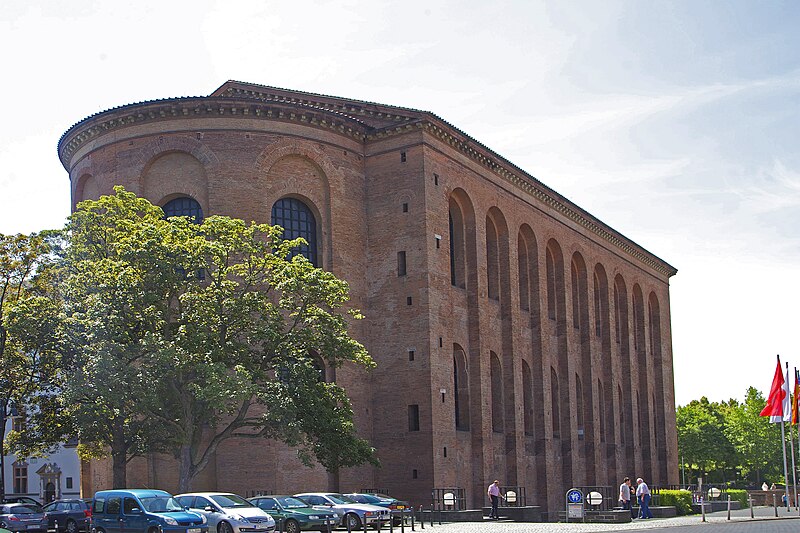
Welcome to the Aula Palatina, also widely known as the Basilica of Constantine, a magnificent architectural triumph and a breathtaking monument to ancient Roman engineering located in the historic heart of Trier, Germany. As you stand here on Konstantinplatz, take a moment to look up at the soaring red brick facade that rises dramatically against the skyline before you. Constructed approximately seventeen hundred years ago in the early fourth century, this colossal hall originally served as the monumental audience chamber for Roman emperors who ruled the vast Western Empire from this very city. Over the succeeding centuries, this extraordinary building underwent a series of remarkable physical transformations, evolving from an imperial throne room into a fortified medieval bishop residence, a grand eighteenth century Electoral Palace, and ultimately a restored nineteenth century Protestant house of worship, all while retaining its original classical grandeur. Recognizing its exceptional universal value and incredible state of preservation, UNESCO inscribed this site as an integral component of the World Heritage listing for the Roman Monuments, Cathedral of St. Peter, and Church of Our Lady in Trier. Today, this monumental hall stands as a living historical bridge that seamlessly connects the ancient classical world with our modern era. Throughout our comprehensive audio guide tour, we will explore the fascinating layers of architecture, history, and sacred culture preserved within these ancient walls. Our walking itinerary has been carefully designed to offer you an engaging and immersive experience of this UNESCO World Heritage monument. We will begin our exploration by examining the massive exterior brickwork on the western side, discovering the extraordinary engineering techniques that allowed Roman builders to construct such an immense uncolumned structure. Next, we will stroll toward the south entrance where ancient Roman masonry dramatically meets the pastel pink facade of the eighteenth century Rococo Electoral Palace. From there, we will step inside the great main hall to experience the awe-inspiring vastness of its column-free interior, marveling at its timber coffered ceiling and discovering the ingenious hypocaust floor heating system hidden beneath our feet. Continuing toward the northern apse, we will inspect the political heart of the hall where the emperor once sat, reflecting on its catastrophic destruction during the Second World War and its thoughtful post-war revival. We will also admire the magnificent symphonic pipe organ mounted on the wall, appreciating how the hall exceptional acoustic design continues to serve sacred music today. Finally, we will gather outside at Martin Luther Platz by the Red Tower to conclude our tour. Now, please follow the path toward the western exterior wall to begin our first detailed spot.
02 The Exterior Brick Wall
This colossal brick wall has stood firm for over seventeen hundred years powered purely by the structural strength of solid bricks and Roman concrete without a single interior supporting column making it the largest surviving single room structure from classical antiquity. Look up toward the soaring vertical lines of the red brick facade and observe how the monumental arched windows repeat in rhythmic harmony against the sky. …
03 The South Vestibule and Entrance
Before entering the imperial throne room visitors originally passed through an elegant transverse vestibule that demonstrated the incredible architectural originality and spatial planning of the Roman basilica structure. Look closely at the arch above the south entrance and then turn your gaze to the adjacent pastel pink facade of the Rococo Electoral Palace resting directly against the ancient Roman brickwork. …
04 The Great Hall and Hypocaust
Measuring sixty seven meters in length approximately twenty seven meters in width and rising to a height of thirty three meters this stupendous hall represents the largest surviving column free interior space from classical antiquity. As you step into the center of the hall look down at the floor beneath your feet and then slowly raise your gaze all the way up to the coffered timber ceiling hanging thirty three meters above you. …
05 The Northern Apse
This semicircular apse was the supreme political heart of the hall where the Roman emperor sat elevated on his golden throne receiving envoys and state guests from across the ancient world. Look closely at the sweeping curved wall of the northern apse and then direct your gaze toward the marble head sculptures mounted against the east wall. …
06 The Grand Eule Organ & Acoustics
Over six thousand individual organ pipes are split and custom mounted directly inside the tall window niches transforming this entire ancient Roman hall into a giant living acoustic instrument. Look up at the three separate organ pipe housings mounted high along the wall and observe how they fit perfectly into the tall vertical window arches. …
07 Closing
As our audio guide tour comes to an end, please take a moment to stand on Martin Luther Platz outside the basilica and look toward the nearby Red Tower and surrounding historical garden. The Red Tower, situated to the north of the basilica, was originally constructed in the seventeenth century as an archival administrative building for the Prince Electors of Trier. …