Contents
History & cultureBY TELLBY7 sections · numbered as on the map01 Orientation
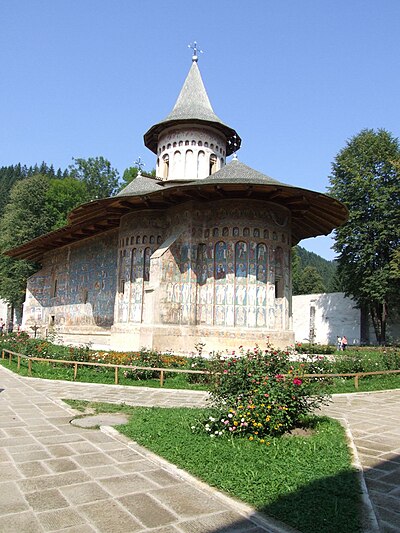
Welcome to the Church of the Beheading of Saint John the Baptist, popularly known as Arbore Church, located in the peaceful commune of Arbore within Suceava County, Romania. This extraordinary sanctuary is celebrated across the globe as one of the renowned painted churches of northern Moldavia. In nineteen ninety-three, UNESCO recognized its outstanding universal value by inscribing it onto the World Heritage list. Unlike typical European religious monuments where exterior wall paintings serve merely as isolated decorative accents, the painted churches of Moldavia present a complete, systematic tapestry of sacred mural frescoes that envelop every outer facade, harmonizing naturally with the surrounding rural landscape.
The origin of this sanctuary traces back to the spring of fifteen hundred and two. It was commissioned by Luca Arbore, a prominent high boyar and nephew of ruler Stephen the Great, who served for nearly four decades as the trusted gatekeeper and military commander of Suceava Castle. Seeking to build a grand private domain and family burial site, Luca Arbore purchased the village land of Solca from the nephews of Carstea Horaetz and Sandru Gherman on March seventh, fifteen hundred and two. Choosing the historical ground of an ancient hermitage, he initiated construction on April second, fifteen hundred and two. Remarkably, the entire structure was completed from its foundation stone to the apex of its roof in just four months and twenty-seven days, concluding on August twenty-ninth of the same year to coincide with the patronal feast day of the Beheading of Saint John the Baptist.
When you look at the silhouette of Arbore Church, you will immediately notice the absence of a central tower or steeple rising above the roof. Under the strict laws and traditions of medieval Moldavia, the right to erect towering steeples on religious buildings belonged exclusively to the reigning voivode or monarch. Because Luca Arbore was a boyar rather than a ruler, his church was designed with a lower, elegant roofline that curves gracefully toward the east. Throughout its turbulent history, the church endured severe trials. During the seventeenth and eighteenth centuries, the sanctuary was looted and left completely roofless for over a hundred years. Astonishingly, even as tall trees grew directly upon its masonry vaults and drove roots into the stone, the underlying structure remained firm, preserving its sacred inner and outer frescoes for future generations.
This audio tour will guide you step by step through the remarkable architectural and artistic details of the complex. We will begin our walkthrough directly outside at the western facade, inspecting its massive arched cavity. From there, we will trace the south wall adorned with monumental murals, step through the Gothic doorway into the pronaos and boyar necropolis, explore the nave with its hidden acoustic masonry, and conclude in the tranquil garden beside the stone bell tower. Please walk over to the western exterior wall to begin our first spot narration.
02 The Western Facade and Miniature Frescoes
Standing before the western facade of Arbore Church, you are immediately confronted with an astonishing chromatic marvel that has defied the passage of centuries. The iconic green background pigment preserved across these exterior walls was formulated using five distinct tonal base shades combined into forty-seven subtle nuances of emerald, olive, and pale green, perfectly harmonized with accents of Voronet blue. …
03 The Southern Facade and Political Frescoes
As you step around to the southern facade of Arbore Church, you encounter a fascinating historical and theological masterpiece painted boldly across the exterior wall. Displayed prominently on this Orthodox sanctuary is a dramatic, large-scale battle scene portraying the seventh-century Persian siege of Constantinople from the year six hundred and twenty-six. …
04 The Gothic Portal and Pronaos
As you pause before the threshold of the southern entrance portal, consider an extraordinary architectural achievement in medieval Moldavia. Arbore Church was erected from its initial foundation stone to the apex of its roof in just four months and twenty-seven days, between April second and August twenty-ninth in the year fifteen hundred and two—an astonishing construction speed for a permanent stone sanctuary. …
05 The Boyar Necropolis and Founder's Tomb
Standing before the boyar necropolis in the pronaos, you are confronted with a haunting and tragic irony of medieval history. The founder of this church, the high boyar Luca Arbore, met the exact same fate as the patron saint of his sanctuary when, in April fifteen hundred and twenty-three, he was falsely accused of treason by political rivals and beheaded without trial amidst court intrigue. …
06 The Nave and Hidden Sound Architecture
Stepping through the thick stone doorway into the nave, the most sacred sanctuary of Arbore Church, you are enclosed within a room governed by a hidden engineering marvel. Built directly into the thick stone masonry of these interior walls are hollow ceramic acoustic jars filled with sand, placed according to a sophisticated Italian architectural method to eliminate harsh echoes and grant vocal chants and liturgical prayers absolute clarity and a resonant, echoing acoustic depth. …
07 Closing
Now, please step out into the open courtyard and take a deep breath of the fresh rural air while walking toward the two-story stone bell tower located to the northwest of the main sanctuary. Erected in eighteen sixty-seven, this charming stone belfry stands in perfect architectural harmony with the medieval church, adding a timeless rural quietude to the monastic enclosure.
Arbore Church has endured a remarkable journey of resilience and survival across more than five centuries of history. …