Contents
History & cultureBY TELLBY7 sections · numbered as on the map01 Orientation
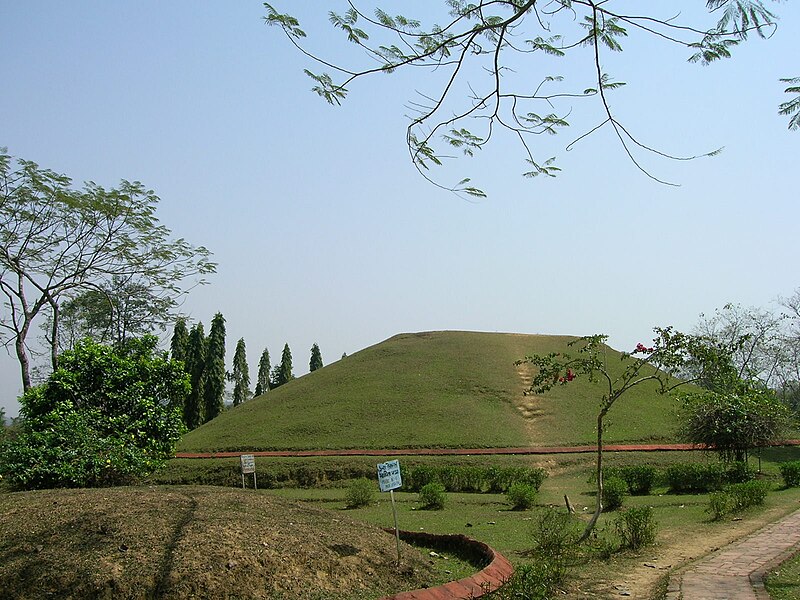
Welcome to the sacred ground of Charaideo Moidams located in the peaceful foothills of the Patkai Ranges in eastern Assam. This magnificent site is a royal mound burial necropolis established by the Tai Ahom dynasty, who ruled this region with grand authority across six centuries of historic tradition. In early times, Prince Siu kha pha led the Tai Ahom migration into Assam and selected Charaideo as their very first capital and the permanent sanctuary for their royal necropolis. The Tai Ahom people regarded their monarchs as divine beings descended from heaven. They believed that when a king or royal family member passed away, their spirit transformed into a deity in a sacred realm that seamlessly bridged the divide between heaven and earth. To honor this unique worldview, they developed an extraordinary system of mound burials known as moidams. Beyond housing royal remains, this necropolis also held profound military and spiritual significance. When enemy rulers or rival warriors fell in battle, such as during the fall of the Chutia kingdom in fifteen twenty four, the severed heads of the defeated Chutia king and his son were ceremonially buried within these grounds to appease spirits and assert sacred dominance. In the year twenty twenty four, during the session of the World Heritage Committee held in New Delhi, this ancient landscape was officially inscribed on the UNESCO World Heritage List. It marks India's forty third World Heritage property and holds immense historic pride as the first cultural heritage site from North East India to receive this prestigious global designation. The site joins Kaziranga National Park and Manas Wildlife Sanctuary as the third World Heritage property in Assam. UNESCO recognized Charaideo Moidams for its outstanding universal value as an exceptional testimony to the funerary traditions and cosmological beliefs of the Tai Ahom civilization. Across centuries, human hands carefully sculpted the natural landscape by building hemispherical earthen mounds over vaulted chambers, channelizing natural streams to form sacred water bodies, and planting holy trees to accentuate the rolling topography. Rather than standing separate from nature, this entire necropolis was engineered into a sacred geography where natural hills, flowing waters, and artificial earthen mounds work together to symbolize the complete Tai universe. As you step onto these sacred grounds, you are walking through a living testament to six centuries of royal lineage, master engineering, and spiritual reverence. Please take your time to walk among these peaceful grassy hills and experience the timeless atmosphere of this royal sanctuary.
02 The Octagonal Dwarf Wall and Sacred Gateway
The name Moidam that we use today comes directly from the original Tai Ahom language phrase Phrang Mai Dam. In this ancient language, the phrase Phrang Mai means to bury or to place into a grave, while the word Dam refers to the dead ones or the ancestral spirit. Therefore, a Moidam is quite literally defined as a sacred home for the spirit of the deceased. …
03 Excavated Chamber of Maidam Number 2
When the Archaeological Survey of India Guwahati Circle excavated this specific mound known as Maidam Number 2 between the years two thousand and two thousand two, they made a remarkable discovery that astonished the archaeological world. Despite extensive historical plundering, archaeologists uncovered a fully intact domed brick vault containing the skeletal remains of five individuals alongside magnificent ivory art objects and structural components. …
04 Maidam Number 1 and the Royal Transformation
The colossal mound standing directly in front of you, designated as Maidam Number 1, spans an astounding diameter of two hundred sixty five meters, reflecting the supreme power and royal authority of the monarch laid to rest inside. Throughout the history of the Ahom kingdom, the physical height and circumference of a Moidam directly mirrored the political stature, wealth, and power of the king. …
05 Sacred Topography and Water Bodies
The moidams at Charaideo are far more than individual isolated tombs. They form a completely engineered sacred landscape where natural hills, planted sacred forests, and stream channels were artificially shaped over six centuries to construct an eternal home for ancestral spirits. The Tai Ahom people transformed the natural terrain into a grand cosmological model that harmonizes human construction with nature. …
06 Chou Cha Li Pavilion and the Sky Realm
The shrine standing atop the peak of the earthen mound, known as the Chou Cha Li, represents Mungklang, a sacred middle space in Tai cosmology symbolized as a golden ladder bridging heaven and earth. It serves as the spiritual conduit through which the soul of the deceased monarch ascends from the earthly realm into the celestial kingdom to become a god. Please raise your eyes to the open brick pavilion standing proudly at the apex of the earthen mound. …
07 Closing
Thank you for taking this audio tour through the sacred royal necropolis of Charaideo Moidams. Today you have journeyed through six centuries of living history created by the Tai Ahom dynasty. The ninety burial mounds scattered across this landscape stand as an exceptional testament to a rich cultural tradition, master engineering, and a spiritual worldview that harmonized human creation with the natural environment. …