 Photo Wikimedia Commons
Contents
History & cultureBY TELLBY7 sections · numbered as on the map01 Orientation
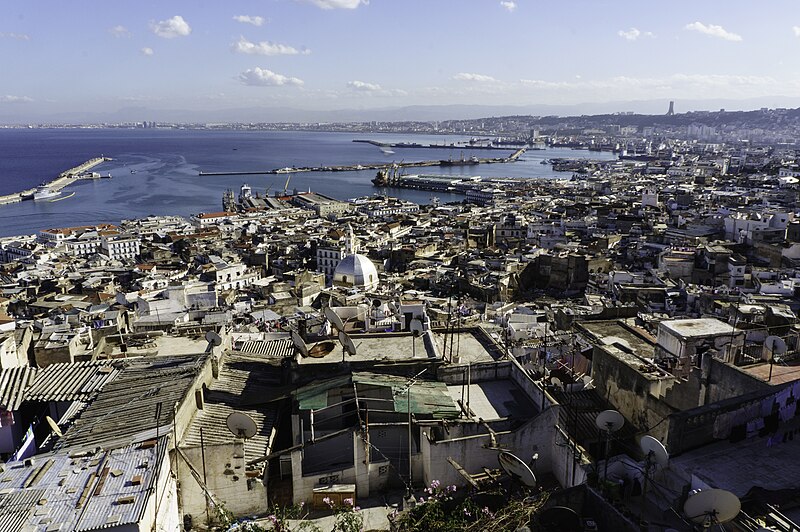
Welcome to the Casbah of Algiers, an extraordinary historic medina cascading down a steep coastal slope overlooking the turquoise waters of the Mediterranean Sea. This remarkable urban ensemble represents an outstanding synthesis of Arab Berber architecture and traditional urban planning. Recognized for its exceptional cultural value and preserved spatial integrity, the site was officially designated a UNESCO World Heritage Site in nineteen ninety two. The human history on this promontory dates back to ancient antiquity. Before the foundation of the current medina, the site served as an ancient Phoenician trading port known as Ikosim, established to connect maritime commerce across the western Mediterranean basin. The name Ikosim historically translated to the island of owls or island of thorns, referring to the small islets sheltering the natural harbor. The city subsequently transitioned through Numidian Berber control and eventually became a thriving Roman settlement named Icosium. The foundational framework of the present medina was established in the tenth century, precisely in the year nine hundred sixty, by Buluggin ibn Ziri, the founder of the Zirid dynasty. He constructed the new urban center upon the ancient Roman ruins, creating a vibrant Berber stronghold named El Djazair, referring to the offshore islets that protected the bay. When viewed from the sea, the Casbah presents a striking visual spectacle. White terraced houses rise progressively along the sharp incline, creating the appearance of a colossal pyramid or a grand triangular amphitheater carved into the hillside. The luminous white facades of the tightly packed dwellings inspired historical travelers and poets to compare the city to a majestic sphinx reclining along the bay. Built across a dramatic topography with an elevation gain of one hundred eighteen meters, the medina features an exceptionally dense urban fabric. Intricate networks of narrow, winding alleyways and vaulted passages were deliberately designed to follow the natural contour of the land while providing formidable defense against potential invaders. Each terraced rooftop was engineered to offer an unobstructed view of the sea while maintaining intimate family privacy. Due to the extreme steepness and narrowness of these historic passages, modern motor vehicles are entirely unable to navigate the interior of the district. Consequently, a traditional practice dating back to the period of the Regency of Algiers remains active today, as donkeys continue to navigate the labyrinthine streets to collect waste and deliver essential goods to residents. Overlooking the entire medina stands the powerful citadel, which historically provided formidable defense against maritime bombardments and land invasions. This dominant defensive presence earned Algiers its celebrated Arabic title El Djazair El Mahroussa, meaning Algiers the Protected. As we step into these ancient cobblestone paths where Mediterranean breezes whisper through centuries of history, let us begin our journey through the living soul of the Casbah.
02 The Citadel of Algiers: The Seat of Power on the Heights
Did you know that in eighteen seventeen, Dey Ali Khodja, the ruler of Algiers, made a dramatic decision to secretly transfer the entire public treasury to this citadel on the heights, barricading himself inside alongside a personal guard of two thousand loyal Kabyle troops to escape the tyrannical threats and violence of the Ottoman janissary militia? …
03 Ketchaoua Mosque: Convergence of Architectural Styles
Did you know that this magnificent structure, originally founded in fourteen thirty six during the reign of Berber dynasties, features an extraordinary synthesis of Moorish, Ottoman, and Byzantine architectural styles, and endured a turbulent transformation when it was forcibly converted into a Catholic cathedral during the colonial era before being triumphantly restored to Islamic worship upon national independence? …
04 Jamaa El Kebir: The Great Mosque of the Almoravids
Did you know that Jamaa El Kebir, the Great Mosque of Algiers, was constructed in ten ninety seven by the Almoravid ruler Yusuf Ibn Tashfin, making it the oldest surviving Islamic sanctuary in the Casbah and preserving its spiritual essence for nearly a thousand years? As the most ancient religious landmark in Algiers, this grand mosque embodies the profound aesthetic influence of Hispano Moorish and Almoravid artistic traditions that flourished across the Maghreb during the eleventh century. …
05 Palais des Raïs: The Corsairs Fortress on the Waterfront
Did you know that the Palais des Raïs, also known as Bastion twenty three, stands as the last surviving coastal palace complex directly touching the waterfront of Algiers, serving historically as both a luxurious residential haven and a fortified maritime stronghold for the legendary corsair captains who commanded the Mediterranean Sea? …
06 Mausoleum of Sidi Abderrahmane: The Spiritual Heart of Algiers
Did you know that when Queen Victoria of the United Kingdom visited this sacred sanctuary, she was so profoundly moved by the serene grace and spiritual sanctity of the burial place that she personally donated exquisite crystal chandeliers that continue to illuminate the tomb to this day? The Mausoleum and Madrasa of Sidi Abderrahmane serves as the paramount spiritual heart of Algiers, offering a tranquil sanctuary of reverence and historical memory for the residents of the medina across…
07 Closing
As we look out across the azure waters of the Mediterranean Sea, our journey through the historic Casbah of Algiers comes to its conclusion. The Casbah is far more than a static museum frozen in time; it is a vibrant, living community where generations of families continue to reside, where the rhythmic hammering of copper coppersmiths and woodcarvers resonates through narrow stone alleys, and where the soulful melodies of Chaabi music, pioneered by masters like Hadj El Anka, echo from…