 Photo Wikimedia Commons
Contents
History & cultureBY TELLBY7 sections · numbered as on the map01 Orientation
Welcome to Site Twenty One Phoukeng Quarry, the cradle of the iconic megalithic stone jars on the Plain of Jars in Xieng Khouang Province, Laos. Situated along the dramatic slopes of Phoukeng Mountain, which rises over fourteen hundred meters above sea level, this ancient industrial landscape offers a profoundly vivid encounter with an extraordinary Iron Age civilization. In two thousand nineteen, UNESCO inscribed the Megalithic Jar Sites in Xieng Khouang on the World Heritage List, recognizing the vast collection of tubular shaped stone jars used for funerary practices during the ancient Iron Age. Among the various component sites that form this extraordinary serial property, Site Twenty One stands out as the largest known sandstone quarry in the entire province. When viewed from a distance, Phoukeng appears to be merely a peaceful forested peak, yet its steep terrain functioned as a monumental ancient workshop. Archaeological research has conclusively confirmed that this quarry served as the exact origin of the magnificent sandstone jars now standing at Site One, located roughly eight kilometers away. Ancient stonecutters carved these massive cylindrical vessels directly from the mountain bedrock and transported them down into the surrounding plateau to serve as central funerary monuments that reflected complex social hierarchies and spiritual rituals. Visiting Phoukeng offers a unique opportunity to witness the complete life cycle of these megaliths. Across the mountain slopes, one can observe raw rock outcrops, partially carved block shapes, unfinished jars still attached to the cliff face, and finished vessels abandoned along the transport paths. Every stage of quarrying, shaping, and transportation is preserved here like a time capsule frozen in stone. The physical effort and technical ingenuity required to extract and move these heavy stone monuments without modern machinery remain truly awe inspiring. Furthermore, the Plain of Jars occupied a vital historical crossroads between major regional cultural systems, facilitating trade, movement, and exchange across Mainland Southeast Asia. As you begin your journey today, listen closely to the whispering mountain winds and imagine the rhythmic echoing of ancient chisels against the sandstone cliff face. Welcome to Phoukeng Quarry, where the enduring memory of an ancient civilization continues to resonate through the silent carved stones.
02 Abandoned Jars along the Lower Slopes
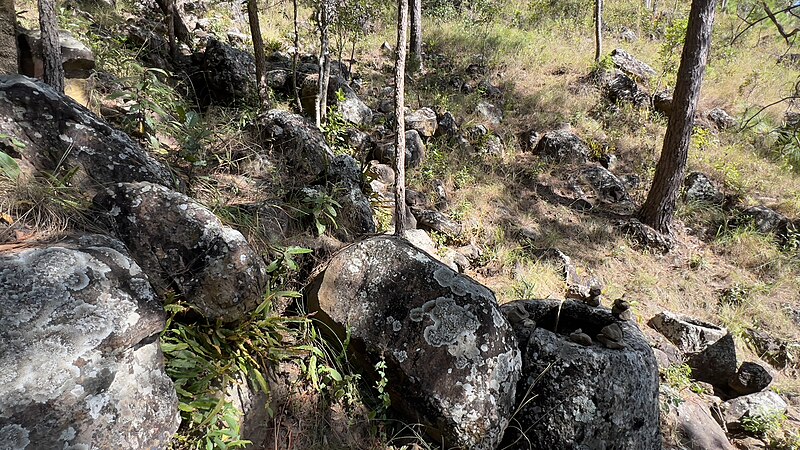
The stone jars resting here in isolation are not finished products, but cargo that came to an abrupt halt during transit over two thousand years ago. Pause your steps for a moment and look toward the left side of the lower slope, among the lush grass and wild vegetation. Scattered along the gentle incline, you will discover several massive sandstone jars, heavily weathered and coated in thick green moss, standing alone or forming small clusters across the terrain. …
03 Carving the Mountain: The Steep Slope Quarries
These monumental stone jars were not fashioned from rocks brought in from elsewhere; rather, they were carved and detached directly from the steep bedrock cliffs of this very mountain. Raise your eyes and look at the sheer, weathered face of the massive sandstone cliff towering directly ahead of you. Perched on the steep slopes of Phoukeng Mountain, which reaches heights exceeding fourteen hundred meters above sea level, these dramatic rock faces are not merely natural geological formations. …
04 Scars of Modern War: Bomb Craters Among Ancient Stones
This serene mountain slope was the tragic site of some of the most concentrated aerial bombing in world history during the twentieth century Secret War. Turn your gaze toward the right, just behind that large rock formation, and observe the broad, crater like depression covered in wild grass. Though it may appear at first glance to be a natural dip in the terrain, this deep hollow is actually a bomb crater blown into the hillside by aerial ordnance dropped during the Second Indochina War. …
05 Unfinished Masterpieces: Hollowed Stone in Progress
This jar is an extraordinary time capsule frozen mid process, where internal hollowing was abruptly halted, preserving the exact working methods of ancient stonemasons. Step closer to the upper mouth opening of the jar and peer into the depths of its hollow cavity. Inside, instead of a smooth, fully excavated chamber, you can clearly observe raw, step like concentric grooves and deep chisel marks on the interior walls, appearing as if the worker laid down his tools only moments ago. …
06 Overlooking the Plateau: The Trail to Site 1
Looking out across the sweeping plateau from this summit viewpoint, just eight kilometers away lies Site One, where hundreds of stone jars crafted on this very mountain are gathered. Cast your eyes far into the distance, taking in the vibrant green Xieng Khouang plateau and the undulating mountain ridges below. The breathtaking panorama unfolding before you served as the grand geographical stage across which ancient communities transported massive megalithic vessels thousands of years ago. …
07 Closing
This concludes our audio guide tour of Site Twenty One Phoukeng Quarry, the remarkable birthplace of the megalithic stone jars on the Plain of Jars in Xieng Khouang, Laos. Today, as you walked along the slopes of Phoukeng Mountain rising over fourteen hundred meters above sea level, you experienced a vivid encounter with an extraordinary Iron Age civilization dating back to five hundred BCE. …