Contents
History & cultureBY TELLBY7 sections · numbered as on the map01 Orientation
Welcome to the official audio guide for Plain of Jars Site 3, situated amidst the picturesque rural countryside near Phonsavan in Xiangkhouang Province. This remarkable location offers a deeply atmospheric encounter with ancient Iron Age megaliths set directly within a serene agricultural landscape. The megalithic jar sites scattered across this central plateau were officially inscribed as a UNESCO World Heritage site in 2019 in recognition of their exceptional universal value and cultural significance. Distributed across the rolling hills and valleys of north central Laos, these carved stone vessels stand as the most prominent enduring evidence of an ancient Iron Age civilization that once flourished throughout the region. Although the people who fashioned these impressive monuments left behind no written records or inscriptions to tell their story, their massive stone creations continue to provide invaluable clues regarding ancient mortuary rituals, social hierarchies, and regional exchange networks.
Site 3 is widely appreciated as one of the most tranquil, unspoiled, and authentic locations among the serial World Heritage components, largely because it receives far fewer tourists compared to larger locations across the province. We are currently beginning our tour at the ticket office area. This entrance station is positioned approximately 550 meters away from the elevated hilltop enclosure where the ancient stone jars are located. Because the paved access road ends completely at this point, all visitors traveling by car or minibus must park here and proceed the rest of the way on foot. Surrounding the ticket office, you will notice a modest local restaurant, visitor restrooms, and a charming local village temple that forms an integral part of the surrounding community life. Day to day management of this site is carried out through village contracts based on national heritage laws and provincial decrees, establishing a sustainable formula for sharing tourism revenue directly with the local community.
From this starting area, our walking journey will take us across active agricultural fields and past beautiful rural scenery toward the elevated ridge ahead. The walking path leads first across a small stream via a rustic wooden bridge, continues along narrow earthen levees separating active rice paddies, and finally ascends a gentle incline to the bamboo fenced perimeter. Taking this path gives you a wonderful opportunity to experience the traditional rhythm of Laotian rural life while preparing to encounter a historical mystery that has endured across centuries. When you are ready to begin, please follow the dirt track forward toward our first stop at the wooden bridge.
02 Crossing the Wooden Plank Bridge
Please take a moment to look down at your feet as you cross this modest structure. This small wooden bridge, which every visitor must traverse to reach Site 3, is an intriguing and surprisingly uncommon piece of local engineering. The most astonishing feature of this bridge lies in how its upper walking surface is constructed. If you observe the timber underfoot closely, you will discover that the thick planks forming the walkway are completely unsecured. …
03 Walking Along the Agricultural Levees
Please take a look to your left and right at the wide expanse of active rice paddies stretching out around us. As we leave the wooden bridge behind, the earthen path we are following runs directly along the narrow levees that local villagers construct and maintain to farm their crops. One of the most striking aspects of visiting Site 3 is that reaching this ancient heritage location requires walking straight through the center of an active, living agricultural landscape where local farmers work…
04 Entrance to the Rectangular Enclosure
Please take a close look at the entrance gate right in front of you. Where you are standing now marks the formal entrance to Site 3, a designated component of a UNESCO World Heritage site. However, it presents a surprisingly modest, humble, and deeply authentic appearance that stands in sharp contrast to what one might expect from a major international landmark. …
05 Dense Cluster of Small Stone Jars
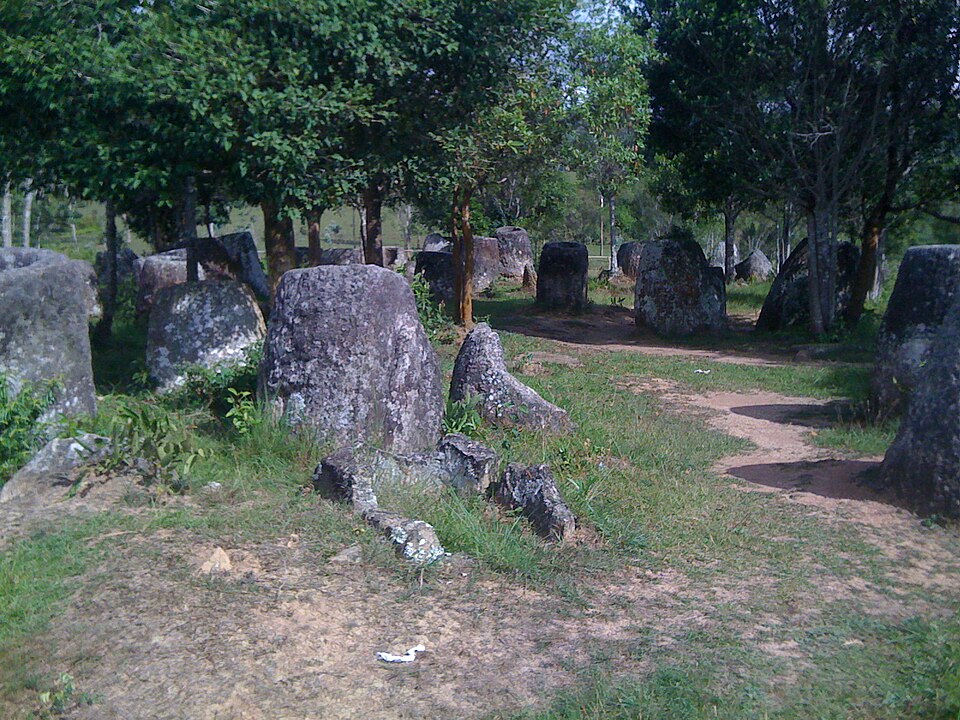
Please take a moment to notice the high density of small sandstone jars arranged in the center of this lawn. As you stand near the middle of this hilltop enclosure, you are surrounded by a remarkably tight concentration of compact stone vessels. In total, Site 3 contains approximately 150 megalithic jars, presenting a striking spatial contrast to larger locations across the plateau where jars are spread across a much broader area. …
06 The Outer Ring of Large Sandstone Jars
Please direct your attention to a massive stone jar situated along the fence line. As your eyes move away from the dense central cluster toward the outer perimeter of the site, you will notice several significantly larger sandstone jars positioned at wider intervals along the edges of the enclosure. Archaeologists and heritage experts offer a compelling multi stage funerary theory to explain this distinct spatial layout separating the small central jars from these massive outer vessels. …
07 Closing
Our audio guided exploration of Plain of Jars Site 3 has now come to a conclusion. Standing here on this quiet hill among these silent stone witnesses, overlooking the peaceful Laotian countryside, offers a truly unforgettable moment of contemplation. These ancient megaliths, crafted with remarkable skill by Iron Age peoples who disappeared without leaving a single written word, continue to speak across time about the universal human desire to honor the departed and mark the passage of time. …