 Photo Wikimedia Commons
Contents
History & cultureBY TELLBY7 sections · numbered as on the map01 Orientation
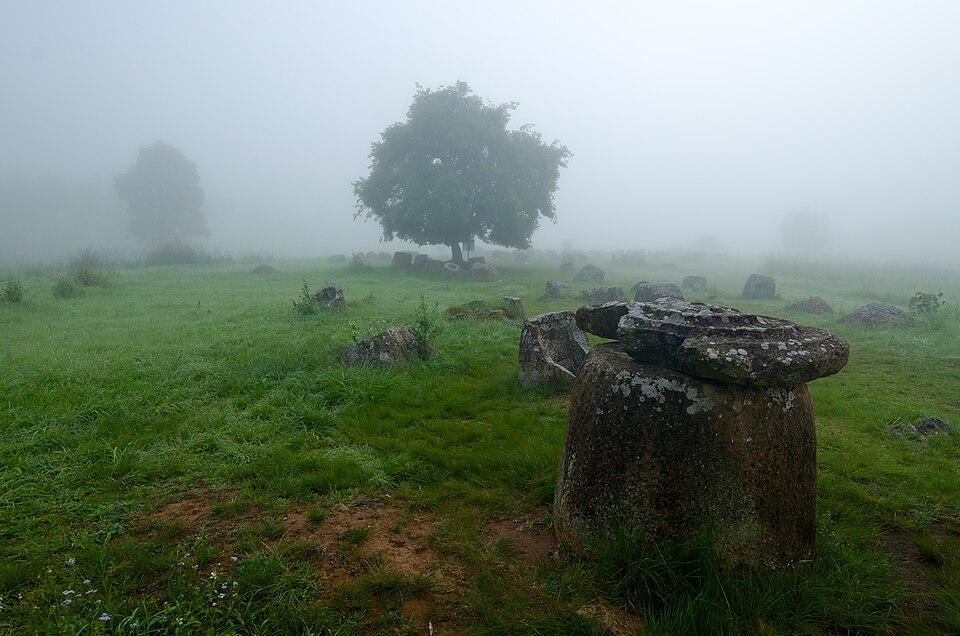
Welcome to Plain of Jars Site 1, one of the most enigmatic and compelling archaeological landscapes in Southeast Asia. As you stand here at the main overview point, take a moment to look out across the rolling green plateau of Xiengkhuang. Dotted across these hillsides are hundreds of massive cylindrical stone vessels that have quietly weathered the centuries. In July 2019, this extraordinary landscape was officially inscribed as a UNESCO World Heritage Site in recognition of its exceptional cultural significance. These megalithic stone jars represent the most prominent remaining evidence of an advanced Iron Age civilization that flourished in central Laos between 500 BCE and 500 CE. The site offers an irreplaceable window into ancient funerary traditions, complex labor organization, and the ritual beliefs of a culture that ultimately vanished around fifteen hundred years ago.
Across the broader Xiengkhuang region, surveys have confirmed the presence of more than twenty-one hundred megalithic jars scattered across one hundred and twenty-nine documented individual sites. Among all these locations, Site 1 is recognized as the largest, most accessible, and historically central area. The Plain of Jars was situated at a vital historical crossroads between two major cultural systems of Iron Age Southeast Asia: the Mun-Mekong River system to the south and west, and the Red River and Gulf of Tonkin system to the east. The strategic distribution of these jar sites along ancient ridge lines and highland passes indicates that they were intimately connected with long-distance overland trade routes that facilitated the exchange of goods, ideas, and cultural traditions across the Indochinese peninsula. The landscape immediately surrounding Site 1 contains five distinct clusters or groups of jars positioned strategically on ridge lines and gentle slopes overlooking the fertile valleys below.
According to a cherished local legend, a mighty king named Khun Cheung once ruled over a race of giants inhabiting this high plateau. After fighting a long and arduous military campaign, King Khun Cheung achieved a decisive victory over an oppressive rival ruler named Chao Angka. To commemorate this monumental triumph, the victorious king ordered his subjects to construct huge stone vessels to brew and store immense quantities of traditional rice wine, known locally as lau hai. Legend holds that the largest jars were reserved for the king and his highest commanders to drink from during a celebratory feast that lasted for months. While modern archaeological science has shown that these vessels were created as mortuary containers rather than wine vats, the legend reflects the deep cultural pride and fascination that local communities have held for these ancient monuments throughout history. As we begin our walk through the site, we will explore how these massive stones were quarried, transported, and carved to serve as the sacred final resting places for an ancient civilization.
02 Megalithic Engineering on the Northern Ridge
Some of these massive stone jars weigh up to fourteen tons, carved entirely out of solid rock over two thousand years ago. As you walk along the designated path toward the northern hill, direct your gaze to the prominent ridge straight ahead. Standing before you is Group 1, a remarkable cluster comprising sixty sandstone jars positioned along the elevated spine of the hill. …
03 The Crescent Hill and the Frogman Relief
Out of more than two thousand stone jars across Laos, only a single jar features a carved human figure on its exterior. Please follow the path and pause in front of the sweeping hill that defines Group 2. Before you lies an exceptional sight, a dramatic crescent shaped arrangement of two hundred and twenty-seven massive stone jars positioned along the curving contours of the ridge. …
04 Unveiling Secondary Burials and Grave Goods
Beneath the soil surrounding these jars lay the skeletal remains of dozens of individuals interred in shared burial pits dating back over a thousand years. Please look down at the ground stretching between the stone vessels, where archaeological teams carefully opened excavation trenches such as the key area known as Unit 4. As you examine the surface, you will notice scattered blocks of limestone and white quartz rich breccia boulders embedded in the dark soil. …
05 The Natural Limestone Cave and Ancient Crematorium
This natural limestone cave served as a sacred space where bodies may have undergone cremation before their final burial. As you finish crossing the open field, approach the foot of the imposing limestone formation rising dramatically to the east. This area forms part of a classic Fengcong karst landscape, characterized by dramatic limestone peaks and natural rock shelters. Stand near the cave entrance and look upward toward the cliff face and the upper ceiling of the cavern. …
06 Traces of War and the UXO Clearance Mission
Between 1964 and 1969, hundreds of millions of cluster bombs were dropped across Laos, leaving this ancient landscape heavily scarred by unexploded ordnance. As you walk along this section of the designated pathway, observe the terrain on either side of the trail. You will notice numerous large circular depressions in the grassy ground. These bowl shaped hollows are not natural landforms, nor were they dug by ancient masons. …
07 Closing
Welcome to the final reflection point of our tour at Plain of Jars Site 1. Today, as we walked among the monumental sandstone jars, carved stone burial discs, secondary burial pits, and the sacred limestone cave, we experienced an extraordinary journey back through two thousand years of Southeast Asian history. The megaliths standing silently across these rolling hills reflect the monumental achievements, technological skill, and deep spiritual devotion of a vanished Iron Age civilization. …