 Photo Wikimedia Commons
Contents
History & cultureBY TELLBY7 sections · numbered as on the map01 Orientation
Welcome to the Bassari Salémata cultural landscape located in the remote southeastern corner of Senegal. This extraordinary territory represents a harmonious synthesis of human ingenuity and natural environment that has evolved over many centuries. Recognized globally as a UNESCO World Heritage site in twenty twelve, the landscape showcases how local communities have adapted to the rugged laterite terrain while creating a vibrant multicultural sanctuary that preserves ancient West African oral traditions and agricultural customs.
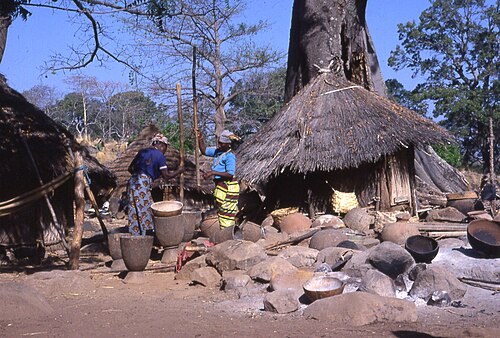
As you stand here at the entrance of the village, take a moment to absorb the striking physical surroundings. Before you stretch rolling hills of deep reddish laterite soil, traditional roundhouses crowned with carefully woven conical thatch roofs, and narrow footpaths worn smooth by generation after generation of local residents. The warm dry air carrying the distant scents of wild grasses and wood smoke invites you into a world where daily existence moves in quiet harmony with the natural rhythms of the earth. The local inhabitants refer to themselves as a-liyan, an indigenous term meaning those of the laterite, honoring the very red earth beneath their feet that has shaped their architecture, farming methods, and spiritual heritage.
This audio walk will guide you through five specific cultural stops that illuminate the deep traditions, artistic craft, and daily life of the community. From this orientation point, you will first visit a traditional roundhouse courtyard to discover the matrilineal family structures and domestic building techniques of the village. Next, you will move to an open-air metalworking hearth where skilled blacksmiths forge tools and ceremonial jewelry. Your path will then take you to an elevated fonio granary in the village square to learn about crop cultivation and agricultural resilience. Following that, you will step near the secluded initiation shelter where young men enter adulthood through sacred rites. Afterward, you will reach the village performance grounds, celebrated for vibrant dancing and traditional crafts. Finally, your journey will culminate at a scenic hilltop lookout offering a sweeping view of the entire landscape.
Please take your time as you walk along the red dirt trail. Whenever you reach a designated spot, pause your steps to observe the subtle architectural details, handcrafted tools, and natural surroundings described in the narrative. Remember to stay on the main paths and respect the daily routines of the villagers who call this living landscape home. When you are ready to begin, start walking slowly along the pathway leading toward the roundhouses ahead.
02 Traditional Roundhouse Courtyard
In this remarkable community, family lineage and property inheritance pass entirely through mothers, establishing women as the foundational social backbone of home construction and ancestral legacy. Unlike many patrilineal societies across the globe, the Bassari organize their households around maternal lineage, giving women a central role in organizing domestic spaces and sustaining family lineage over generations. …
03 Blacksmith Workshop and Metallurgy Hearth
Bassari blacksmiths have practiced complex metalwork since the late nineteenth century without owning local mines, relying entirely on long-distance regional trade networks to acquire their raw ore. Despite the complete absence of local iron or copper deposits in their immediate territory, these skilled artisans developed a sophisticated metallurgy tradition that became famous throughout the region for its technical precision and artistic elegance. …
04 Fonio Granary and Village Square
Bassari farmers routinely store grain reserves inside elevated granaries for two to three years in advance, creating an extraordinary system of agricultural security to survive harsh dry seasons. In a region where the off-season between August and November brings severe food scarcity and unpredictable rainfall, this tradition of long-term stockpiling guarantees community survival while providing valuable surplus grain for market trade with neighboring towns. …
05 Sacred Initiation Shelter
To become a recognized adult man in this community, a fifteen-year-old youth must undergo a profound symbolic rebirth mediated by a mysterious guttural sound known as endaw. This spiritual transformation marks the transition from childhood to adulthood, granting the initiate formal entrance into the sacred traditions that have governed Bassari society for centuries.
Cast your eyes upon the wide spreading branches of the ancient sacred tree shading the stone clearing directly in front of you. …
06 Ritual Dance Grounds
Despite violent efforts during the nineteen sixties regime to destroy initiation societies by publicly burning ritual objects and unmasking elders, the Bassari preserved their sacred traditions completely intact. When political authorities attempted to erase their heritage through intimidation, the community responded with quiet resilience, hiding their sacred masks and continuing their secret ceremonies in remote locations across the laterite landscape. …
07 Closing
Welcome to the hilltop lookout overlooking the living cultural landscape of Salémata. Standing high above the village, you are rewarded with a breathtaking panoramic view of reddish laterite footpaths, traditional thatched roundhouses nestled among green trees, and the expansive West African wilderness stretching out toward the horizon.
Today, as you walked along these ancient trails, you experienced firsthand the quiet dignity, resilience, and living heritage of the Bassari people. …