Contents
History & cultureBY TELLBY7 sections · numbered as on the map01 Orientation
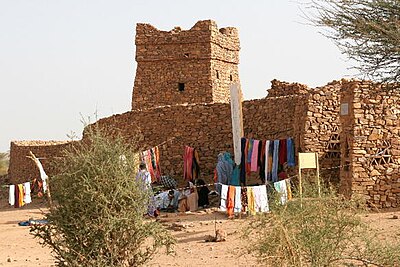
Welcome to the ancient Ksar of Ouadane, a historic treasure located on the eastern edge of the Adrar Plateau in central Mauritania. In nineteen ninety six, this exceptional desert settlement was officially inscribed on the UNESCO World Heritage list as part of the collective site known as the Ancient Ksour of Ouadane, Chinguetti, Tichitt, and Oualata. Between the twelfth and sixteenth centuries, Ouadane served as a critical trading and religious node along the trans Saharan caravan routes that crossed the vast expanse of the western Sahara. It stands as an outstanding historical testimony to a traditional nomadic culture and an urban framework brilliantly adapted to the extreme environmental challenges of the desert. Geographically, Ouadane is situated in the central desert region of Mauritania, positioned roughly ninety three to one hundred twenty kilometers east of its neighboring historic town of Chinguetti, commanding a strategic position atop the sandstone cliffs of the Adrar escarpment. Before you step into the stone ruins, please pause here at this outer viewpoint to orient yourself physically. Take a moment to scan the sweeping panorama of the rocky plateau, the desert horizon, and the dry stone masonry walls that rise dramatically against the open Saharan sky. This natural cliffside entrance offers an ideal perspective to appreciate how medieval builders integrated their defensive walls directly into the top of the plateau. As you prepare to explore, imagine the endless trains of camels laden with valuable regional commodities arriving at this very cliff edge after weeks of arduous travel across the shifting dunes. Our walking tour will guide you sequentially through the ancient urban layout, beginning at the oldest high district of Tegherbeyat, descending into the historical trade square where European merchants once operated, visiting the ruins of the grand fifteenth century mosque, strolling through the wind protected courtyard residential streets, and culminating at the restored home of the town founder before concluding at a breathtaking plateau viewpoint. Take a slow breath, adjust your footing on the rock path, and prepare to step through the ancient gates into a world sculpted by medieval trade, scholarship, and stone masonry.
02 Tegherbeyat Upper Ruined Quarter
Now that you have entered the upper sanctuary of the ancient ksar, you are standing in Tegherbeyat, which is almost certainly the oldest section of Ouadane. First settled in the twelfth century, this elevated citadel formed the original medieval heart of the town, housing its earliest community and first place of worship before the buildings gradually fell into complete stone ruin over centuries of desert abandonment. …
03 Portuguese Entrepôt Site and Trade Square
You have now descended from the upper fortress into the vibrant historical trading square of Ouadane. In the year fourteen eighty seven, Portuguese traders operating under the royal patronage of King John the Second established a short lived inland trading post, or feitoria, right here in Ouadane. This bold initiative marked an unusual European attempt to directly penetrate interior desert trade networks and intercept the lucrative flow of Saharan gold, rock salt, and enslaved persons before…
04 The Fifteenth-Century Lower Mosque
Standing before you are the striking structural remains of Ouadane's lower mosque, built during the fifteenth century as the town expanded downhill. This grand religious sanctuary featured a massive prayer hall supported by five distinct rows of elegant horseshoe arches, measuring twenty four meters along its eastern wall. Look directly at the standing stone horseshoe arch straight ahead of you, taking in its graceful curve constructed entirely from hand dressed local stone. …
05 Courtyard Houses and Salt Caravan Street
You are now walking through the dense residential core of Ouadane, where narrow, twisting alleyways pass between the solid, unadorned outer walls of traditional courtyard houses. These dense streets were deliberately engineered by medieval planners to act as natural windbreaks against fierce Saharan sandstorms, trapping cool morning air while keeping private inner family courtyards sheltered and peaceful. …
06 House of El-Hadj Ethmane and Restoration Center
You are standing before the beautifully reconstructed House of El-Hadj Ethmane, traditionally revered as one of the principal founding figures of medieval Ouadane. This masterfully restored residence serves as the primary physical benchmark for historic Saharan dry stone architecture, demonstrating how noble families combined security, comfort, and refined stonework within a compact desert home. …
07 Closing
We have reached our final stop at this panoramic clifftop viewpoint along the outer edge of the old ksar. From this commanding vantage point, take a moment to look out across the vast, timeless landscape of the Adrar Plateau, where the golden sands of the Sahara desert stretch endlessly toward the distant horizon. Nearby lies the extraordinary Richat Structure, a giant circular geological phenomenon deeply tied to this desert realm. …