 Photo Wikimedia Commons
Contents
History & cultureBY TELLBY6 sections · numbered as on the map01 Orientation
Welcome to the Gedeo Cultural Landscape, an extraordinary UNESCO World Heritage site situated in south-central Ethiopia. Stretching along the dramatic eastern flank of the Main Ethiopian Rift, this unique cultural territory spans an impressive elevation ranging from thirteen hundred and seven meters to over three thousand and seventy-two meters above sea level. For thousands of years, this rugged escarpment has served as the cherished homeland of the Gedeo people, who created a living realm where ancient megalithic monuments, sacred groves, and sustainable multi-layered agricultural traditions exist in profound harmony. Today, our journey guides you along a route extending from south to north across the landscape. You will encounter dense fields of standing steles, ancestral burial cairns, and thriving traditional agroforests that continue to sustain local communities. Before we step forward into this living sanctuary, we kindly ask you to observe a few essential visitation guidelines. The standing monoliths, subterranean tombs, and sacred forests you are about to see are not merely historical artifacts. They represent deeply revered cultural spaces where social memory, spiritual devotion, and environmental stewardship converge. Please refrain from touching, leaning against, or climbing any of the stone monuments. We also ask that you leave all ground surface materials undisturbed, as even the smallest obsidian flake beneath your feet carries invaluable archaeological context detailing ancient toolmaking traditions. Furthermore, the sacred forests scattered throughout the landscape are traditional conservation zones governed by customary laws that strictly prohibit tree clearing or resource harvesting. By staying on designated paths and walking quietly through these shaded groves, you help preserve the integrity of a fragile ecosystem and show respect to the living heritage of the Gedeo people. The walking paths feature gentle slopes and unpaved terrain with scattered stones and shaded moist soil, so please maintain a comfortable pace and watch your step. Throughout this audio tour, we invite you to immerse yourself in the rich narratives, scientific discoveries, and timeless wisdom preserved within this remarkable landscape. Let us now begin our exploration at Sakaro Sodo, home to the oldest megalithic monuments in the region.
02 Section 1
Sakaro Sodo marks the southernmost extreme of the Gedeo stele zone, holding a place of paramount archaeological significance as the oldest dated megalithic site in the region. Radiocarbon analysis of charcoal retrieved from Unit Two Level Five yielded an extraordinary date of twenty twenty-three BP, calibrated to nineteen BC, establishing that the tradition of erecting monumental steles in southern Ethiopia began more than two thousand years ago. …
03 Section 2
Spanning an expansive hillside area of over thirteen thousand two hundred square meters—a field substantially larger than a standard football stadium—Chelba Tutitti presents an astonishing sight where more than thirteen hundred steles stand packed in remarkable density. Please scan your eyes from left to right across the landscape to absorb the breathtaking spectacle of stone pillars standing in parallel alignment. …
04 Section 3
Beneath the unassuming mound of gathered rocks resting beside this trail lies an elaborate subterranean burial complex containing eight distinct tombs dating to the thirteenth century AD. Radiocarbon testing of organic samples recovered from Unit One Level Nine yielded a baseline age of twelve hundred and seventy-eight BP, calibrated to a median date of seven hundred and twenty-six AD, with burial activities continuing into the medieval period. …
05 Section 5
It is a truly astonishing ecological fact that over ninety percent of the total land area in the Gedeo Zone is covered not by open monoculture fields, but by a lush multi-layered agroforest that closely resembles a primeval natural forest. Please look up at the soaring canopy formed by native hardwood trees, and observe the broad green leaves of the false banana, known locally as Ensete, growing thick beneath them. …
06 Closing
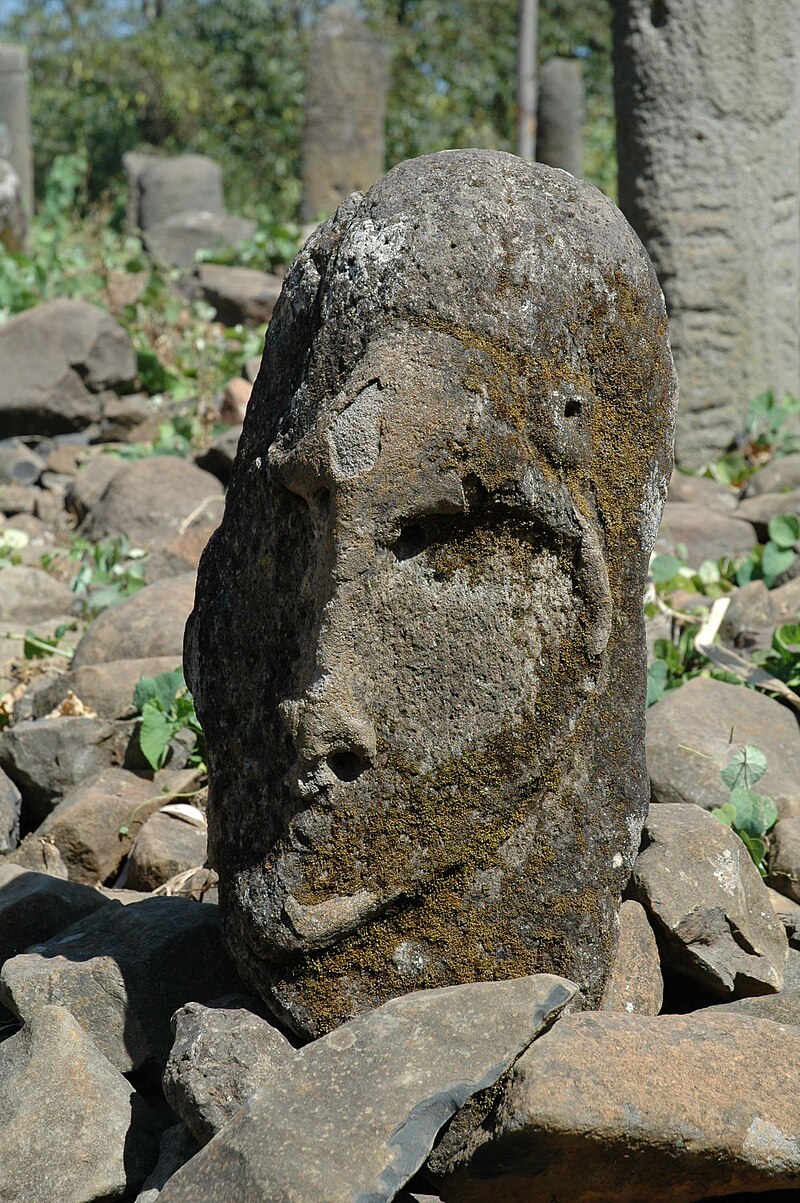
Today we have completed a memorable journey through the Gedeo Cultural Landscape, traveling across two thousand years of monumental history and living ecological wisdom. From the ancient phallic monoliths at Sakaro Sodo to the dense stone forest of Chelba Tutitti, the subterranean burial cairns at Soditi, the anthropomorphic face carvings and local ancestry at Tuto Fela, and the vibrant canopies of traditional agroforestry, we have witnessed a landscape where human culture and natural ecology…