 Photo Wikimedia Commons
Contents
History & cultureBY TELLBY7 sections · numbered as on the map01 Orientation
In two thousand nineteen, UNESCO inscribed the Ancient Ferrous Metallurgy Sites of Burkina Faso as a World Heritage site, officially celebrating one of the most significant independent technological breakthroughs in human history. For decades, outdated diffusionist theories claimed that advanced pyrotechnological skills were transmitted into West Africa from Mediterranean or Near Eastern civilizations. However, groundbreaking archaeological research right here at the Douroula complex shattered those assumptions, proving beyond doubt that indigenous West African societies independently developed high-temperature iron reduction long before foreign trade networks arrived.
You are standing at the primary orientation area of the Douroula metallurgical complex, situated within the fertile Mouhoun Bend region. As you look across the surrounding savanna landscape, notice the gentle, rounded earthen mounds rising above the flat terrain. In the local Marka language, these distinct artificial mounds are known as Tomo. They are not natural geological formations, but rather the cumulative physical deposits of continuous human habitation and industrial production spanning more than two millennia. Ancient populations deliberately chose these elevated inland rises rather than settling directly along the banks of the Mouhoun River, primarily to avoid endemic waterborne diseases such as river blindness or onchocerciasis that historically afflicted the river valley. Generation after generation, inhabitants constructed mud-brick compounds, operated high-temperature furnaces, crafted tools, and discarded domestic and industrial debris, causing the land beneath their feet to rise gradually into monumental cultural mounds.
The Tora Sira Tomo complex before you spans approximately forty-five hectares and encompasses seventeen distinct mounds, each fulfilling a specialized spatial function within this ancient industrial center. At the northern perimeter lies a massive residential mound stretching over two hundred meters long, surrounded by dedicated satellite mounds for ore quarrying, iron smelting, black-smithing, textile weaving, indigo dyeing, and karité shea oil processing. This complex spatial layout demonstrates that Douroula was not a collection of isolated seasonal workshops, but a self-sustaining industrial metropolis where daily family life, specialized crafts, regional commerce, and sacred rituals formed a harmonious social ecosystem.
As you prepare to journey through this open-air reserve, take a moment to absorb the atmospheric wind of the West African savanna. Follow the main red dirt foot-path leading forward, where our tour will bring you face-to-face with the very earliest documented iron-smelting structures in Sub-Saharan Africa.
02 TST-1 Ancient Iron Smelting Furnace Shaft
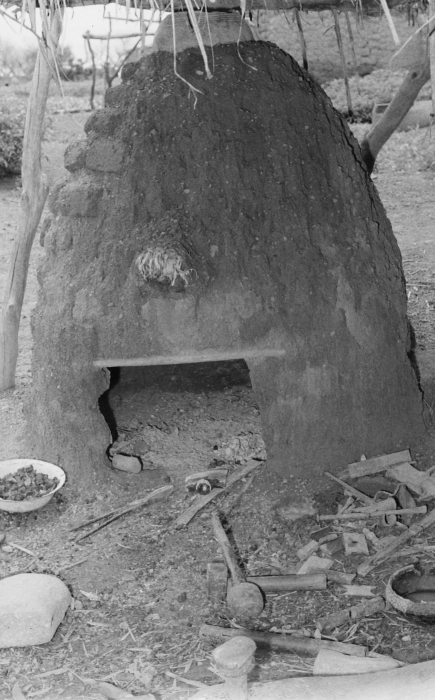
Radiocarbon dating proves West Africans were smelting iron right here as early as the eighth century BCE, shattering outdated views on African technology. For over a century, Eurocentric historical narratives maintained that high-temperature pyrotechnology was a complex invention that could only have originated in Anatolia or the Mediterranean basin before gradually diffusing southward across the Sahara Desert. …
03 TST-2 Iron Ore Quarry and Building Extraction Site
The very rock beneath the village supplied both the lethal iron for weapons and the durable stone to construct houses. In most ancient civilizations, stone quarrying and metal mining were treated as entirely separate industries located in distant geographic zones. However, at Douroula, the unique geological composition of the Mouhoun Bend provided an extraordinary double advantage. …
04 TST-3 Central Residential Mound and Blacksmith Forge
This massive mound, spanning over two hundred meters, was formed entirely by human habitation debris piling up over two thousand years. Known to modern archaeologists as site TST-three, this is the grandest central residential and blacksmith forge mound within the entire Douroula cluster. Unlike modern towns that expand outward across horizontal space, ancient West African communities lived vertically, constructing new mud homes directly on top of the melted clay walls of their ancestors. …
05 TST-4 Textile Dyeing and Weaving Workshop Mound
Ancient West African iron-smelting communities were also thriving centers of specialized textile production and indigo dyeing. For many decades, popular history portrayed early metallurgical sites strictly as male-dominated heavy industrial zones centered exclusively around mining and hot iron forging. However, systematic testing across the Douroula complex shattered this narrow perception. …
06 TST-17 Karité Oil Production Workshop Mound
The oil extracted from wild shea trees was as vital to the survival and metallurgy of this ancient city as iron itself. While modern visitors naturally focus on iron ore and smelting furnaces, archaeologists studying site TST-seventeen uncovered a crucial ecological connection. Iron production required vast human energy, specialized wall-sealants, and physical protection for furnace crews working under extreme thermal radiation. …
07 Closing
The ancient landscape of Douroula stands as an extraordinary open-air monument to West African technological innovation, self-reliance, and profound environmental mastery. Throughout our journey today across these seventeen cultural mounds, we have witnessed how indigenous West Africans independently pioneered high-temperature iron smelting as early as the eighth century BCE. …