 Photo Wikimedia Commons
Contents
History & cultureBY TELLBY7 sections · numbered as on the map01 Orientation
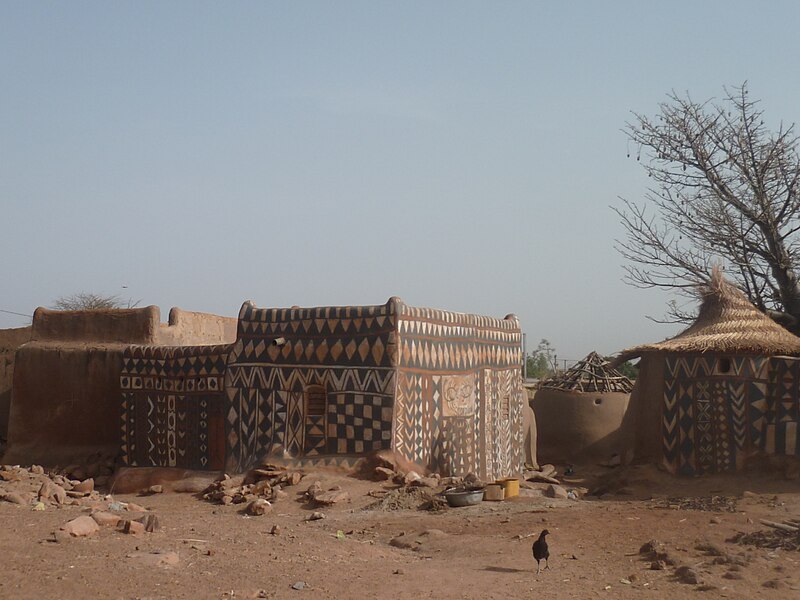
Welcome to the Royal Court of Tiébélé, a magnificent living heritage site nestled at the base of Mount Tchébilí in the arid Sahelian landscape of southern Burkina Faso. As you stand before the main entrance of this historic earthen complex, you are stepping into a vibrant community where the Kassena people have maintained their architectural and cultural traditions uninterrupted since the sixteenth century. In July 2024, UNESCO inscribed the Royal Court of Tiébélé as a World Heritage Site, recognizing its extraordinary representation of traditional earthen architecture, gender-defined construction roles, and the seamless continuity of sociocultural practices that have endured for over five hundred years. This recognition is not merely about preserving ancient clay structures; it honors an active home where more than four hundred residents across fifty-four families reside today. The entire complex spans approximately one point five hectares, serving as the official residence and court of the Kassena king, known locally as the Pè. What makes this site profoundly unique is the harmonious synthesis of architecture, art, and social hierarchy. The construction relies on an ancestral division of labor that reflects the cosmological beliefs of the Kassena community. Men are responsible for harvesting local earth, timber, and straw to build the thick cob structures and adobe walls, constructing the protective physical shell of the dwellings. Conversely, women hold sole guardianship over the decorative tradition, hand-painting intricate geometric murals on the exterior clay facades using natural pigments derived from laterite, kaolin chalk, charcoal, and organic binders. This dual process embodies the Kassena philosophy that while men construct the physical vessel of the home, women infuse it with life, identity, and spiritual protection. As you begin your tour at the entrance of the royal compound, observe how the earthen huts and curved walls organically form a protective, labyrinthine enclosure. Narrow pathways wind between distinct family compounds, creating an intricate layout designed for both social cohesion and defensive security. Every building, courtyard, and sacred element within these walls tells a story of lineage, spiritual devotion, and environmental adaptation. Over the course of this audio guide, you will discover how these earthen structures naturally regulate extreme Sahelian temperatures, how complex geometric symbols convey non-verbal communication across generations, and how annual communal rituals continuously revitalize this living masterpiece. Please take a moment to absorb the atmosphere of this ancient clay palace before we proceed into the sacred heart of the Royal Court of Tiébélé.
02 The Royal Entrance and Sacred Stones
In the sixteenth century, Patyringomie, a prominent chief of the Mossi people who originated from Loumbila, fled a severe succession dispute and migrated south to establish a settlement on Tchibeli hill, setting the foundation for a royal dynasty that was fully consolidated when his successor, Buinkiété, traveled to Nanlorgho to acquire the potent sacred fetish known as Kora. …
03 The Sacred Mound of Pourou
What appears at first glance to be an ordinary mound of accumulated dirt and household refuse is in reality the Pourou, the most sacred spiritual epicenter of the entire royal compound, where the placentas of all newborn Kassena infants are reverently buried to anchor their souls to their ancestral land. Please turn your attention to the right and observe the gently elevated, rounded earthen mound known as Pourou rising softly from the compound floor. …
04 Dinia: The Hourglass House of Elders
Featuring an entrance doorway that measures less than eighty centimeters in height, this extraordinary structure forces every single visitor to stoop, bend double, or crawl on hands and knees to enter, revealing an ingenious defensive design created to protect vulnerable family members. Please direct your eyes to the front entrance of the mud dwelling before you, which forms a distinctive figure-eight or hourglass-shaped architectural contour. …
05 Mangolo Hut and the Symbolic Murals
Without ever using commercial paintbrushes or industrial pigments, Kassena women exclusively create these dazzling geometric murals using raw natural materials like guinea fowl feathers, calabash combs, charcoal, kaolin chalk, and baobab leaf decoctions. Please turn your attention toward the vivid facade before you, featuring sharp diamond patterns, chevrons, and interlocking geometric motifs painted across the mud plaster. …
06 Draa Round Huts and Rooftop Terraces
Thanks to a natural plaster formula combining harvested earth, chopped straw, and dried cow dung, these earthen huts miraculously maintain a remarkably cool indoor temperature even during the scorching heat of the Sahelian dry season. Please tilt your gaze upward toward the flat earthen roofs supported by timber beams and imagine village families spreading harvested millet and sorghum across these elevated terraces to dry under the West African sun. …
07 Closing
The Royal Court of Tiébélé that we have explored together today is far more than an ancient architectural monument made of clay and timber. It represents an eternal cycle of renewal and artistic regeneration, where every year after the monsoon rains subside, the women of the village gather to re-plaster the eroded mud walls and repaint the symbolic geometric murals anew. …