 Photo Wikimedia Commons
Contents
History & cultureBY TELLBY7 sections · numbered as on the map01 Orientation
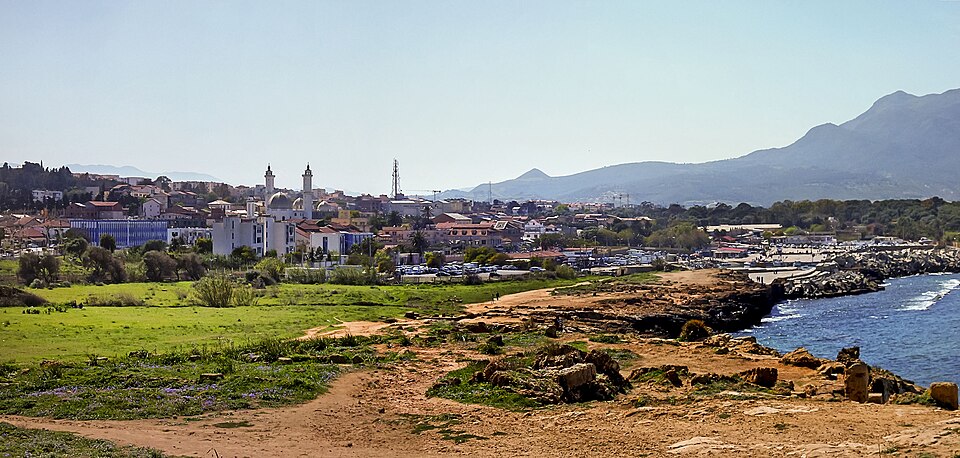
Welcome to the Tipasa Eastern Archaeological Zone, a breathtaking historical landscape situated between the brilliant turquoise waters of the Mediterranean Sea and the majestic northern slopes of Mount Chenoua in coastal Algeria. This extraordinary region represents an ancient crossroads where Phoenician and Punic maritime traders, Mauretanian royal dynasties, and Roman imperial administrators converged across centuries to build a flourishing coastal community. Celebrated for its unique architectural synthesis of North African indigenous traditions and Classical Mediterranean urban planning, Tipasa was officially designated as a United Nations Educational, Scientific and Cultural Organization World Heritage Site in nineteen eighty two. While most travelers concentrate their visits on the grand public basilicas, marble temples, and civic forums within the central urban core, our audio journey guides you eastward into the unexcavated outer hinterland that provided the essential economic foundation sustaining the ancient city. Extending nearly nine kilometers along the shoreline from the eastern periphery of the modern town toward the monumental Royal Mauretanian Mausoleum, known locally as Kbor er Roumia or the Tomb of the Christian, this coastal corridor contains an amazingly preserved network of ancient production sites. Here, hidden among coastal scrub and sea cliffs, lie sandstone quarries, fish-salting installations, pottery kilns, olive pressing facilities, and expansive rural agricultural estates that operated continuously from the Hellenistic era through Late Antiquity. As you walk along these scenic pathways, you will discover how ancient quarrymen cut heavy building stones directly from shoreline ledges, how entrepreneurs manufactured prized garum fish sauce inside hydraulic plaster vats, and how local farmers cultivated olives and grapevines for distant Mediterranean export markets. The physical artifacts recorded along this coast, including imported fine tableware and wine amphorae from Italy, Gaul, and Hispania, confirm that Tipasa was not an isolated frontier settlement but a vibrant commercial hub deeply integrated into imperial trade networks. Today, this priceless archaeological landscape faces acute environmental hazards, including severe coastal wave erosion and rapid modern urban expansion. Designed to illuminate the profound historical importance of these peripheral sites, this guided audio walk brings to life the daily routines, craftsmanship, and economic resilience of ancient North African coastal workers. As you feel the gentle sea breezes and admire the sweeping views of the Mediterranean shoreline, prepare to embark on a memorable journey connecting natural beauty with thousands of years of human ingenuity.
02 Corne d'Or Sandstone Quarry and Coastal Bathhouse
It is a remarkable historical paradox that ancient Roman sandstone quarries and a sophisticated seaside bathhouse are preserved directly within the grounds of the modern Corne d'Or resort village. When the renowned French architect Fernand Pouillon designed this modern tourist complex in nineteen seventy one, he recognized the extraordinary historical value of the coastal ruins and deliberately integrated them into his architectural plan without destroying the underlying ancient foundations. …
03 Demonchy Maritime Villa and Fish Salting Complex
When you step into the coastal sector of Demonchy, it is astonishing to discover that a massive industrial fish-salting factory and luxury maritime villa once operated directly along the water's edge. Rather than relying solely on local subsistence fishing, the ancient inhabitants of Tipasa carved deep processing vats into the sandstone bedrock to manufacture garum fish sauce and salted fish, transforming local marine resources into highly valued commodities for Mediterranean export. …
04 Kouali Agricultural Farmstead and Inland Trade Route
It is fascinating to discover that right alongside modern Road R eleven lies the remains of an ancient Roman inland farmstead that operated continuously for over two hundred fifty years. While many coastal sites experienced brief periods of activity, the Kouali farmstead maintained uninterrupted agricultural production from the first century AD well into the sixth century AD, serving as a vital breadbasket and agricultural processing center for ancient Tipasa. …
05 Kechni Coastal Settlement and Opus Africanum Masonry
Standing along the rocky cliff edges of the Khechni sector, it is breathtaking to encounter tall stone piers constructed using the unique North African architectural technique known as opus africanum. Situated on an exposed rocky peninsula west of modern Khechni, this extensive maritime villa and settlement complex flourished for over four centuries, combining native North African building traditions with Roman coastal infrastructure. …
06 Eastern Gateway Press House and Late Antique Cemetery
It is deeply compelling to find that inside a green roundabout at the eastern entrance of modern Tipaza, an ancient Roman agricultural press house and a sixth-century stone cemetery overlap within the exact same plot of land. Located along the main eastern access road into ancient Tipasa, this site provides an exceptional example of spatial metamorphosis, illustrating how an Early Empire industrial olive and wine pressing installation was systematically transformed during Late Antiquity into a…
07 Closing
Today, we have journeyed across the extraordinary landscape of the Tipasa Eastern Archaeological Zone, exploring the rich hinterland nestled between the blue waters of the Mediterranean Sea and the towering slopes of Mount Chenoua. From the ancient sandstone quarries and seaside bathhouse at Corne d'Or to the rock-cut fish salting vats at Demonchy, we have traced the economic vitality of ancient North Africa. …