 Photo Wikimedia Commons
Contents
History & cultureBY TELLBY7 sections · numbered as on the map01 Orientation
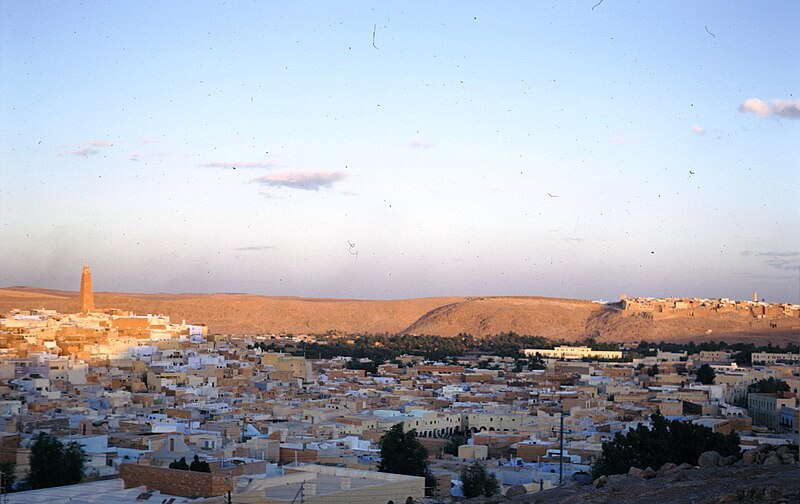
For over a thousand years, the remarkable residential architecture that emerged in response to the harsh desert environment has demonstrated human wisdom in living in complete harmony with nature. The Mzab Valley is recognized as a UNESCO World Heritage site precisely because its sustainable desert urban planning and traditional way of life have been preserved intact for centuries. The fortified city we are exploring today is Ksar Melika, also known locally as At Mlichet, which was established in the early eleventh century. It occupies a highly strategic position midway between Ghardaia and Beni Isguen, perched proudly on the eastern bank of the Oued Mzab valley bed. Ksar Melika stands as a unique historical space where populations of diverse origins gathered to build a shared community. Throughout the centuries, it has been revered as an enduring symbol of brotherhood, cohabitation, and peaceful neighborliness among different social groups. Facing extreme desert heat and relentless winds, the inhabitants worked together on this rocky ridge to cultivate a resilient and unified home. Today, as we stand at the entrance of this ancient city, we begin a journey through time into a desert stronghold shaped by cooperation and mutual respect. From this viewpoint at the ksar entrance, look across the valley to see how the natural contours of the eastern bank provided both defense and community coherence. Notice how the settlement fits compactly onto the elevated rock, maintaining a protective distance while staying connected to the surrounding valley floor and agricultural groves. As you prepare to walk through the entrance, observe the way the stone pathways curve gently inward, guiding visitors away from the harsh desert elements and into the sheltered interior of the settlement. This walking tour will take you through the core spaces of the ksar, revealing how its unique urban layout supported daily social life, commercial exchanges, and religious harmony. As you ascend the gently sloping path, pay attention to the solid stone underfoot and the warm earth-toned walls that reflect the changing desert light. Please follow the winding path as it leads away from the outer viewpoint and toward the central crossroads of the city. As you step forward, feel the subtle change in temperature created by the thick mud brick walls and stone foundations designed to keep out the fierce heat. Take your time to absorb the historical atmosphere, allowing the ancient silence of the valley to frame your passage into the heart of Ksar Melika, where our next stop awaits at the central junction of community life.
02 Section 1
As you arrive at the central junction of Ksar Melika, you are standing before a truly surprising urban arrangement that sets this city apart from every other settlement across the entire Mzab Valley. Unlike all the other fortified cities in the region, Melika features a market square that is attached directly to its central mosque right at the core intersection of the city. …
03 Section 2
As you step into the quiet narrow pathways of the artisan quarter, you are entering a zone that holds one of Ksar Melika most distinguished and proudest cultural traditions. Historically, the skilled artisans of Melika held an exclusive monopoly on the production of green pottery across the entire Mzab Valley. No other city or settlement in the valley possessed the right or the technical knowledge to manufacture these distinctive green-glazed ceramics. …
04 Section 3
As you reach the outer defensive wall at the edge of Ksar Melika, you are encountering a remarkable urban phenomenon that sets this location apart from every other city in the Mzab Valley. Ksar Melika is the only city in the entire Mzab Valley that never experienced urban expansion beyond its initial perimeter, owing strictly to its steep, constrained rocky terrain. …
05 Section 4
As you step outside the northern perimeter of Ksar Melika, you enter a quiet realm known as a true city of the dead. The northern cemetery of Melika is far more than a simple burial ground, presenting an extraordinary landscape of surreal, sculptural plaster tombstones that spread dramatically across the open ground. …
06 Section 5
As you step onto the broad open grounds spread directly in front of the mausoleum complex, you are standing in a space that plays a vital role in preserving the living cultural memory of Ksar Melika. Every spring, a remarkable cultural tradition takes place on this very ground, when the Azzaba, or council of elders, gathers the entire community for the annual ziyara. …
07 Closing
We have returned to the overlook vista point where our exploration of Ksar Melika first began. Looking out once more over the vast sweep of the Oued Mzab valley, we can fully appreciate the enduring identity of this eleventh-century stronghold as a living monument of harmony, compact desert adaptation, and spiritual heritage. Throughout our walk, we have seen how Ksar Melika embodies a profound human answer to the challenges of arid desert living. …