 Photo Wikimedia Commons
Contents
History & cultureBY TELLBY5 sections · numbered as on the map01 Orientation
Welcome to the official audio guide for the Colonial Transisthmian Route of Panama, a monumental historical crossroad that linked the Pacific Ocean with the Atlantic Ocean across centuries. In two thousand twenty five, this extraordinary network of historical paths and defense structures was officially inscribed as a UNESCO World Heritage Site, receiving global recognition for its paramount contribution to human history and international commerce. Beyond technical terms or complex administrative criteria, the true significance of this route lies in its identity as the first truly global transport network that bridged two great oceans and connected distant continents. From the sixteenth century through the nineteenth century, this narrow and rugged Panamanian isthmus operated as the vibrant epicenter of world trade and maritime logistics. Enormous quantities of silver and gold extracted through coerced labor from the deep mines of Peru and Bolivia were loaded onto mule trains and transported across this treacherous path. Meanwhile, exquisite silks, precious spices, and fine porcelain arriving from the Philippines crossed the Pacific Ocean to be moved over this land toward European markets. In return, manufactured goods and essentials from Europe traversed this same route to supply colonies across the Americas. To maintain and safeguard this vast commercial system, the Spanish Crown designed an intricate network combining overland roads and river waterways. Crucial components included the Camino Real, an entirely overland trail connecting old Panama City on the Pacific coast to the Atlantic ports of Portobelo and San Lorenzo, alongside the Camino de Cruces, which strategically blended land trails with river transport along the Chagres River to convey travelers and cargo. Crucially, as recognized in the UNESCO framework, this transisthmian system was not merely a peaceful trade route; it was a contested arena marked by colonial power dynamics, the essential navigation knowledge of Indigenous guides, and the forced labor of enslaved African people who endured brutal conditions under tropical heat and disease. Today, as you walk through these legendary historical grounds, you will experience firsthand the centuries of heritage preserved in dense rainforests, sturdy stone walls, and polished cobblestone paths. Please listen closely to the whispering ocean breeze and the sounds of the surrounding forest as you begin your immersive journey along this remarkable global corridor.
02 Plaza de la Independencia and the New City
It represents one of the most audacious urban decisions in colonial history that in sixteen seventy three, the entire city was completely relocated and rebuilt upon a naturally fortified peninsula surrounded on three sides by the ocean to permanently deter pirate raids. Please stand in the middle of the square and look around at the imposing twin-towered cathedral and the surrounding arched colonial structures. …
03 Las Bóvedas and the Waterfront Promenade
It is a fascinating historical contrast that these thick stone vaults were originally designed as heavily fortified gunpowder magazines, secure military prisons, and secret storage vaults for royal Spanish treasures. Please look up at the vibrant canopy of bougainvillea flowers shading the walkway above and gaze out at the vast ocean blue beyond the historic stone parapets. …
04 The Canal Museum: From Colonial Routes to the Modern Canal
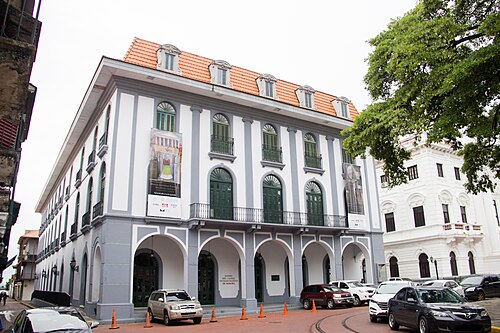
It is a remarkable testament to historical foresight that as early as fifteen thirty two, King Charles the First of Spain officially ordered a detailed royal survey to determine whether an interoceanic canal could be cut through this narrow isthmus to unite the two oceans. Please admire the elegant large windows and grand facade of the French architectural style building at the museum entrance. …
05 Closing
This concludes our comprehensive audio guide tour of the Colonial Transisthmian Route of Panama, a truly monumental world heritage site connecting two great oceans. Today, we have journeyed together through dense tropical rainforests, along winding riverways, past the ancient stone cathedral tower and plazas of Panama Viejo, and around the formidable coastal fortresses and promenades of Casco Viejo. …